
Work hard, play hard is a mantra that’s been repeated in our school community for years. Fun can only be had after the hard work is done. As parents, we’ve preached this to our families, too. You want to watch tv? You better do the dishes, first. You want to play with your friends? You better clean that room of yours! Work hard, play hard applies to many situations at school and at home, but should it?
At The Village School we believe in play. In fact, we believe in Maria Montessori’s belief that “play is the work of the child” so much we label ourselves play-based and we mean it. We pride ourselves on providing all learners, no matter what age, extensive time for free-play, as well as cultivating a playful learning mindset around our academic learning design. At The Village School playing hard is our hard work, not the reward we get after.
Despite the fact that educators across the country place a high value on more playtime for students, the average elementary age student has access to 25 minutes of free play and middle schoolers only get 15 minutes per day, if any. Project Zero, Harvard Graduate School of Education’s research group supports the high value on more playtime for all young people, and suggests a Pedagogy of Play is a necessity when it comes to both childhood development and deep learning.
According to their research, Playful learning occurs “when the learning goals of adults and the interests and curiosities of students align.” Playful learning draws on what we know from years of research about the nature of deep learning: Learning is a complex process that involves cognition and emotion. These facts are the underpinning of the learning design at TVS. We rely heavily on experiential learning and work hard not to deliver content, but to create rich learning experiences from which young people will make their own meaning.
All of this meaning-making occurs in both structured and unstructured environments where learners and adults are co-creating a playful mindset and approach. A “playful” approach to learning is necessary, especially in a learner-centered and self-directed school environment when learning is not linear and surprises occur often.
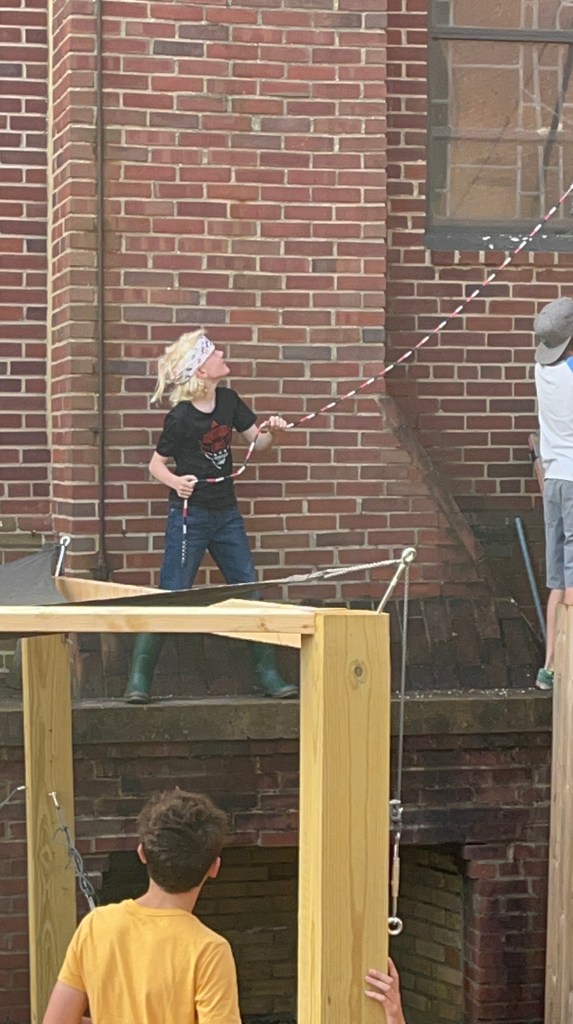
These playful surprises happen often across all of our studios. There was The Great Bunny Rescue last year in our Spark Studio, or the Sandbox Situation featured on this back to school blog. One of my personal favorites is the Rescue-Balls-from-the-Roof day. It began towards the end of our hour-long outdoor lunch and recess block in the middle school studio when the last of the remaining kickballs got lodged (with several others) on the roof of the school building. There was still a precious ten minutes left in free time and the middle schoolers were committed to retrieving the ball in an attempt to savor those remaining minutes. I spent the next sixty minutes observing a youth driven pedagogy of play. The entire middle school studio proceeded to work together to create a contraption that was able to reach the roof and successfully retrieve the ball. Yes – we skipped our regularly scheduled afternoon of “work”, and it was worth every second. As I observed, I did what any TVS guide would do: I documented. I took photos and videos which I played back for the learners during the day’s closing circle as I posed the question: Where in these images do you see evidence of our studio values? The learners responded with overwhelming evidence of collaboration, trust, self-direction, and joy.
We know that valuable learning moments flourish through free, open play. As educators, it’s our responsibility to protect these spaces – especially in a world that increasingly values over-structured experiences for kids. At TVS, play isn’t a reward – it’s the cornerstone of deep learning. We don’t work hard to play hard. At TVS, we simply play hard.

 villageschoolnova.blog