
One of the primary jobs of a guide at The Village School is to curate the optimal learning environment. Loris Malaguzzi, the founder of the Reggio Emilia approach famously states “there are three teachers of children, adults, other children, and the environment.” Those of you familiar with our school know that we are not the type of private school with rolling hills, grand columns, and a school campus that rivals an Ivy league university – we are, in fact, quite the opposite. Regardless of our humble and ordinary campus, we take our space and the artifacts that fill our spaces quite seriously. When people visit our school for the first time and make their way through each of our studios, they always comment on the space, mostly noticing how non-traditional it appears. There are no desks, no clear “front of the classroom”, flexible seating areas, rugs, plants, and learner-curated “walls that talk,” as one of our Discovery Guides describes.
Creating a reflective environment is one intentional step that is often both overlooked and owned by adults in most classrooms and schools. Using materials, equipment, and decorations that reflect the voices of the learners and the community and culture they are building is arguably the most important role of a guide at The Village School or any learner-centered educational space.
Close your eyes and imagine your own elementary school classroom, or the typical elementary school classroom as depicted on television or in movies. Keep your eyes closed and imagine yourself walking in the front office, down the hallways, and peeking into a classroom or two. Draw your attention to the walls in these spaces. Most likely, you’ll see carefully curated bulletin boards, perfectly cut out bubble letters, aesthetically pleasing images, all designed by the adult “in charge” of the space.
Our goal at TVS is the opposite of this – our goal is that the walls of our studios reflect back the voices of our learners rather than the voices of the adults. This purpose and vision permeates our intentional design of the spaces, walls, and the products that our learners create.
Think back to the last poster you saw your learner working on or the ones you saw lining the tables during the last end-of-session Exhibition. If you’re like me, you viewed them from an adult perspective with a highly critical eye for sloppy cutting and pasting, spelling mistakes, organization, and consistent font (anything but Comic Sans). If you’re like me you notice each place where they crossed things out, erased too hard, or wrote in pencil or yellow marker (why???) instead of a legible color. If you’re like me you wonder why they didn’t plan more before gluing things down. If you’re like me you smile through gritted teeth and force a compliment in the form of “Wow!”
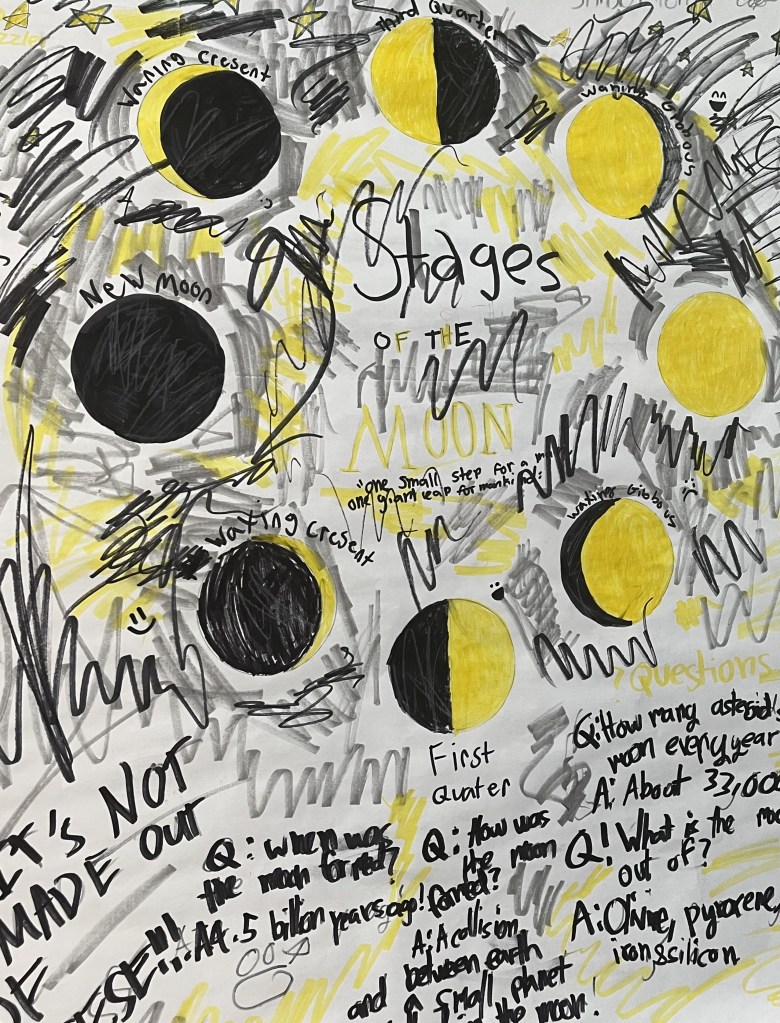
I used to think a perfectly curated poster was indicative of deep learning. Now I know that the opposite is true: real learning is a real messy poster. As a parent and a TVS guide, my assessment of learning is now reliant on those not-quite-erased pencil marks and the not-quite-glued scraps of paper. The more imperfections, the more likely the poster was created entirely by a young person, and this is the goal. With the exception of a few detail oriented learners, I’m suspicious of any learner-created product that appears too perfect. The Village School is a learner-centered, self-directed school, after all. We purposefully create agentic learning experiences – including opportunities to create a (messy) poster. At The Village School a messy poster is a meaningful expression, not something that needs straightening or correcting.
Our goal is that the walls, posters, and any products our learners create to communicate their voice, not ours. A reflective environment is one in which the walls talk – and at TVS it’s the learners who are doing the talking.

 villageschoolnova.blog