
As I’m sure many of you have heard or even seen, Adventure took on an infamous middle school project during Session 4–building and lighting cities for tomorrow. I first heard about the electricity project last school year, when older learners would share memories of the challenge with haunted eyes and faraway expressions. From their recollections, I learned that they found the project to be difficult and frustrating, and in the end, no one earned the project badge.
When the time finally arrived in our three-year project rotation to take on this same challenge, though some were excited, several of the learners who had heard about the project from graduated learners or older siblings responded with the same emotion: apprehension. To be completely honest, the nervous energy was totally fair. The journey from project launch to exhibition was a tumultuous one–and completely necessary.
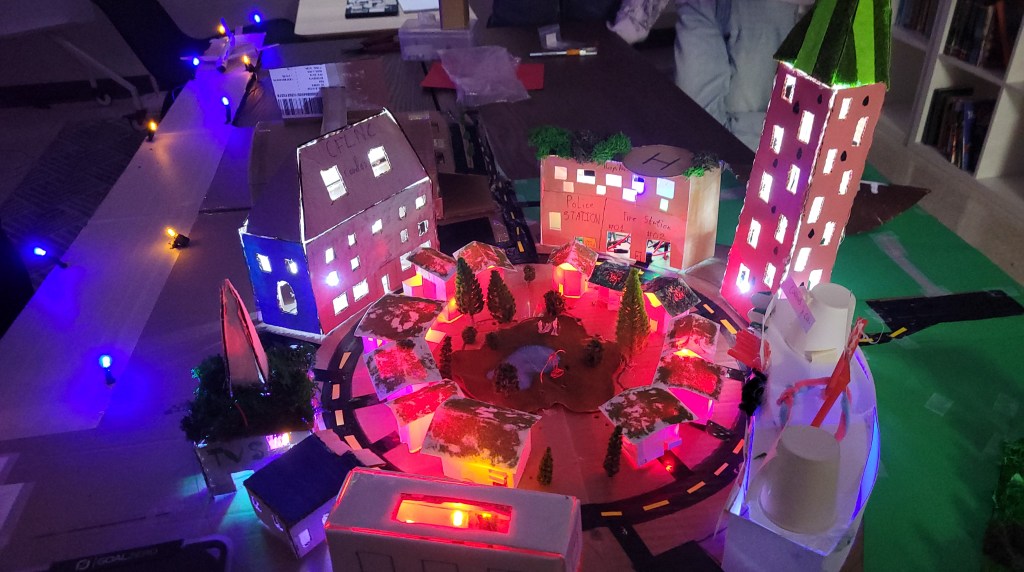
I have developed, prepared, and implemented many projects in my time as a guide. From Building the Team to Chemistry of Candy to Entrepreneurship, each project has offered its own challenges and lessons learned. The electricity project, however, stands out as the most difficult project to not only prepare for, but also observe learners engage with. Let me explain. At the beginning of the session, learners were tasked with creating a fully illuminated city for tomorrow within the timeframe of six weeks. To make this vision a reality, learners were challenged to experiment with different kinds of electrical circuits and circuit components, create team contracts, sketch blueprints of their cities, design and construct full city models, and plan and wire their very own electric grids.

After the first few tasks, learners expressed excitement and optimism about their projects. Hands were covered in paint, a rainbow of LEDs blanketed the floor, and very few surfaces were left untouched by hot glue. As the exhibition date drew closer, hints of doubt gradually gave way to genuine frustrations. Entire sections of electric grids blew and had to be relit. Breadboards were scorched. Wire after wire came loose and had to be reconnected. For several project periods, the Adventure studio was…tense, to say the least.
I remember circling up with the learners one afternoon and listening to their frustrations. Some asked if the requirements could be adjusted. Others asked if they could earn the badge even if their cities did not light up at exhibition. It would be dishonest of me to deny that I had also considered these same options. What if no learners earned the badge? What if they all worked so hard to end up with a room full of unlit cities at the end of the session? Was the project too challenging? Should I step in and ease their frustrations, just a little bit?
Even as an educator who deeply believes learning occurs at the point of challenge, watching a learner struggle is still difficult. Nevertheless, as a guide—a partner on the journey—my role isn’t to remove the obstacle, but to acknowledge its difficulty and support each learner as they find their own way to overcome it.

In the end, several cities lit up completely, others lit up partially, and some remained in the dark. Some learners earned the badge, some did not, and both outcomes are valued. Although this project was reported by many (if not all) as the most frustrating and challenging, it was also the project where the most learners were passionately engaged in the learning process. As two learners perfectly summarized, “This was the most difficult project I’ve ever done, and the one I learned the most from,” and, “Even if you fail, you should still try your best.”

 villageschoolnova.blog