More Capable Than the World Gives Them Credit For

Earlier this session, the TVS team and I were sitting around the table in the guide room, sparkling waters and Cheez-Its sprawled across the surface, discussing documentation. Lauren Coyle was igniting us with authentic, meaningful, and purposefully imperfect examples of learner projects and work inspired by the Reggio Emilia approach. While I could spend this entire post gushing over the examples Lauren shared, today, I’d like to zoom in on a question posed during the meeting. Regarding documentation, the question was, “What do you want people to notice?” I thought about this for a while. Yes, I want people to notice the learners’ kindness, compassion, and joy. Of course I hope they recognize the learners’ perseverance and dedication. The one word that kept flying through my mind, however, was capable. I want those inside and outside of our TVS community to see how incredibly capable the learners are. Thus, the purpose of this post is serving as part of my documentation of learner capability. 

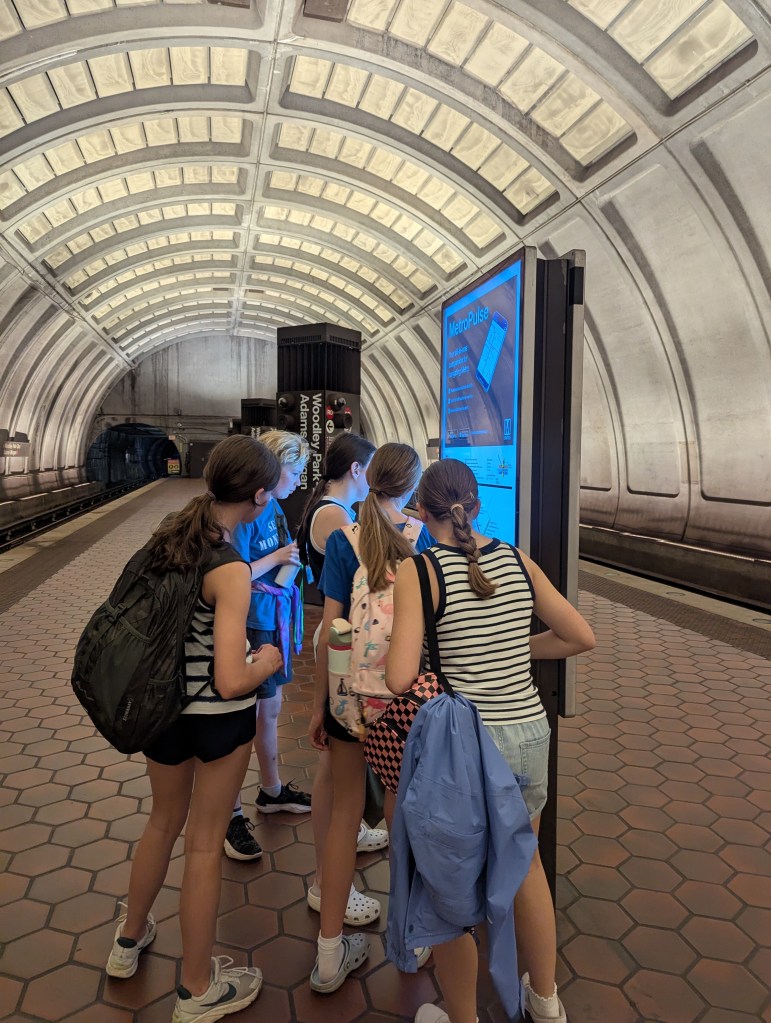
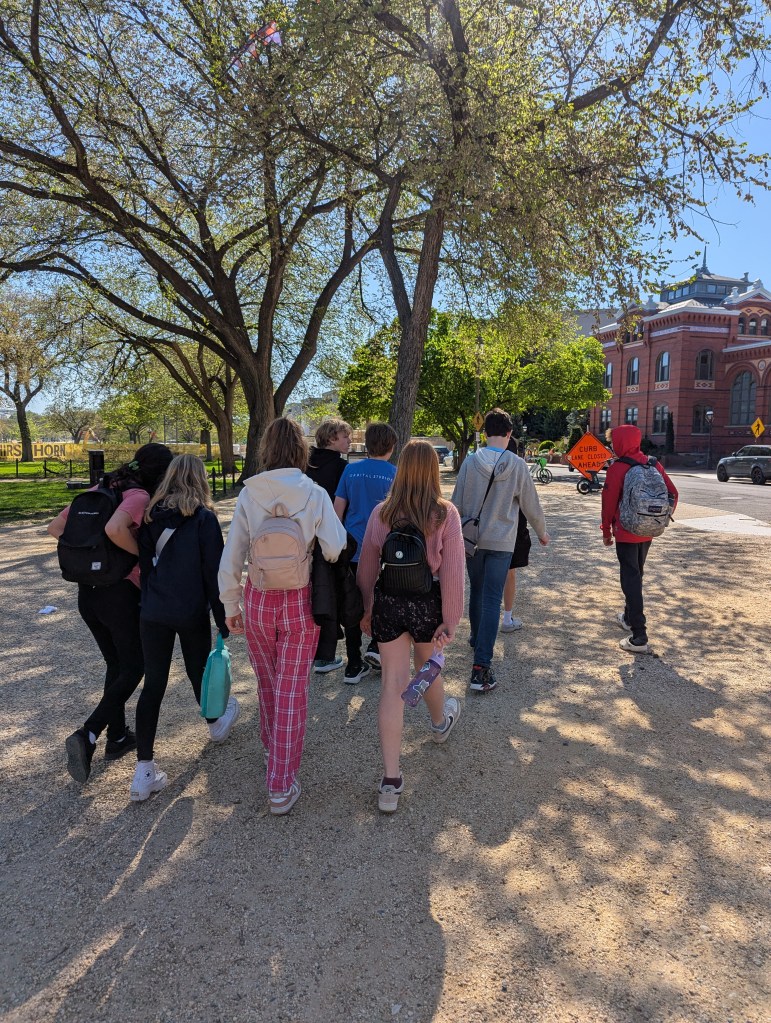
When we adventure beyond the boundaries of TVS, we are met with a wide range of reactions. Some adults see us and share a smile or laugh. Some look at us with puzzled expressions, curious about why 28 children and several adults are boarding their metro car. Others have looks of fear, terrified of simply existing within the same space as a group of middle schoolers. One example of this is the recent field trip we took to the zoo. Completely learner-led, learners created field trip proposals, voted on their favorite plan, followed through with the plan, had complete control of the schedule, and were responsible for getting us all to and from the zoo safely. What one might not realize from an outside perspective is all of the work and planning that went into that one trip. Standing at a metro station, with adults trying to awkwardly shift away from the large and enthusiastic middle school group, it is not evident that we (the guides) were actually following the children. People probably didn’t notice learners figuring out how the metro works, looking for signage, learning how to engage with a metro map, and holding each other accountable. 

Another example is the creation of the music video. Though the learners had specific requirements for successfully completing the challenge (e.g., being at least three minutes long), it was up to the learners to figure out how to make it all happen. They had to choose a song,  develop and film the scenes, edit the video, ensure everyone was included, and confirm all of the requirements were met. They did all of this while managing their own goals and deadlines. Making decisions in a small group for a single project can be challenging enough. Executing a unified vision with the ideas and personalities of 28 middle schoolers is even harder. Still, they did it, and even more importantly, they built their team and self-confidence in the process. 

These are only two of the many stories of learner capability. As showcased through their own documentation at the Session 1 Exhibition of Learning, Adventure did the following in just six weeks: created their own studio contract and discussion guidelines; built badge plans and set their own goals; planned and executed a learner-led field trip; created a music video; engaged in challenging conversations about AI, resulting in an AI studio contract, learner-written guidebook for AI, and more wonderings about the future of AI; started learning how to play the Ukulele; agreed with, disagreed with, and persuaded each other during civilizations discussions; developed stronger thinking in math; and learned more about who they are in Health and Wellness. This is not a comprehensive list, but rather a skimming of the surface. They also led discussions, served our community, worked together to clean the space, set their own goals, held themselves and others accountable, solved conflict, and so much more. 

Middle schoolers are way more capable than the world gives them credit for, and I look forward to observing this year’s group of learners lean into that truth more and more.
Onward with Confidence: Evidence in the Everyday

As we humans often do when approaching the end of a chapter, I have found my mind slipping to memories of this past year. Creating the music video. Knocking on doors at the Rayburn House Office Building. Tossing eggs attached to parachutes out of the third-floor windows. Somehow surviving the Billy Goat Trail. Celebrating Valentine’s Day with a Sharks and Hearts party (yes, SharkBoy and Lavagirl is now an Adventure Studio favorite). Sharing our dreams for our community. Nostalgic, I know. To be honest with you, thinking about the end of the year hasn’t exactly been at the top of my priority list. All of the beautiful milestones and celebrations at the end of the year also come with transitions. 

In a mixed-age environment, we–learners, families, and guides–have the honor and privilege of partnering with each other for several years at a time, giving us the opportunity to cultivate real and meaningful relationships. We see each other on our better days and our hard days. We struggle together. We celebrate together. We solve conflicts together. We grow together. In this environment where genuine care is fostered, and transitions lie ahead, I can’t help but wonder—as a guide—will they be okay? Spoiler alert: yes, they will. And here’s why… 

Adventure encourages backing up one’s claim with evidence. In light of this, I’ve been searching for a story to prove my confidence, however, I keep returning to the everyday–those small, steady choices that speak loudly. I’d like to share some of those moments with you. 

  • As you know, our outside space is cozy and multiple activities take place at the same time. One group will sit in a circle and chat while another group engages in an intense game of volleyball and another group plays soccer. When someone accidentally gets hit with a ball, someone else asks if they’re okay. When someone falls to the ground, there’s a hand outstretched and a pat on the back. TVS learners take care of each other.  
  • One of my favorite Adventure Studio traditions is celebrating someone’s birthday with character callouts. I have yet to see a celebration where hands do not immediately fly up to uplift a fellow trailblazer. The learners often recognize strengths like kindness, empathy, humor, and determination. TVS learners celebrate each other’s strengths, wins, and moments of joy. 
  • The times I have seen one learner help another, or sometimes even multiple learners, with challenging problems on Khan are more than I can count. The times I have seen a learner check in on someone when they are down are more than I can count. The times I have seen a learner stand up for someone are more than I can count. TVS learners support each other through struggle and show compassion.  
  • Our model encourages learners to grow in self-direction. They set goals for themselves every day, and often reach them. They pursue passions unapologetically, like when two learners decided TVS needed a makerspace so they wrote a proposal, secured funding, and made the space available to the community. When learners don’t meet their goals, they reflect, make plans for moving forward, and keep trying until they identify the tools and strategies that work best for them. TVS learners take ownership of their journeys.
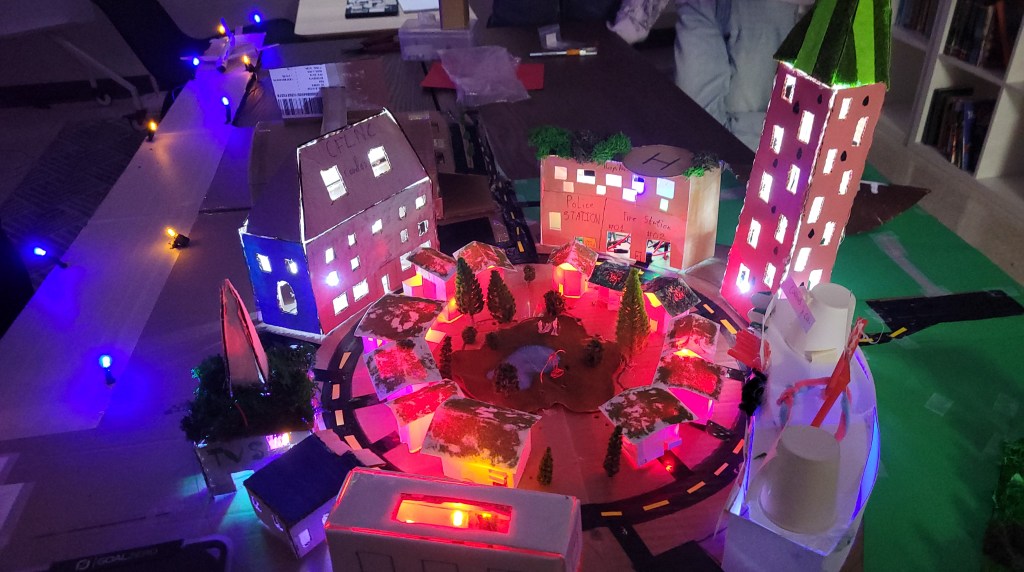
  • Failure is an important and necessary part of the learning process. Especially when learners fail, there are valuable lessons learned. Take building Cities for Tomorrow as an example of this. Was there frustration? Yes. Was it challenging? Absolutely. Did the learners feel emotions that can be difficult to feel? Of course. And, in time, they stood back up and dusted themselves off. TVS learners are resilient.  

So, will they be okay? Yes. They will care, celebrate, support, take ownership, and get back up again when they fall. Transitions are hard, but we can have confidence that whatever the next step is–taking on more challenging badge work, transitioning to a new studio, or moving on to a new adventure–TVS learners will thrive.

A Lesson Learned the Hard Way is Still a Lesson Learned

As I’m sure many of you have heard or even seen, Adventure took on an infamous middle school project during Session 4–building and lighting cities for tomorrow. I first heard about the electricity project last school year, when older learners would share memories of the challenge with haunted eyes and faraway expressions. From their recollections, I learned that they found the project to be difficult and frustrating, and in the end, no one earned the project badge. 

When the time finally arrived in our three-year project rotation to take on this same challenge, though some were excited, several of the learners who had heard about the project from graduated learners or older siblings responded with the same emotion: apprehension. To be completely honest, the nervous energy was totally fair. The journey from project launch to exhibition was a tumultuous one–and completely necessary. 

I have developed, prepared, and implemented many projects in my time as a guide. From Building the Team to Chemistry of Candy to Entrepreneurship, each project has offered its own challenges and lessons learned. The electricity project, however, stands out as the most difficult project to not only prepare for, but also observe learners engage with. Let me explain. At the beginning of the session, learners were tasked with creating a fully illuminated city for tomorrow within the timeframe of six weeks. To make this vision a reality, learners were challenged to experiment with different kinds of electrical circuits and circuit components, create team contracts, sketch blueprints of their cities, design and construct full city models, and plan and wire their very own electric grids. 

After the first few tasks, learners expressed excitement and optimism about their projects. Hands were covered in paint, a rainbow of LEDs blanketed the floor, and very few surfaces were left untouched by hot glue. As the exhibition date drew closer, hints of doubt gradually gave way to genuine frustrations. Entire sections of electric grids blew and had to be relit. Breadboards were scorched. Wire after wire came loose and had to be reconnected. For several project periods, the Adventure studio was…tense, to say the least. 

I remember circling up with the learners one afternoon and listening to their frustrations. Some asked if the requirements could be adjusted. Others asked if they could earn the badge even if their cities did not light up at exhibition. It would be dishonest of me to deny that I had also considered these same options. What if no learners earned the badge? What if they all worked so hard to end up with a room full of unlit cities at the end of the session? Was the project too challenging? Should I step in and ease their frustrations, just a little bit? 

Even as an educator who deeply believes learning occurs at the point of challenge, watching a learner struggle is still difficult. Nevertheless, as a guide—a partner on the journey—my role isn’t to remove the obstacle, but to acknowledge its difficulty and support each learner as they find their own way to overcome it. 

In the end, several cities lit up completely, others lit up partially, and some remained in the dark. Some learners earned the badge, some did not, and both outcomes are valued. Although this project was reported by many (if not all) as the most frustrating and challenging, it was also the project where the most learners were passionately engaged in the learning process. As two learners perfectly summarized, “This was the most difficult project I’ve ever done, and the one I learned the most from,” and, “Even if you fail, you should still try your best.”

The Art of Studio Maintenance

Learning is messy—both metaphorically and literally. Walk into any studio at almost any time of day, and what you might first perceive as chaos tells a deeper story. Scattered art materials, stacks of books, laptops tangled with cords, snacks, and heaps of paper all reflect the learning happening daily. A cluster of laptops on a table signals collaboration. A pile of markers and cardboard reveals creativity in progress. A mountain of pillows holds the remnants of worlds visited during DEAR. Learning is messy, and that’s a good thing.  

The Village School model embraces this kind of messy learning, which makes one daily ritual indispensable: studio maintenance. During studio maintenance, learners team up to clean their shared space, ensuring it is ready to welcome everyone the next morning. While the process varies by studio, the goal remains the same: fostering a sense of responsibility, teamwork, and care for the community space. Along the way, learners practice practical life skills—cleaning, cooperation, communication, teamwork, and advocacy.  

For example, in Adventure this session, learners formed their own studio maintenance groups rather than being assigned. Unsurprisingly, they chose to team up with close friends. This decision gave learners the opportunity to hold not just their peers accountable but their close friends, too—a skill that is often one of the most challenging to master in middle school.  

Studio Maintenance in Spark  

In Spark Studio, guides often incorporate games to make cleaning up fun and engaging. One favorite is looking for “magic trash”—hidden pieces of trash lurking in sneaky places around the studio—or playing “I Spy.” For example, a guide might say, “I spy something shiny under a table!” and learners excitedly search for the hidden clutter. At other times, learners gather on a rug while guides read aloud a list of tasks that need to be completed. Each learner picks their task and together transform the studio into a spotless space.

Studio Maintenance in Discovery  

In Discovery Studio, learners work in groups, with each group assigned a specific space (e.g., the math room) to clean. After completing their assigned tasks, learners get the green light from a studio maintenance champion, the space is closed, and the group moves on to assist another team. This cycle repeats until the entire studio is spotless. Cleaning zones rotate each session.

Studio Maintenance in Adventure  

In Adventure Studio, learners also clean in rotating groups assigned to specific zones. Each zone has a checklist of tasks, and group members decide who will handle each job for the week. At the end of studio maintenance, one or two learners assess the zones and note any areas needing further attention. These remaining tasks are read aloud during Close, and learners finish them before joining free time outside.  

In a typical school setting, cleaning is usually left to the adults–the teacher, the janitor, the parent volunteer. Like so many parts of our learning model, allotting time and space for cleaning up after yourself is intentional, by design, and character-building. Studio Maintenance is more than a collection of chores; it’s a chance for learners to build agency, embrace shared responsibility, and develop essential life skills. As written in each studio’s contract, learners commit to taking ownership of their space–not just for cleanliness, but to nurture a thriving learning community. 

Defying Gravity with Physics!

Have you ever wondered why you don’t fall off a roller coaster when it goes upside down? Have you ever wondered how airplanes stay up in the sky despite being so heavy, or why you feel heavier in an elevator when it starts moving? Have you ever wondered why your shadow changes size throughout the day, or why the sky changes colors at sunrise and sunset? Have you ever wondered what makes a car speed up or slow down, or why a ball bounces back when you throw it on the ground?

If you have asked yourself or someone else these questions, you are not alone! Thanks to the curiosity of scientists, architects, artists, engineers, and others, we have a better understanding of how the world works–and it all comes down to one thing: physics.

We kicked off our exploration of physics on Monday with the introduction above, followed by a discussion about several different branches of physics and its relevance in everyday life. Of course, at TVS, merely talking about the wondrous world of physics isn’t enoughwe must theorize, experiment, create, celebrate, and have fun!

On Monday, learners experimented with Newton’s laws of motion through a series of balloon races. They manipulated variables like volume, mass, and force, observing how each affected their balloon’s speed and distance traveled. On Tuesday, learners expanded their scientific understanding by building their vocabulary and learning fundamental physics formulas. These experiments and research activities set the stage for the adventure to come. 

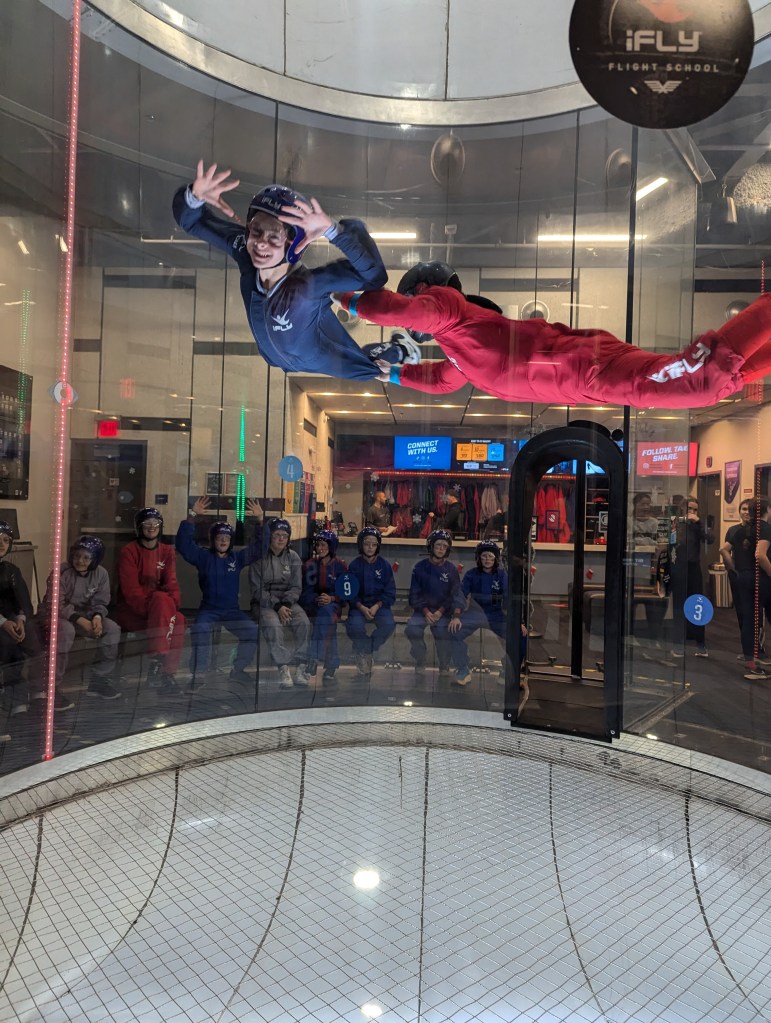
On Wednesday, we embarked on one of the most highly anticipated field trips in TVS history: iFLY Indoor Skydiving. When I say the learners screamed with excitement upon hearing about the surprise field trip, I mean they screamed. You could feel the electric mix of enthusiasm and nervous energy buzzing through the air. And you know what? Their joyful screams were completely justified. Speaking as a first-time flyer, I can confidently say that at iFLY, physics is magic. I did my fair share of exuberant screaming in the wind tunnel!

At iFLY, we spent the day immersed in physics. We participated in a lab activity, building, experimenting, and making predictions using differently shaped parachutes. We explored the physics behind the wind tunnel and discussed real-world applications. We also watched expert flyers manipulate their bodies to create exhilarating shows of flight mastery. Most thrillingly of all, zipped into flight suits and donning pointy goggles, we flew

Reflecting on the experience, one learner shared, “The most interesting takeaway was how, if you move your hands just a little bit in a direction, you’ll completely move in that direction.” Another learner humorously concluded, “I did well and didn’t die. The smallest adjustments make the biggest differences.”

At the end of the experience, an iFLY instructor pulled out a tub filled with various objects and invited us to predict which items would fly up first in the wind tunnel. The items were thrown into the tunnel and, one by one, we watched them soar.

“The most interesting take away from the field trip was when they put all the different objects in the wind tunnel. Even if our hypothesis was wrong, it was still cool to realize our mistakes and learn from them, like which one we thought would fly first.”

-Adventure Learner

Over the next two weeks, Adventure learners will put their physics skills to the test. They’ll design, build, test, and finalize a protective structure that will safely deliver an egg from a high drop. The culmination of their efforts will be showcased at our “Eggshibition” at the end of the session. We hope to see you all there! 

Young Leaders in Action: Reflections from SparkHouse

Last week, I had the privilege of attending SparkHouse, an event hosted by Education Reimagined with a mission to connect, equip, and ignite both learners and educators in learner-centered environments across the country. One of the most anticipated parts of SparkHouse is the sharing fair, where learners have the opportunity to present their learning environments, answer participants’ questions, and learn from one another. As the five Adventure learners representing TVS prepared for their presentation, quickly adding categories and phrases to their chart paper visual, I couldn’t help but step back and take it all in. I saw a small group of middle schoolers working calmly and efficiently toward a common goal. Each learner contributed naturally, without prompting. Each added their own ideas of what makes TVS special, and each understood the role they would play in the presentation.

As a guide in a small learning community, I get to observe growth every day. Moments like these, however, allow me to truly reflect on how far the learners have come since we first met. Each learner, though unique in their delivery, displayed ease and clarity in their communication. They answered every question—whether from children or adults—with knowledge and confidence. These young people carried themselves in ways few would expect from middle schoolers. Thankfully, we know better. Was I surprised to see the learners speak with eloquence and poise? Not at all. Was I engaged, encouraged, and a bit nostalgic for the passing time? Absolutely. What I enjoyed most, though, was hearing the passion with which they spoke. What are they proud of? What do they love about their learning environment?

The learners began by sharing insights into several aspects of the TVS Adventure learning design, including apprenticeships, skills badges, civilizations, projects, communications, and unstructured play. They talked about Health & Wellness, the valuable time spent outdoors at the park, and living in community. They spoke about the freedom of choice. For each subject they shared, the learners articulated real-world applications. For example, when discussing apprenticeships, one learner noted the similarities between securing an apprenticeship and a job. She explained, “You may apply to one hundred and hear back from one. That’s real life, and you just have to keep going.” When talking about Civilizations, another learner shared that in the Adventure Studio, they hold discussions each week and learn to think critically and from multiple perspectives. Another shared that TVS middle schoolers deliver speeches for change each year, lead service opportunities on Fridays, and are currently writing to politicians about their ideas for a better future. 

It’s not just the five learners who attended SparkHouse who have taken ownership of their journeys; in one way or another, all of our learners have. They aren’t waiting for tomorrow to shape their futures; they are actively shaping their lives and who they are now. SparkHouse left me feeling hopeful, once again proving the incredible power of learner-centered environments. When we trust learners and put them in the driver’s seat, giving them both freedom and responsibility, they are empowered to learn, grow, and change our world.

Commitment in Action: Building Community with Our Studio Contract

Here at The Village School, we are a community. In our mixed-age learning environment, awe-inspiring moments are happening all the time. I have witnessed our oldest learners inviting our youngest learners to play games. I have witnessed learners cheering each other on when they reach their goals. I have witnessed budding friendships transform into deep loyalties, and individuals with a common cause uniting to take action and create positive change. All of this is beautiful. These are the moments we love to hear about—guides and families alike. Still, our TVS community is composed of more than just these moments.

In addition to these more straightforward instances, I have seen learners navigate truly challenging conflicts with one another and even with themselves. I have seen learners wrestle with change and experience frustration and anger when they fail. I have listened to stories of personal hardship and seen learners pull inward when they are hurt. Already, learners are grappling with their identities and the roles they play in our ever-changing world. Why am I sharing this? Can’t we go back to talking about the harmonious games played between the oldest and youngest learners?

I’m sharing this because conflict, failure, hardship, and struggle are a huge part of why TVS is a true community. We don’t shy away from the difficult—in fact, we run toward it. In learning how to work through conflict, learner relationships, empathy, and self-advocacy grow stronger. By understanding that failure is normal and essential for growth, learners persevere and cheer each other on in the process of becoming. In sharing their stories and contemplating their roles, learners discover what they are passionate about and what they can do to make change. Every learner’s step and misstep, achievement and failure, is met with the promise of a community to support them both when they fall and when they soar.

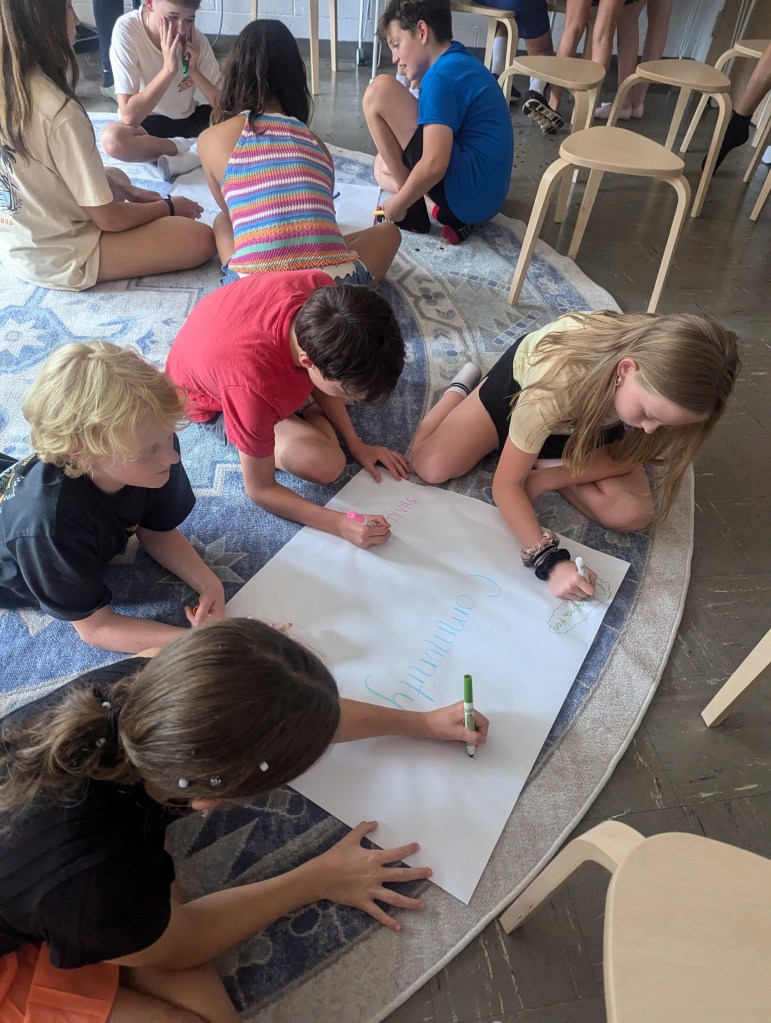
During the first session of each school year, every studio creates a studio contract. The studio contract is a learner-created document that outlines the agreements each learner promises to uphold. Adventure learners were tasked with this challenge during the first week of the session. They began building the contract by making their thinking visible with the Making Meaning Thinking Routine. First, learners were separated into small groups, and each group received a piece of chart paper with one of the following words: community, learner, or trailblazer. Next, every learner wrote a word they associated with the main word on their chart paper. Then, each learner chose another learner’s word and expanded on it by writing a phrase. Learners drew lines connecting their words and ideas. Based on their collective input, they created the following contract:

  1. Keep the studio clean.
  2. Take responsibility for my education.
  3. Treat everyone the way they want to be treated.
  4. Be respectful to others, their boundaries, ideas, and things—and NO body shaming.
  5. Be accountable for yourself and others.
  6. Always try your best and produce your best work.
  7. Be kind and patient with others.
  8. Have a growth mindset.
  9. Stop means stop, and no means no.
  10. Come to school ready and prepared.

This document reflects what our TVS learners want for our community—a community that celebrates, supports, learns, and holds itself to a high standard. It is also aspirational—we understand it may not always be followed, and when it isn’t, that’s when learning and growth occur. What more is there to say? Only this: building this kind of community is both a challenge and a constant effort. It takes trust, perseverance, time, care, and a whole lot of hope. Based on my experience with the TVS learners so far, it is well worth it.

We Celebrate Character with Rocks

“The more you praise and celebrate your life, the more there is in life to celebrate.” Oprah Winfrey

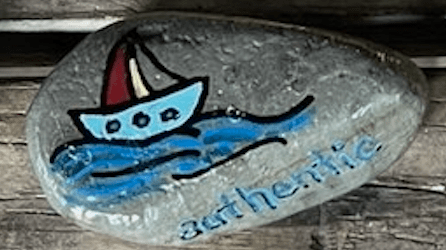
At the end of the school year, each studio carves out time for a long-awaited celebration: Character Rock Ceremony. One of the most honored and sacred traditions at The Village School, Character Rock Ceremony gives every learner and studio community the opportunity to celebrate who they are. At their studio ceremony, each learner receives a special rock with a word painted on it. The word identifies one trailblazing trait the learner exhibited and shared with the community throughout the year. 

On Tuesday, Adventure celebrated the end of the year with a sunset hike at Bear’s Den Scenic Lookout. After an engaging climb, learners, families, and guides gathered together in anticipation of the studio Character Rock Ceremony.

Rock Ceremony Introduction

This hike marks the end of the 2023/24 school year for Adventure Studio. For some of you, this is your first sunset hike, and for some it’s your last. Tonight we are celebrating two things: first, we are celebrating the strong team that you all have created together since Session One. Second, we are celebrating each of your unique contributions that have made our studio and school a better place. We are also here to recognize our four graduating learners. Regardless of when you joined our studio, each of you will always be a TVS Trailblazer. 

As you all know, a trailblazer is someone who discovers their passions, creates their own path in the world, and inspires others along the way. At The Village School we believe that each of us are trailblazers on our own journey to learn as much as we can about ourselves and the world around us. A trailblazer understands their own strengths and weaknesses and makes intentional choices to grow each day. Trailblazers have a vision for a different future, a faith that turns their dreams into reality, and a determination that cuts through barriers and obstacles. All of you have shown the traits of a trailblazer this year. And now we will present you with your character rock representing the trait that you have most contributed to our community this school year.

Presentation of Rocks

Following the introduction, guides gave a character callout to each learner and presented them with their rock. Several of the callouts and pictures of the corresponding rocks are below.

Ralph Waldo Emerson wrote, “To be yourself in a world that is constantly trying to make you something else is the greatest accomplishment.” [Learner], we can count on you for so many things–kindness, compassion, an incredible amount of knowledge about history–and something we always know you will do is be true to yourself. By showing up as your true self, you encourage others to do the same. [Learner], you lead by example and balance being honest with being kind. You are intentional in your interactions with friends–you’re always willing to listen and support–and remain genuine even in the midst of challenging conversations or situations, which is not easy to do. [Learner], thank you for showing us how to be authentic.

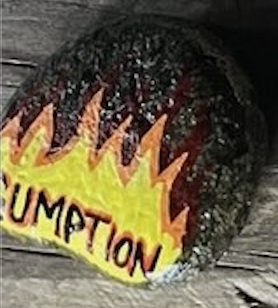
“The hero’s journey in the real world is about moving forward through challenges and obstacles; overcoming one then starting again with a new fear to face and new thing to accomplish.” [Learner], you shared this quote in your speech “What Defines a Hero?”, a speech that deeply inspired our community this year. There is no mountain too big for you. When you set goals, you go for them with confidence, determination, and grit; and, when you reach your goals, you celebrate your wins with grace and are ready to take on the next mountain. You show us what it means to take ownership of our own stories with courage, purpose and spunk. [Learner], we would call that gumption.

You know the feeling you get when you look up at the stars and think, “How is something this amazing possible?” If you take that feeling of curiosity and mix it with a deep love of life, you will find [learner]. You want to know how things work and why things happen. You are unafraid to take something completely apart so that you can learn how to put it back together again, often inventing your own ideas along the way. In conversation, it is a joy to see you light up when talking about the curiosities around you. You really do inspire all who cross your path. [Learner], we would call your joy for deep learning and beautiful outlook on life wonder.

Stephen Covey said, “Every human has four endowments – self-awareness, conscience, independent will, and creative imagination. These give us the ultimate freedom… The power to choose, to respond, to change.” [Learner], in your time at TVS, you have certainly changed, grown, and become an exceptional young man.You have not only contributed to our studio’s culture but you have impacted our entire community with your bravery, creativity, determination, and compassion. You have pushed yourself to become a better person and in turn, have set in motion the determination for all of us to question who we are and who we want to become. [Learner], you show us every day what it looks like to constantly challenge yourself to be a better human, relying on your inner strength to show you the way. For this, we would call that independence.

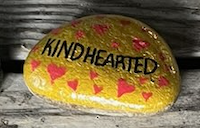
[Learner], you are like the sun–you are bright, warm, and make people feel better on good days and really challenging days. You have a superpower. You care about others and take the time to really check in on them. When you ask, “How are you?” our community knows that you are truly interested in how the person on the other end of the question is doing. You not only listen to those around you, but you also take action to make our community a safe and warm space. So many times we have seen you uplift others by leaving small notes in people’s cubbies, sharing a silly meme with the studio, or telling much-needed jokes throughout the day. [Learner], thank you for showing us what it means to be truly kindhearted.

To close the event, we listened to the inspirational words of poet Cleo Wade’s What the Road Said, watched the sunset, and celebrated our community of trailblazers. 

As a guide, I’ve had the honor of getting to know our amazing TVS learners and seeing each one grow. Now having experienced one, Character Rock Ceremony is an event I will always look forward to in my time at TVS. I couldn’t think of a better way to celebrate who our trailblazers are than with a ceremony dedicated to community and the sharing of rocks.

“Trailblazing is what we do when we find ourselves in the wilderness, with no path to guide us but our own intuitive understanding of nature and our destination. At times we must walk through the night, guided only by the stars. We know when to sit and rest, to shelter from storms, when to gather water, and what on the trail will sustain us and what will do us harm. We are courageous and cautious in equal measure, but we are driven forward, not only by our own desire to reach our destination, but also by the desire to leave a viable way for others who follow.” -Lucy H. Pearce

Session 6 Sneak Peek

Spark Studio

Spark learners will discover and explore the wonders of air and space in Session 6. Learners will learn about astronauts and people who paved the way for future space exploration. Learners will imagine the possibilities of flying and exploring the stars through constellations. We will travel back in time and explore how planets and space originated and virtually visit aviation museums around the world to learn more about its history. 

For project time this session, learners will experiment with concepts of light, shadow, and gravity. From designing parachutes to creating their own universe, learners will engage in hands-on projects to discover how humans design aircraft and spacecraft. 

Learners will discuss our character trait for the session “perseverance” and examine what that entails. We will highlight different topics and how they can navigate each situation without giving up. Spark learners will conclude the session with a field trip to Parkhurst Park.

Photo by NASA on Space.com

Discovery Studio

Get ready to dive into the world of watersheds and discover why they’re vital to our ecosystem. In this session’s project, learners will roll up their sleeves and embark on a hands-on exploration of the Four Mile Run Watershed. Through a series of immersive activities, participants will learn about the crucial role healthy watersheds play in providing ecosystem services. From purifying water to supporting biodiversity, there’s so much to uncover. Armed with newfound knowledge, learners will set out to assess the health of our local watershed. Learners will gather valuable data to answer the burning question: “Is our local watershed healthy?” This session’s project will conclude with learners collaborating to craft a scientific report detailing their findings and recommendations for protecting the watershed.

Simultaneously, learners will participate in this session’s Field Guide Writer’s Workshop, where the power of words meets the wonders of nature. Each participant will choose a species of animal or plant native to the Four Mile Run Watershed to research and write about. From elusive salamanders to majestic oak trees, there’s a world of discovery waiting to be explored. Learners will research and craft entries to exhibit in the Discovery Studio Field Guide. 

Learners will see their work come to life as their Reports and Field Guide will be shared with the community through online platforms. Together, let’s inspire change and safeguard the future of the Four Mile Run Watershed.

Image by Arlington County Virginia on arlingtonva.us

Adventure Studio

Get ready for an exhilarating start to this session as Adventure Studio gears up for a thrilling two-night camping expedition at Lake Fairfax Campground! The learners have planned the food arrangements based on our studio budget, and are going to be building and setting up their tents at the campsite. This camping trip serves as a celebration of our collective hard work throughout the year and is a great opportunity to keep building our team.

This session’s Project will invite the Adventure Studio to put the finishing touches on our much-anticipated TVS school yearbook! From designing the cover to crafting the pages, every detail will reflect the essence of our memorable journey together.

Lastly, for communications, Adventure Studio will focus on creating their Learning to Live Together presentations. 

We are so excited for our exciting adventures this session, and are ready to witness the creativity and teamwork in Adventure Studio!

Photo by Stuart Burford Photography on yearbooklife.com

Health & Wellness

“Life’s most persistent and urgent question is, what are you doing for others?”

Dr. Martin Luther King, Jr.

This session, our learners will focus on what it means to be a servant leader. Servant leadership is a key characteristic of learning to live together, a pillar of our learning model. Each learner will explore what it means to be a servant leader, the qualities and characteristics of a servant leader, and participate in activities that will give them the opportunity to practice servant leadership. The learners will make an impact on their studio, the TVS community, and the community surrounding Madison Manor Park.

Image by Getty Images on Inc.com

3-2-1 Blast Off!

Adventure learners are wrapping up their three-part chemistry deep dive this session. In Session 3, learners experimented with edible slime and created their own recipes for families to try at the end-of-session exhibition of learning. Thank you to the many brave family members and friends who courageously tried the studio concoctions! During Session 4, learners prepared three-course meals for two professional chefs to sample and offer feedback on. We had appetizers, entrées, and desserts ranging from fresh Italian cuisine to flavorful Japanese fare. For this session’s project, learners have stepped into the shoes of a rocket scientist and are igniting their curiosity as they learn about the chemistry behind rockets. The Rockets Project invites learners to design rocket models, experiment with different kinds of fuel, and record, analyze, and share their data.

To kickstart our project, learners researched how rockets work. The questions they explored included:

  • How do rockets function? What are the different parts of a rocket? 
  • What is the point of fuel?
  • What chemical reactions do we see happening when a rocket is launched?
  • What is propulsion?
  • Is it a sustainable / environmentally friendly process to launch rockets into space?

Next, learners identified a current event or project in the world of rocket science to fuel their inspiration. Topics included:

  • Recent rocket launches by SpaceX and other space agencies
  • Advancements in rocket propulsion technology
  • Missions to explore other planets or celestial bodies
  • Space tourism initiatives
  • Developments in satellite technology

After setting up their science notebooks, learners prepared for experimentation. The first rockets learners launched were Alka-Seltzer rockets. Consisting of only three materials – film canisters, Alka-Seltzer tablets, and water – these simple rockets encouraged the learners to focus on the importance of ratios. Learners repeatedly placed tablet pieces of varied sizes into their canisters, added water from the creek, and stepped back in anticipation. They watched as rockets all around them either remained earthbound or fizzled and sputtered before launching into the air. Some popped up just a few inches, while others soared high into the air. One learner shared, “I didn’t think that small rockets would go so high!”

Next, learners experimented with 16-ounce baking soda and vinegar rockets. Upon reflection, several learners shared that they expected the rockets to fly higher than they had. While the studio discussed what had and hadn’t worked, one learner shared, “I thought I needed to use a lot of vinegar at first but when I used less vinegar the rocket went higher. I think the gas in the bottle was able to build up more because there was more space.”

On Thursday, learners were challenged to launch a rocket of their own creation and a 2-liter soda bottle rocket. Some learners used Alka-Seltzer and water, some used baking soda and vinegar, others utilized all available materials, and some relied on air pressure. Now imagine a field full of energetic middle school learners experimenting with materials that go ‘boom’ and launching bottle after bottle into the air. A few rockets flew straight up while many followed surprising and laughter-inducing trajectories. Expectedly, there were successes and failures. One group, whose rockets had failed previously, experienced one successful launch after another. A different group, whose rockets did not soar as high as they were hoping, shared several lessons learned and new strategies for moving forward. 

Over the next two weeks, learners will continue making headway on their rockets through trial and error. Adventure has two more opportunities to make adjustments to their rockets and one more test day before our final launch. For a successful mission, a rocket that launches at least four meters into the air on the first attempt, learners will be challenged to stretch their perseverance, patience, creativity, and curiosity.

Good luck, Adventurers! You’ll ROCKet!