We Teach Ourselves How to Fish

Just this week I was reminded about a moment of failure that I endured as a TVS guide. Three years ago I was brand new to the TVS team, leading the middle school studio – which then was made up of mostly sixth graders. As an educator I had spent the past fifteen years working with high school students; this was a new challenge for me, and I was ready for it. 

The moment occurred during the first few weeks of the school year when I prepared a launch (a mini-lesson) focused on the proverb: 

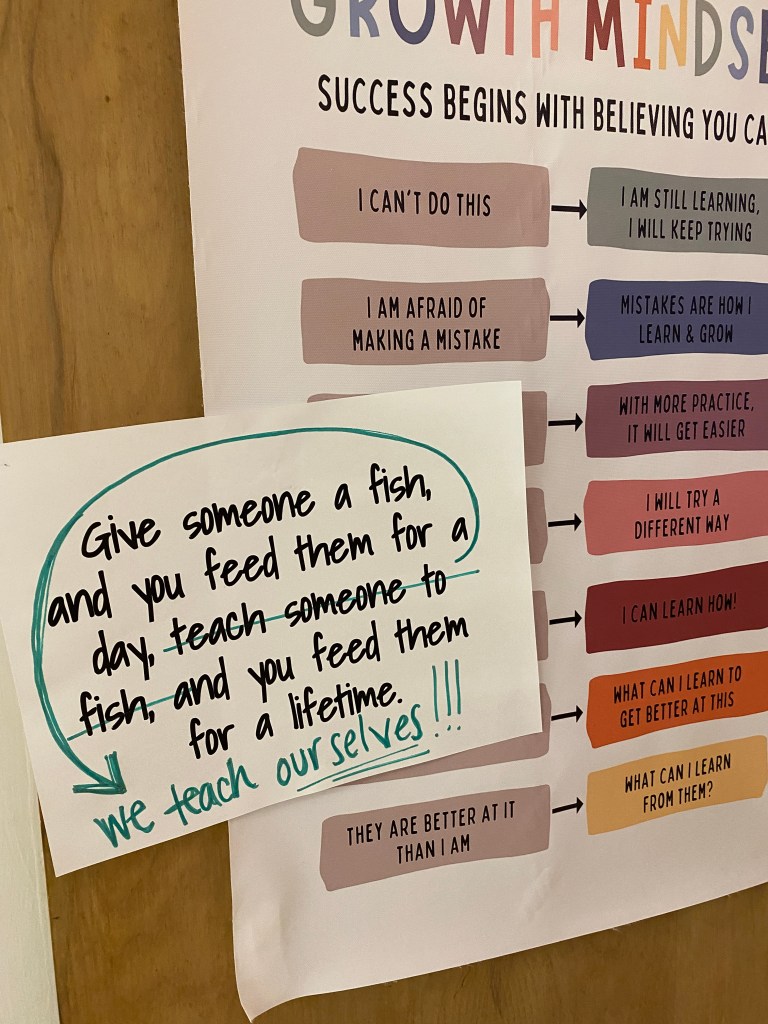
Give someone a fish and feed them for a day, teach someone to fish and you feed them for a lifetime. 

The quote was displayed in a carefully chosen font on the large television screen and the learners were carefully arranged in a circle, ready for discussion. I was prepared and excited for my carefully planned discussion. I read the quote, shared the first socratic question, and what happened next was not what I had planned. The learners read the widely-accepted, well-known adage and tore it apart with one single comment: 

Ms. Elizabeth, no one teaches us how to fish. We teach ourselves. This is The Village School, remember?

Talk about a mic drop moment. The lesson I had so carefully prepared for no longer applied. I remember thinking to myself: 

Who are these kids and what is happening? 

Are they really pushing back on an ancient proverb? 

Who do they think they are and how can I be more like them? 

I wasn’t sure if I was annoyed, impressed, or both. I’d like to say this was the first and last time the learners at The Village School found a loophole I didn’t see coming and took me on a journey I never anticipated, but this moment proved to be the first of many. 

This particular failed discussion of fish was buried in my memory until a few weeks ago when I was observing one of our 8th graders give their final presentation as a TVS learner. She was asked what one of her most memorable moments was and she looked straight at me and said: That discussion about fish. That was a good one. 
It took me a few minutes to retrieve the memory, and once found, the experience all came flooding back. Impressed by the fact that this three-years-ago conversation had stuck with her I realized its own significance to me and how so many of the discussions and experiences I have had over the past three years could be related back to the lesson this early conversation held: At TVS we teach ourselves to fish. 

I’m not even sure which lesson gleaned here is the most important. 

Is it that young people are just as or more wise than ancient wisdom?

Is it that young people are more capable of new analysis where adults see fixed understanding? 

Is it that young people are adept critical thinkers when given a chance to think for themselves? 

Or, is it that we actually have no idea what experiences might stay with a young person as a core memory that contributes to their understanding of themselves and their place in the world?

This particular learner referenced the fish discussion with a sense of pride. What was a moment of failure for me, was a source of empowerment for her, as she learned the power of questioning – or as she put it: I really love finding a loophole, and I’m good at it. 

I think what she really found is the power in her own voice, and isn’t that what we all want for all our children? 

Before this moment during her presentation, I had been sitting quietly and strategically in the corner of the room, trying my best to be a fly on the wall and simply take in the scene. I anticipate these end of year presentations with equal parts dread and joy. They are modeled after a Portfolio Defense, however at TVS the title “Character Defense” would be more accurate. We call them “Learning to Live Together” presentations, as learners must provide evidence of their growth in the character traits represented on our school’s Profile of a Learner. While other schools mark the end of the year with a summative test, we mark it with a celebration of character and growth. 

These presentations often hold emotional moments between young people and the people who care about and spend the most time with them: their teachers and parents. I cherish the opportunity to observe the connection between these groups and the bittersweet reminder of the fleeting nature of childhood and the power of the TVS agentic learning model. As an observer I watch the dynamic between the learner and her audience. 

I watched her mother’s face as she spoke about her growth in respect and accountability. 

I watched her guide’s faces as she spoke about her ability to collaborate with her peers.

I felt my own face soften as she spoke about compassion towards others and herself.

I watched her own face when she said “I really just like myself. I like who I am.” 

I watched her friend’s faces nodding in agreement, laughing quietly at a photograph in the presentation, or a reference to a joke only they understood.

I watched everyone in the room turn towards this young person with pride, a deep sense of respect, and reverence for their thoughts and ideas about their own learning experience. The magic of the Learning to Live Together presentation is that adults are asked to set aside their own judgements about how this young person had experienced school and life – and forced to lean in, listen and trust. 

One of the TVS values is that we trust young people to learn from their own experiences, and these presentations are just one example of how we live out that value. 

My favorite defense question to post to learners at the end of these presentations is to fill in the blank: I used to think…now I think about what they have learned about themselves as a result of their time at our school. Here are a few of their responses: 

I used to think I didn’t have the power to change the world, but now I know that I do. 

I used to think that I had to get everything perfect all the time and now I know that I don’t – even though I still want to. 

I used to think that I wasn’t a leader, but now I think that I am. 

I used to think I was the kind of person who didn’t care about school work, and now I think I am the kind of person who cares and I feel really good about it. 

What a gift to learn such powerful lessons about yourself at such a young age. If one thing’s for sure, learners at TVS will leave knowing more about themselves than their peers – and sometimes their parents. 

At the end of this school year, I was reminded that I used to think my role as a TVS guide was to teach young people how to fish – and now I think, my role is to cheer young people on as they teach themselves. 
Terrible First Drafts 

“Almost all good writing starts with terrible first drafts” is one of many insights into the art of writing from author Ann Lamott. As a C- high school English student,  former high school English teacher, and successful doctoral student, I’ve written and read my fair share of terrible first drafts. Because of these experiences I think I’ve earned the right to have my own insights about writing, how to teach it, and more importantly, how to create opportunities for young people to grow into confident writers. 

For those of you who know me, you’ve probably heard my story about being an avid reader, writer, and published poet, until September of my freshman year of high school when a teacher shared some pointed feedback in crisp red pen on an unfortunately terrible essay about Gilgamesh. After that moment I quit English, abandoned books, and stopped writing. Spoiler alert: I found my way back. (All that happened in between is a story for another time.) 

Since the trauma of the red pen I’ve grown into a (mostly) confident writer. I’ve also had the privilege of learning from all of the mistakes my students and I made together over my ten years in the English classroom and three years it took me to write my dissertation. The most valuable takeaway for me was the power of writing to learn over learning to write. 

One aspect of the Village School learning design that impressed me the most when my family first joined the school five years ago was the volume of writing to learn that was required. Teachers, and especially high school teachers, are cautious about the volume of writing assignments because the more writing, the more pages to grade with that infamous red pen. Most classrooms are places where writing is expected to be formulaic (easier to grade), perfect (easier to grade), and without individual voice (easier to grade). 

Writing to learn is different from learning to write, as the focus positions writing as a powerful tool for thinking, exploring ideas, and developing intellectual identity. Additionally, writing itself is one of the most significant acts a person can make in terms of deep learning. The primary goal at TVS is that we foster an environment where young people develop their writer’s voice and belief in their ability as a writer. We expect to see lots of mistakes in those terrible first drafts and even in some final submissions. We refrain from the red pen because we’re choosing to focus on long term growth over short term perfection.

The quickest way to squash a developing writers’ confidence is to take a red pen to a piece of writing to correct  lower order concerns like grammar or spelling mistakes. If you don’t believe this, my ninth grade self will tell you how it feels to have an adult point out all that is “wrong” with your paper and so will the research. The most impactful feedback anyone can provide to another writer is feedback on the ideas present in the writing, not the technical aspects. These are known as higher order concerns, and what college writing centers focus on and so do TVS guides. Feedback should cause thinking, not more work. 

I know this begs the question – and I know what some of you skeptics might be thinking. Trust me, my mother asks the same questions out loud (not in her head). “These kids need to learn capitalization!” “But, what about commas?” “Please, diagram some sentences!”I hear her, and I hear you. Parents often have the same questions and are skeptical about the type of feedback their learners receive on writing specifically – because they, like many adults, are looking through the lens of that infamous red pen. A missing period or misused comma are an easy correction that might seem harmless, however this type of feedback misses the mark, pun intended. Sometimes these questions emerge after we send home TVS elementary schoolers standardized test scores that show a deficit in these technical aspects of writing (that are a lot easier to ‘measure’ than creative ideas and a compelling thesis). However, those same test scores also report that by the time learners get to 8th grade, they’ve figured it out without any formal grammar instruction. (Please tell my mother!)

A writing to learn approach is not an abandonment of these conventions, it’s about a trust that these aspects of a piece of writing will become important to the learners over time. It’s a testament to the constructivist belief that The Village School is built upon, as well as our intentional design for deep, purpose driven learning. 

Recently a parent stopped me to share about their fifth graders’ middle school visit day experience. They specifically wanted to share with me how proud their child was about completing the Civilizations writing assignment – a rigorous task that most learners new to middle school find quite challenging. I smiled as they shared their critique of their learner’s essay. In their own words: “it was terrible.” I asked the next question about the parent’s response with my fingers crossed. And as they answered with a knowing smile and reported that through gritted teeth they told their learner how great it was. (High-five, TVS parent!) Terrible first drafts are exactly what we are going for, more often than not. 

So, the next time you show up to an Exhibition or are reviewing a young person’s writing, ask them questions about the ideas in their writing instead of the technical aspects like the format or the font (unless it’s Comic Sans.) And, fine, if you just can’t help yourself, we give you permission to correct just one (of the most likely many) grammar mistakes.  As long as you promise to remember: they are writing to learn. 

Unplugged Learning: Why TVS Learners Leave Their Laptops Behind 75% of the Day

Not a day goes by that I don’t have a conversation with my own kids about screens: No screen time tonight. Close the laptop. Please close the laptop. Five more minutes and it’s off. No, you can’t get a phone. These phrases pour out of my mouth with the same ease as an I love you or a sleep tight, goodnight, or a more honest – please hurry up. 

Screen time and all that comes with it is an incessant struggle for modern day parents. At The Village School, these kinds of questions land on our desk daily: “Just how much screen time will my child have?” “How much time are the kids on their laptops?” “Do you have built-in screen breaks during the day?” “Are the kids just on their computers the whole day?” 

Wonderings around our school’s technology policy have always come up, but over the  past several months we’ve noticed an exponential increase. This newfound awareness over screen time might have something to do with Jonathan Haidt’s latest book, The Anxious Generation and the passionate following that has ensued since its release. Inspiring parents and policy-makers alike, the book has resulted in 17 states including Virginia passing school cell phone bans, and Australia passing legislation restricting access to social media for children under the age of 16. 

Haidt’s book was a Parent Book Club pick last year and our Guide Team read several excerpts that validated and inspired some of our learning design regarding healthy tech boundaries. As a learner-centered school many assume we rely on technology more than a more traditional, teacher-centered environment. If there is no “teacher” then the kids must be relying on their tech to learn…right? 

When it comes to our approach to technology use we are guided by the same throughlines that shape all parts of our school: research-based, developmental appropriateness, and thoughtful design. Despite perception, our learners spend the majority of their time at school away from the screen, and the time they do have tech access is intentional. 

This example schedule is a helpful gauge of the screen and screen free time our learners have. Out of the 35 hour school week, learners in our elementary and middle school have access to their computers for 9 hours, which makes up 25% of their time at school. Early childhood learners have even less, technology only being an option for 1 hour for older learners who have mastered either reading or math curriculum and are preparing to transition to the next studio.

Lunch, outdoor play, and afternoons at the park are strictly tech-free. This is a boundary many Guides new to TVS are surprised they have to enforce – as learners will often insist on bringing their laptops to lunch or to the playground to continue their Khan minutes or Lexia streaks. Telling a young person “no, you can’t do any math right now” feels awkward at first, however our commitment to screen-free, unstructured play is an essential part of our learning design.

There are two specific times during our schedule where learners have access to their computers: Morning Work and Project Time. During Morning Work learners might use their computers to achieve some of their individual badge goals such as reading fluency (Lexia) and math (Khan Academy). Laptops are also necessary for some of their other individual goals such as Typing Club or certain aspects of their reading and writing curriculum. There are also individual badge goals that are intentionally designed to avoid the use of technology such as reading and practicing fact fluency. The Discovery Studio writing curriculum requires learners to complete the majority of their writing by hand, with the exception of the final draft. 

Each studio also abides by a Technology Contract that acts as safety guardrails supporting learners in healthy tech habits. 

When a learner breaks the tech contract, they lose the privilege of using technology in the studio for a week. Breaking the contract and facing the consequences is something the Guide Team considers an important rite of passage for a self-directed learner developing a growth mindset. In fact, we expect this to happen at least once during the course of a learner’s time at TVS. When this occurs, some parents are concerned about their child’s ability to work on goals and complete work without access to their laptops. Guides and learners know this is not the case: there are many tech-free options, not to mention the important learning experience of dealing with an inconvenience. 
The screen time debate is certainly an inconvenience for me as a parent – but I know well enough that it’s not going to disappear anytime soon. Just like the TVS approach, I believe technology is an important tool that my own kids (and myself, too) need to learn how to learn with and learn how to learn without. At TVS our learner-centered approach means school is less about learning with technology and more about learning about ourselves through a mindful approach with or without a screen.

Community-Driven Learning

Learning at The Village School is an active experience that connects young people to the community in which they live and beyond. Since Session 1 of this school year learners across our three of our studios have connected with our local community by welcoming experts onto our campus to share their experiences and by embarking on over a dozen field trips and counting. 

Connecting with community experts

Learners have heard from community experts including a reporter from Arlington Now, US Park Ranger Jen from the National Mall, a Peace Ambassador, an Arlington County City Planner, Professional Lobbyists for the National Guard, Yoga Instructors and personal trainers, the Arlington County Park Manager, and a biologist from The Stark Lab. While career-day might be a once a year event in the typical school, the  inclusion of subject matter experts into the learning design of each six-week session is a unique and intentional aspect of the TVS model. Research focused on the importance of representation reveals the importance of these experiences for all young people – as the saying goes, they must see themselves before they can believe in themselves. 

The Community as Classroom

Learners have also ventured out into the community for a total of 12 (and counting!) field trips to the Senate Offices on Capitol Hill, the National Museum of American Indian, the Hirshhorn, the Holocaust Museum, the Washington Monument, the Air & Space Museum, and CBS morning news studios, where they were featured on the local news! Each of these field trips have required the use of public transportation – part of the field trip experience that we believe is just as important as the final destination. 

Middle school learners have also ventured out to our community trails and hiked two of three planned hikes so far this year. In addition to the organized field trips learners travel off-campus and into the community each week to visit the park, which we have officially adopted, and the library. Similar to the once-a-year Career Day, learners in a typical school might have a once-a-year opportunity to attend a field trip with their class. Our school size, flexible schedule, and access to public transportation make taking a field trip to explore our local community easy in comparison. 

Thanks to The Village Fund we’ve extended our community to reach beyond the Washington DC Metro stops. Elementary learners took the very first TVS charter bus trip to the Baltimore Aquarium to observe oceanic biomimic inspiration. Middle schoolers kicked off their study of physics with a trip to iFly and will celebrate their year-long focus with a bus trip to Hershey Park for their Physics Day. 

Community driven learning is one of the three main pillars of the The Village School learner experience, and as you can see, we are loyal to our design. Community engagement is an important part of the learners’ experience that starts with involvement in the studio community and ends with middle schoolers’ involvement in apprenticeships that transcend the TVS campus. The experience-based Apprenticeship program places trust in a young person to learn about themselves, explore interests, and develop passions through active participation in the world of work. A Village School graduate will leave our community with an expansive web of connections that reflects a minimum of 3 Apprenticeship experiences, and a sense of self and community support that will far exceed their peers. 

Our goal is that TVS learners feel like a valued member of their community and most importantly – like they have the power to change their community for the better, because we know they can, and they will. 

Real Learning is a Real Messy Poster 

One of the primary jobs of a guide at The Village School is to curate the optimal learning environment. Loris Malaguzzi, the founder of the Reggio Emilia approach famously states “there are three teachers of children, adults, other children, and the environment.”  Those of you familiar with our school know that we are not the type of private school with rolling hills, grand columns, and a school campus that rivals an Ivy league university – we are, in fact, quite the opposite. Regardless of our humble and ordinary campus, we take our space and the artifacts that fill our spaces quite seriously. When people visit our school for the first time and make their way through each of our studios, they always comment on the space, mostly noticing how non-traditional it appears. There are no desks, no clear “front of the classroom”, flexible seating areas, rugs, plants, and learner-curated “walls that talk,” as one of our Discovery Guides describes. 

Creating a reflective environment is one intentional step that is often both overlooked and owned by adults in most classrooms and schools. Using materials, equipment, and decorations that reflect the voices of the learners and the community and culture they are building is arguably the most important role of a guide at The Village School or any learner-centered educational space. 

Close your eyes and imagine your own elementary school classroom, or the typical elementary school classroom as depicted on television or in movies. Keep your eyes closed and imagine yourself walking in the front office, down the hallways, and peeking into a classroom or two. Draw your attention to the walls in these spaces. Most likely, you’ll see carefully curated bulletin boards, perfectly cut out bubble letters, aesthetically pleasing images, all designed by the adult “in charge” of the space. 

Our goal at TVS is the opposite of this – our goal is that the walls of our studios reflect back the voices of our learners rather than the voices of the adults. This purpose and vision permeates our intentional design of the spaces, walls, and the products that our learners create. 

Think back to the last poster you saw your learner working on or the ones you saw lining the tables during the last end-of-session Exhibition. If you’re like me, you viewed them from an adult perspective with a highly critical eye for sloppy cutting and pasting, spelling mistakes, organization, and consistent font (anything but Comic Sans). If you’re like me you notice each place where they crossed things out, erased too hard, or wrote in pencil or yellow marker (why???) instead of a legible color. If you’re like me you wonder why they didn’t plan more before gluing things down. If you’re like me you smile through gritted teeth and force a compliment in the form of “Wow!” 

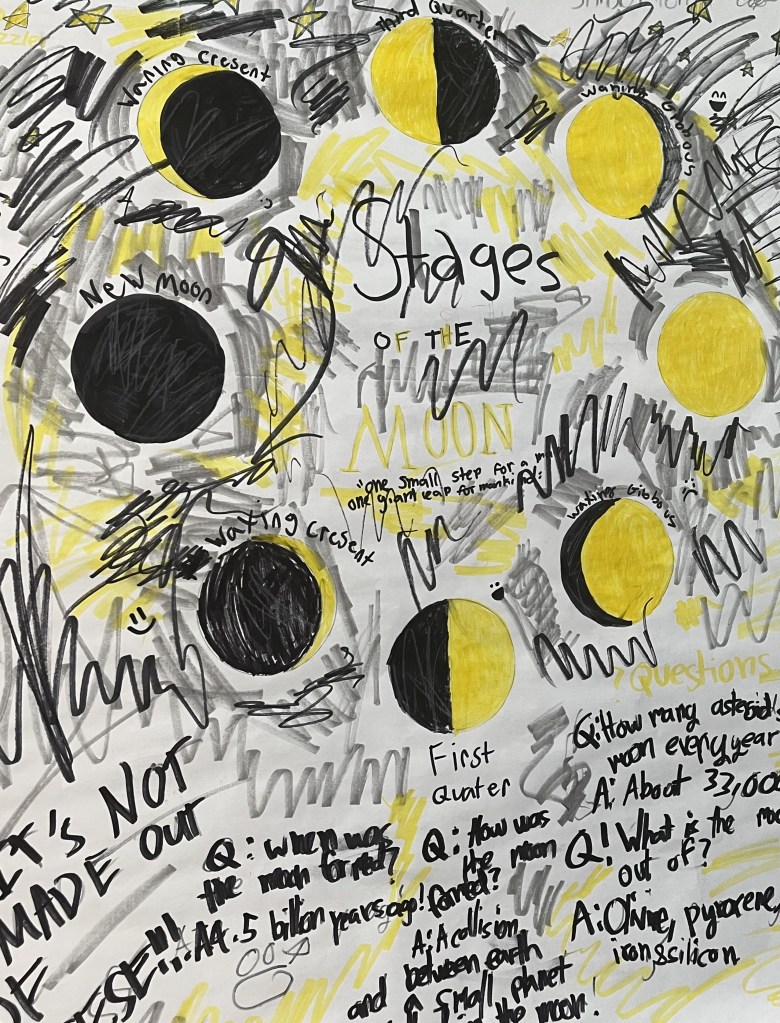
I used to think a perfectly curated poster was indicative of deep learning. Now I know that the opposite is true: real learning is a real messy poster. As a parent and a TVS guide, my assessment of learning is now reliant on those not-quite-erased pencil marks and the not-quite-glued scraps of paper. The more imperfections, the more likely the poster was created entirely by a young person, and this is the goal. With the exception of a few detail oriented learners, I’m suspicious of any learner-created product that appears too perfect. The Village School is a learner-centered, self-directed school, after all. We purposefully create agentic learning experiences  – including opportunities to create a (messy) poster. At The Village School a messy poster is a meaningful expression, not something that needs straightening or correcting. 

Our goal is that the walls, posters, and any products our learners create to communicate their voice, not ours. A reflective environment is one in which the walls talk – and at TVS it’s the learners who are doing the talking. 

The Myth of Work Hard, Play Hard

Work hard, play hard is a mantra that’s been repeated in our school community for years. Fun can only be had after the hard work is done. As parents, we’ve preached this to our families, too. You want to watch tv? You better do the dishes, first. You want to play with your friends? You better clean that room of yours! Work hard, play hard applies to many situations at school and at home, but should it? 

At The Village School we believe in play. In fact, we believe in Maria Montessori’s belief that “play is the work of the child” so much we label ourselves play-based and we mean it. We pride ourselves on providing all learners, no matter what age, extensive time for free-play, as well as cultivating a playful learning mindset around our academic learning design. At The Village School playing hard is our hard work, not the reward we get after. 

Despite the fact that educators across the country place a high value on more playtime for students, the average elementary age student has access to 25 minutes of free play and middle schoolers only get 15 minutes per day, if any. Project Zero, Harvard Graduate School of Education’s research group supports the high value on more playtime for all young people, and suggests a Pedagogy of Play is a necessity when it comes to both childhood development and deep learning. 

According to their research, Playful learning occurs “when the learning goals of adults and the interests and curiosities of students align.” Playful learning draws on what we know from years of research about the nature of deep learning: Learning is a complex process that involves cognition and emotion. These facts are the underpinning of the learning design at TVS. We rely heavily on experiential learning and work hard not to deliver content, but to create rich learning experiences from which young people will make their own meaning.  

All of this meaning-making occurs in both structured and unstructured environments where learners and adults are co-creating a playful mindset and approach. A “playful” approach to learning is necessary, especially in a learner-centered and self-directed school environment when learning is not linear and surprises occur often. 

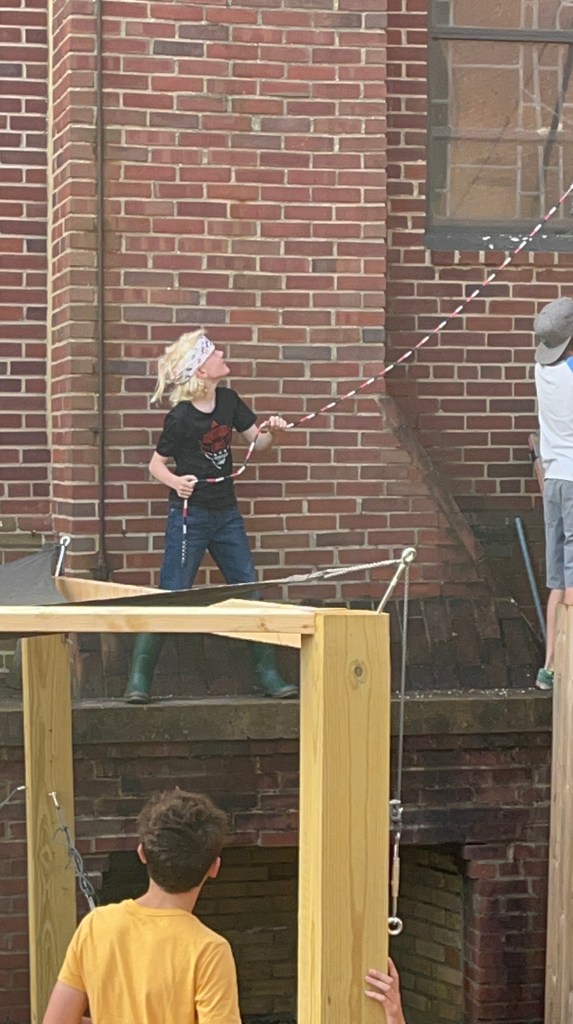
These playful surprises happen often across all of our studios. There was The Great Bunny Rescue last year in our Spark Studio, or the Sandbox Situation featured on this back to school blog. One of my personal favorites is the Rescue-Balls-from-the-Roof day. It began towards the end of our hour-long outdoor lunch and recess block in the middle school studio when the last of the remaining kickballs got lodged (with several others) on the roof of the school building. There was still a precious ten minutes left in free time and the middle schoolers were committed to retrieving the ball in an attempt to savor those remaining minutes. I spent the next sixty minutes observing a youth driven pedagogy of play. The entire middle school studio proceeded to work together to create a contraption that was able to reach the roof and successfully retrieve the ball. Yes – we skipped our regularly scheduled afternoon of “work”, and it was worth every second. As I observed, I did what any TVS guide would do: I documented. I took photos and videos which I played back for the learners during the day’s closing circle as I posed the question: Where in these images do you see evidence of our studio values? The learners responded with overwhelming evidence of collaboration, trust, self-direction, and joy. 

We know that valuable learning moments flourish through free, open play. As educators, it’s our responsibility to protect these spaces – especially in a world that increasingly values over-structured experiences for kids. At TVS, play isn’t a reward – it’s the cornerstone of deep learning. We don’t work hard to play hard. At TVS, we simply play hard.

Learning Occurs at the Point of Challenge

At the heart of all passionate educators is a deep desire to see young people succeed. As an educator (and a parent), I can relate. Watching a student’s eyes light up after a newly found realization is a dopamine hit like no other. It’s probably why I can remember most of the 150 high school students who I had the pleasure of getting to know during my first year of teaching almost 20 years ago. Like so many first year teachers, I spent all of my time considering new ways to support them in their success. Despite the changes the field has endured since my early years, one thing hasn’t changed: the heart of educators. They show up each day because they care so deeply – which is exactly why it is so difficult for them to see their students’ “fail.” 

This desire to help is the Achilles heel of all educators because learning occurs at the point of challenge. I know this to be true from my life experience, but also because Ron Ritchhart said so. Ritchhart and his research at Project Zero, Harvard Graduate School of Education’s Research Group, has been a lightpost for me (and so many others) over my entire career. I was recently at a conference where Ritchhart was a featured speaker and he shared more about how learning and challenge go hand in hand. I couldn’t help but think about how his research focused on teachers and students applied to parents and their children and our TVS belief that failure is essential to learning. 

Ritchhart shares that despite the fact that we can all acknowledge that in order to learn we must face challenges, make mistakes, and even fail, we do all that we can to prevent our students from experiencing those things. I think many parents (myself included) fall into the same trap. Ritchhart offered not one, but eight reasons why we avoid the challenge zone with our students. As you read through the list, replace the word teacher with parent and the word student with child, and notice how many you can identify in your own practice as a parent: 

  1. Teachers don’t see the benefit from learning from mistakes and we aren’t rewarded for them. 
  2. Teachers want all our students to be successful…all of the time.
  3. Teachers fear student frustration. 
  4. Failure of any kind is seen as a negative reflection on us as teachers. 
  5. Teachers are used to procedural explanations and giving good explanations to reduce grappling and increase efficiency. 
  6. The benefits of direct instruction have been oversold. 
  7. Mistakes and challenges feel inefficient and messy. 
  8. Teachers are outcome driven, looking for correctness above all else, so we value products over process. 

If you’re like me, you were nodding your head at just about everyone on that list. Don’t feel too humbled, yet – learning occurs at the point of challenge, remember? All of these resonated with me as I listened through the lens of an educator- but two really stuck out to me when I considered the list through the lens of a parent. 

Number 3: Teachers have a low tolerance for student frustration. I am way more comfortable with other children’s frustrations than the frustrations of my own – mostly because I don’t have the time or patience. (I really hope you’re nodding your head here, and I’m not revealing a deficiency in my parenting because you’ll read more about that in a few paragraphs). Lisa Damour offers a reason for this low tolerance. She claims that being the parent of a tween or teen requires one to be an “emotional garbage can,” there to collect all of the feelings of your child as they learn to deal with, react to, and process their feelings. Lately, I find this to be one of the most challenging aspects of parenthood (specifically when rushing out the door in the morning, or after a long week at work). 

Educational research indicates that educators share this low tolerance for struggle and frustration and often define their role as someone whose job it is to remove discomfort from students. The issue, as Ritchhart points out, is that when teachers remove the challenge (emotional or academic) learned helplessness and low self-esteem ensue. The reality is, that if deep learning is what we are after, discomfort is a prerequisite. Teachers (like parents) need to learn to deal.

Number 4: Failure of any kind is seen as a direct reflection of me as a parent. Is it not? This reminds me of one of our recent parent book club picks, Never Enough, where the author references the immense amount of pressure parents (especially affluent parents) put on their children to be the best at whatever they attempt – all because our children’s success are a direct reflection of us and our ability and competencies as parents. Dr. Becky would call this co-dependence and Krissy Posatek would call this enmeshment, and they both would agree that this is unhealthy and severely misguided. 

Educational researchers also suggest this to be misguided. In fact, several studies have shown that explaining too much or even providing too clear directions can actually be detrimental to learning. Bjork’s research on this topic posits a strong connection between “grappling” and deep learning. In a world that prioritizes ease and convenience, what we actually need to learn is to grapple more, because ease and convenience do not, in fact, improve human performance – or learning. 

Despite our propensity to avoid challenges for both ourselves as parents and for our children, there are some things Ritchhart suggests we do to encourage and support what we are all after: deep and meaningful learning experiences. Most encouraging to me as a TVS parent and guide is that according to the experts, the best way to lean into challenges is to ensure that the decision making power is in the hands of the learner. 

At The Village School our learners are always chasing their “challenge zone” whether it’s a new badge book they are reading or a new math skill they are learning. Guides across all of our studios often lead discussions focused on the challenge zone and learners are well versed in how to identify what is challenging to them, what’s too easy, and what feels too difficult. Our school and studio culture values challenge and failure despite how uncomfortable it might make the adults, because we know the powerful learning that always results. 

What we (the adults) must focus on is building up our tolerance for challenges, recognizing the powerful impact it will have on our kids. Ritchhart suggests that an indicator of an educator’s effectiveness should not be how many students in the classroom are “succeeding” but rather how many learners are encountering a struggle, because this is an indicator that deep learning is happening. As a parent, I’m going to work on my tolerance for this. The next time one of my kids is grappling with what to pack for lunch or how to divide fractions I’m going to do my best to resist the urge to remove the challenge and instead lean in (while hiding from them in the bathroom).  

Taking Responsibility for Your Own Education

Have you ever had the feeling of awe while watching your child? Not pride or fulfillment or joy, but awe. Dashner Keltner describes awe as the feeling you get in the presence of something vast that changes your understanding of the world as you know it, like looking up at a sky full of stars or a first glimpse of the Grand Canyon. 

As a parent at The Village School for the past five years I’ve felt a lot of emotions: frustration, worry, pride, gratitude – and I’ve learned to lean into all of them. Each emotion is a vital part of parenthood, and  especially important during the parenting of a self-directed learner. I’ve also had the privilege of experiencing awe based on the learning experiences that my own children and others have as learners at TVS. These moments occur in all the expected spaces like the end of year Character Rock Ceremony, or the middle school I have a dream speeches, but my favorite experience of awe are the experiences that sneak up on you when you’re least expecting and create the kind of awe Kelter summons and changes the way you see the world. 

One of those moments happened just a few weeks ago when my 9 year old daughter tearfully shared a fear that she would never be able to memorize multiplication facts. Thankfully, I had some patience left in my tank from the day. I gave her a hug, affirmed her feelings, and asked if she had any ideas for how to overcome this worthy challenge. After a little back and forth, I showed her a strategy other TVS learners have used – a menu of online courses including some on multiplication. After several minutes of doing her own research, she called me over to show me a three night class that started that night. Fifteen minutes later she was live on a zoom class with a teacher and seven other 9 year olds. 

For the next three nights my husband, her sister, and I sat in the other room eavesdropping and meeting each other’s knowing gaze each time we witnessed her participation. The learner who was in tears afraid of the multiplication challenge was zoned in, engaged, raising her hand, participating on a zoom class (something she had never experienced before), getting questions right, getting questions wrong, asking for explanations and clarifications, and even completing “homework” in the traditional sense. Each night the class was just over an hour and she was locked in the entire time. 

Towards the end of the third and final class the three of us eavesdroppers looked at each other in awe. The determination to take responsibility for her own education and her belief in herself that she could do it was a moment of full of wonder for us – it didn’t matter if she learned any multiplication, what mattered was her ability to set a goal, follow through, and face a fear.

Taking responsibility for your own education is a throughline of The Village School experience. At the beginning of each year learners in all studios sign a contract that lists the promises they make to themselves and each other with the goal of creating and maintaining a healthy community. A line on each contract reads: I promise to take responsibility for my own education

Most parents share that this feels like a huge relief, and I agree. On the surface, I’m relieved to have one less thing to add to my never-ending to-do list, or maybe I’m just excited to add something to my list that I can immediately check off (if you know, you know). Short-term relief to my mental load as a parent is always a win, but when I think more about what the promise my kids and the other learners at The Village School make to themselves, I’m more curious than relieved. The recent experience of my 9 year old demanding to take an online class to help her with math is a tangible example – but my curiosity persists. How do other parents recognize it happening? What does it mean to other families – and what does it mean to the learners? Really, I’m mostly curious about what the young people themselves think about this promise. Forget what it means to me and the other adults, but what does taking responsibility for their own education mean to them? So, I did the obvious, and I asked them. 

Here are some of their responses: 

It means to be helpful and use kind words. age 7

To always make sure that you’re working hard. – age 10

It means to hold yourself accountable and look out for others, too. – age 9

Be ready to learn and keep track of your goals. – age 7

Finding a place to focus and find flow. – age 8

We take responsibility for our own education because we get to choose what we are working on and it’s up to us to not get distracted or distract others.  age 10 

I get to choose what I want to do and take my own time to finish it. – age 11

As expected, the learners’ were able to articulate their experience better than me. I posed the same question to our team of guides: What does it look like when a learner is taking responsibility for their own education in your studio? The discussion that followed was rich with examples of young people, but one story really stuck with me. 

A guide shared that during a routine guide meeting with a sixth grader, she noticed that despite completing a unit on Khan academy several weeks prior, the learner had yet to begin the next unit. Curious about why this might be the case, the guide inquired. The learner gave a knowing sigh and shared “Ah, yes. I haven’t moved on to the next unit because even though I mastered the percentage unit on Khan, I don’t feel like I have a deep enough understanding of percentages and how they work. I don’t want to move on until I understand it better. I think percentages are important in life and I want to really get it right.” The guide asked if the learner had any ideas about how to gain the deeper understanding she so desired. The learner shared a thoughtful plan that involved more practice and promised to follow up in a few weeks – once she felt more confident in her ability and understanding. Can you think of a time in your sixth grade life that you had this perspective on your school work? If you’re like me the answer is a definite nope. Never, ever. This is what taking responsibility for your own education looks like. 

As a parent (and a guide) taking responsibility for your own education means more than the relief of one less adult responsibility. The promise represents a manifestation of the value and trust that I have in my own kids. It communicates that they don’t need me to accomplish their goals – they can set goals and reach them on their own. Of course I’m here to cheer them on, support them, and guide them, but ultimately, it’s their responsibility. At The Village School taking responsibility for your own education is not just a concept, it’s a daily practice that when reflected upon can change one’s view of the world and activate a sense of awe. 

The Folds of Truth & Beauty

I’m drawn to bookshelves. Library bookshelves are fine, but I’m really more interested in the personal ones, the bookshelves in someone’s home. I’m drawn to them because of what they might reveal about the curator. What are the contents? How are they organized? What is the significance of the small treasures that are nestled between the spines? I’m drawn to the neverending stories hidden within the pages and the shelves. 

Recently my family and I spent the weekend at a rental house near our favorite lake a few hours north. The house was nestled right along the shore, but I didn’t choose it for the location – secretly, I was drawn to the bookshelves. The images of the house online included a few artistic shots of a bookshelf I couldn’t resist. Upon arrival, I dropped my luggage in the entryway in search of the shelves. I stood in awe before the floor to ceiling wall of well-loved and worn-in bookshelves glowing under two bright red spotlights just like the image online. So many books and stories to uncover. I carefully took in each shelf: a few familiar titles, some classics, one too many books about psychology, and more than a few New York Times bestsellers. In the corner of the bottom shelf, slid tightly between an illustrated version of Harry Potter and a neighborhood association handbook was a thinly bound book titled, “Origami for Beginners.” Further down on the shelf was a retro tin lunch box filled to the brim with origami paper – a lakeside vacation windfall.

Like any good parent, I suppressed my urge to share my discovery and excitement and left the book and materials nonchalantly on the kitchen table hoping one of the kids would see the possibilities and take the bait. (Thanks, mom for the expert parenting move). Hook, line, and sinker, it wasn’t long before the scene I hoped for was a reality. Origami paper was strewn all across the kitchen table, followed by mornings full of folding jumping frogs and one particularly rainy afternoon folding hearts and puppies. Our foray into folding reminded me that origami is not for the faint of heart. Following the written instructions is like solving a challenging math problem. You’re forced to sit in the confusion staring at the same seemingly simple instructions and folding and unfolding your paper until something clicks. Until things click the instructions stare back at you, and the longer you stare, the more it feels like they might be mocking you. 

Like many artforms, origami has a hazy history. Some claim its origin was Japan, others China, and some claim a German educator, Frederick Froebel gets credit for perfecting the art of paper folding. Froebel is also credited for inventing the idea of Kindergarten, with origami as an essential part of the curriculum. Froebelian Folding, as it became known, claims three different types of folds are essential to the art of origami: the folds of life, the folds of beauty, and the folds of truth. 

The final morning at the lake, I sipped my coffee staring out over the purple jumping frogs, orange puppies, and pink and red origami hearts that filled the kitchen table. I couldn’t help but think about the folds of a single pink origami paper crane that sits in a prominent spot on the well-loved bookshelf in my own house. 

That pink crane came to life because of The Village School onboarding challenge during the summer of 2020. I can still remember sitting down with my seven year old daughter as she clumsily folded the paper and looked with frustration at the google slide instructions. The challenge involved folding multiple paper cranes and noticing how each crane was (hopefully) an improvement from the previous. The lesson was less about cranes and more about growth mindset. 

It wasn’t until that quiet morning at the lake surrounded by origami that I made the connection that her pink paper crane still lived – on our bookshelf. I assure you that keeping the crane was not intentional at first, but like many things, the longer something sticks around the harder it is to release. Over the years the crane has flown from shelf to shelf, been found in the bottom of the kitchen junk drawer, and was once even rescued from the slobbery mouth of our golden retriever – a little wet, but still intact. Enough time has passed that I’ve grown attached to her.  

When I brush my own hands along her edges and folds I feel that kind of bittersweet longing parents feel as children grow. I imagine her six year old hands brushing over those same folds, and now I will save this pink paper crane for life. When you come to our house and are drawn to our bookshelf, you’ll see the perfectly imperfect pink paper crane prominently displayed. Every once in a while when I walk past, I gently pick her up and wonder if these are the folds of life, the folds of beauty, and the folds of truth that Froebel had in mind. 

As we close out this calendar year, I’m reminded that like origami, life is a series of careful folds, unexpected creases, moments of frustration and revelation. We collect these folded memories on our shelves, in our hearts, watching how they transform and persist. Some, like my daughter’s pink crane, become talismans of growth, reminders that our most treasured stories are not about perfection, but about the patient, persistent act of becoming. 

Here’s to a new year full of life, truth, and beauty on all of our bookshelves.

Session 3 Sneak Peek

Spark Studio

In this session, learners will explore different cultures. They will imagine themselves in another country and learn about different languages and traditions (foods, drinks, clothing, and how things are made). They will also discuss how those differences and similarities play a part in our everyday lives. Learners will have the opportunity to engage in hands-on materials in each area of the studio that reflect our theme.  Spark will conclude the session with an international celebration for Exhibition that features handcrafted drinks and treats. 

Photo by Porapak Apichodilok on Pexels.com

Discovery Studio

Discovery will be deepening their understanding of identity, culture, and self-expression through mask making in this session’s Project.  Learners will make connections between their own crafted masks to traditions across the globe. Learners will take away that masks can symbolize protection,  or enhance, or disguise appearance in some cases such as battle, theater, film, and more. By the end of the session, learners will be able to write an artist statement that conveys the deeper meaning behind their art.

Writer’s Workshop: Every hero’s journey encompasses a narrative that outlines the experiences that encompass their lives. This session, learners have the opportunity to write an autobiography that includes background information, their triumphs, and climactic events. Through sharing beautiful and unique anecdotes about themselves, learners will become authors in their own right, championing them to share their stories with the world.

Photo by Artem Podrez on Pexels.com

Adventure Studio

Project: Get ready to dive into the thrilling world of physics! During this session, Adventure will team up to unravel the secrets of acceleration, force, momentum, and energy. With hands-on experiments and a secret mystery project, they’ll channel their inner scientists and embrace the excitement of the scientific method through trial and error to create innovative prototypes. Our experimentation culminates in a high-energy Exhibition, where learners will showcase their finished product in action. 

Communications: This session learners will explore the transformative power of gratitude and discover how expressing their gratitude can enhance their well-being. Using the pastiche technique, they’ll focus on expressing their appreciation rather than simply reflecting on it. At the end of the session, learners will share their thoughtfully composed letters with their recipients, deepening their relationships and experiencing the joy and fulfillment that comes from meaningful expression.

Photo by Pixabay on Pexels.com

Health & Wellness

“Nutrition is a critical part of health and development. Good nutrition means your body gets all the nutrients, vitamins, and minerals it needs to work its best… Healthy eating promotes stable energy, strong bones and teeth, improved mental health, healthy weight, and prevention of chronic diseases.” – American Academy of Pediatrics

Spark Studio: It’s back – Be Your Own Food Critic! Spark learners will try different fruits and vegetables and learn about how they  impact our bodies in amazing ways. 
Discovery & Adventure Studio: Learners will be reflecting on healthy nutrition habits, dental care, and sleep habits. We will also have a chance to try fruits and vegetables that can have positive benefits to our dental health and aid in getting a good night’s sleep.

Photo by John Finkelstein on Pexels.com