Community-Driven Learning

Learning at The Village School is an active experience that connects young people to the community in which they live and beyond. Since Session 1 of this school year learners across our three of our studios have connected with our local community by welcoming experts onto our campus to share their experiences and by embarking on over a dozen field trips and counting. 

Connecting with community experts

Learners have heard from community experts including a reporter from Arlington Now, US Park Ranger Jen from the National Mall, a Peace Ambassador, an Arlington County City Planner, Professional Lobbyists for the National Guard, Yoga Instructors and personal trainers, the Arlington County Park Manager, and a biologist from The Stark Lab. While career-day might be a once a year event in the typical school, the  inclusion of subject matter experts into the learning design of each six-week session is a unique and intentional aspect of the TVS model. Research focused on the importance of representation reveals the importance of these experiences for all young people – as the saying goes, they must see themselves before they can believe in themselves. 

The Community as Classroom

Learners have also ventured out into the community for a total of 12 (and counting!) field trips to the Senate Offices on Capitol Hill, the National Museum of American Indian, the Hirshhorn, the Holocaust Museum, the Washington Monument, the Air & Space Museum, and CBS morning news studios, where they were featured on the local news! Each of these field trips have required the use of public transportation – part of the field trip experience that we believe is just as important as the final destination. 

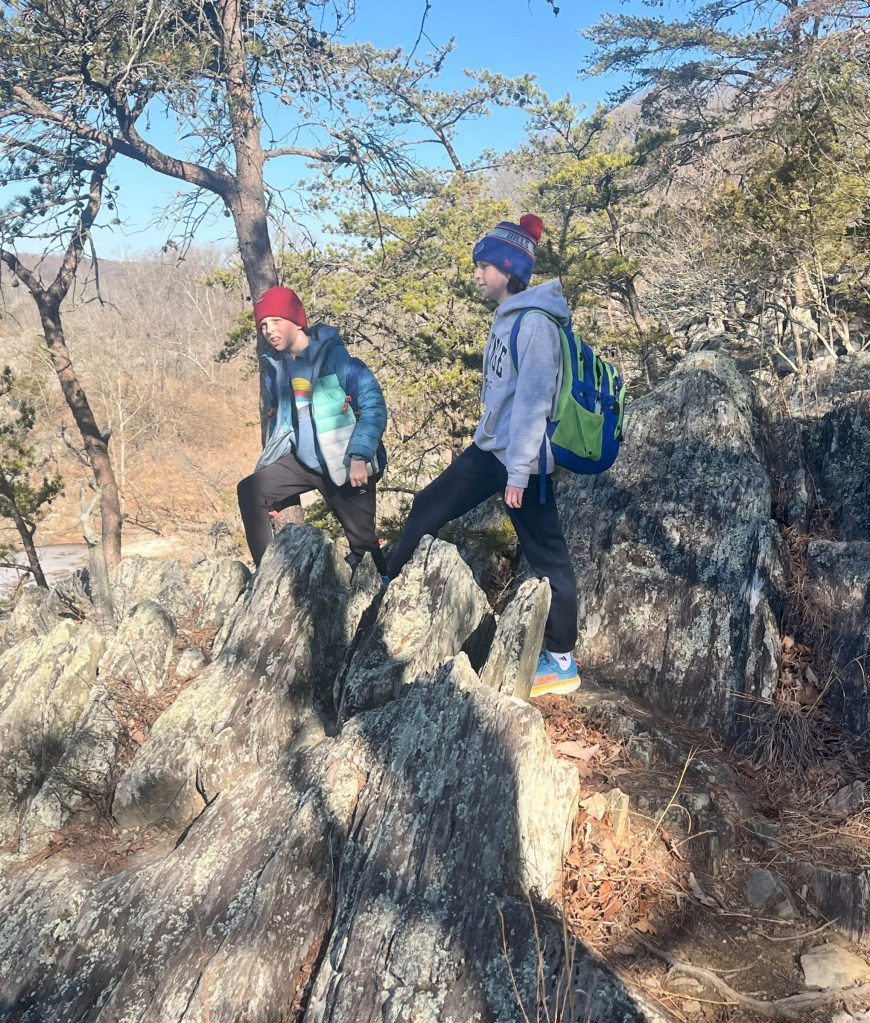
Middle school learners have also ventured out to our community trails and hiked two of three planned hikes so far this year. In addition to the organized field trips learners travel off-campus and into the community each week to visit the park, which we have officially adopted, and the library. Similar to the once-a-year Career Day, learners in a typical school might have a once-a-year opportunity to attend a field trip with their class. Our school size, flexible schedule, and access to public transportation make taking a field trip to explore our local community easy in comparison. 

Thanks to The Village Fund we’ve extended our community to reach beyond the Washington DC Metro stops. Elementary learners took the very first TVS charter bus trip to the Baltimore Aquarium to observe oceanic biomimic inspiration. Middle schoolers kicked off their study of physics with a trip to iFly and will celebrate their year-long focus with a bus trip to Hershey Park for their Physics Day. 

Community driven learning is one of the three main pillars of the The Village School learner experience, and as you can see, we are loyal to our design. Community engagement is an important part of the learners’ experience that starts with involvement in the studio community and ends with middle schoolers’ involvement in apprenticeships that transcend the TVS campus. The experience-based Apprenticeship program places trust in a young person to learn about themselves, explore interests, and develop passions through active participation in the world of work. A Village School graduate will leave our community with an expansive web of connections that reflects a minimum of 3 Apprenticeship experiences, and a sense of self and community support that will far exceed their peers. 

Our goal is that TVS learners feel like a valued member of their community and most importantly – like they have the power to change their community for the better, because we know they can, and they will. 
Loose Part Play: Reimagining Recess

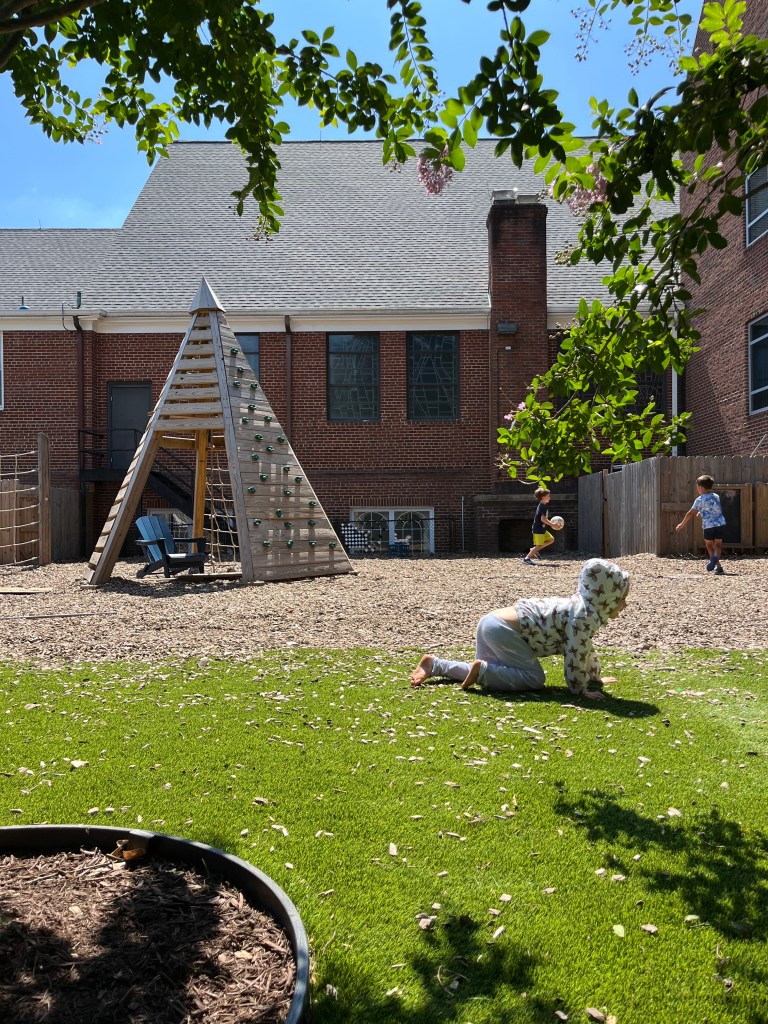
When I visited The Village School for the first time, I was surprised to see such a bare playground. I expected to see the classic jungle gym with multiple slides, large steps, climbing walls, and monkey bars, or even a blacktop with four-square or basketball. All I saw were monkey bars and a climbing wall. Little did I know the magic that could happen on this “empty” playground.

The “empty” playground

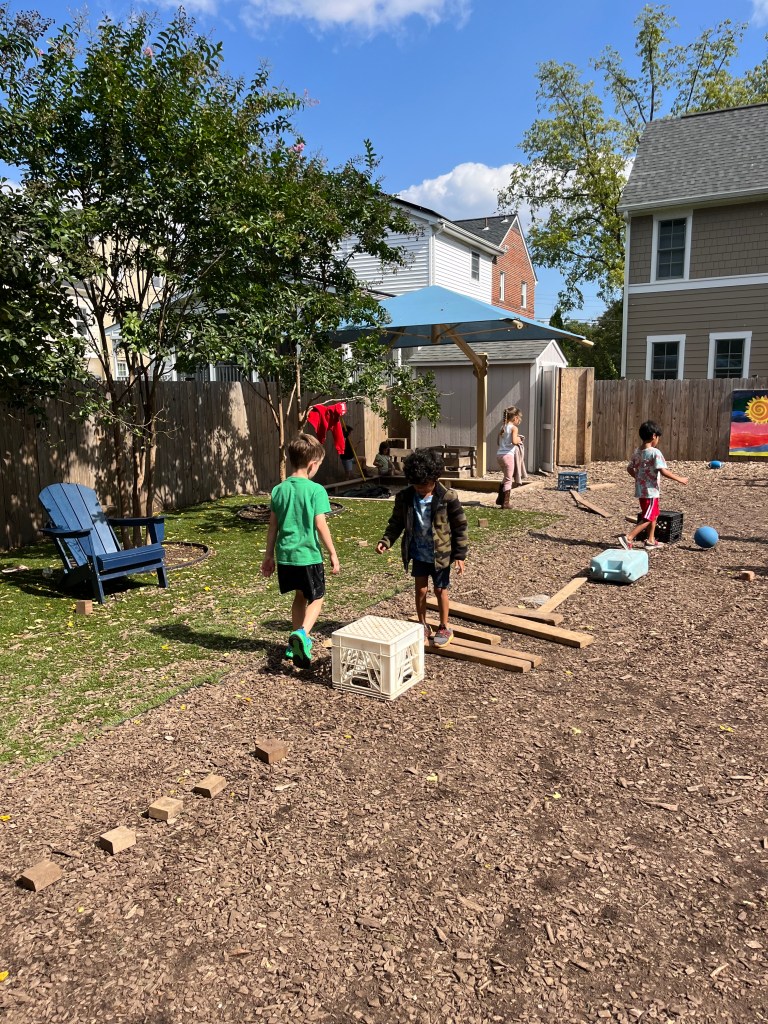
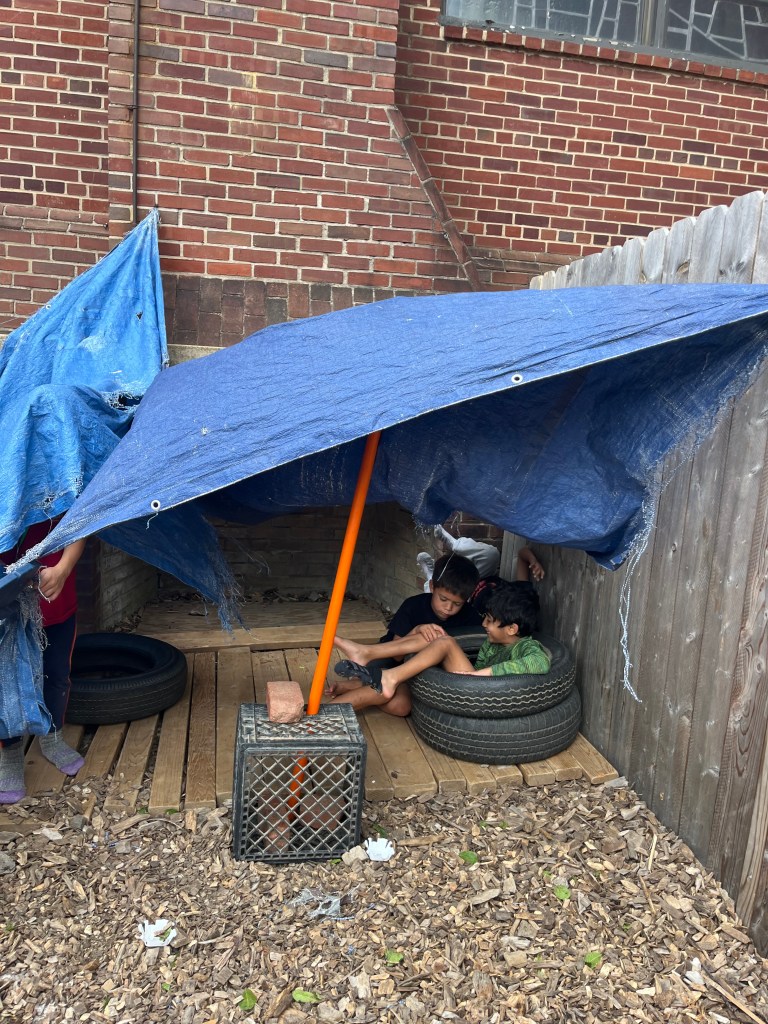
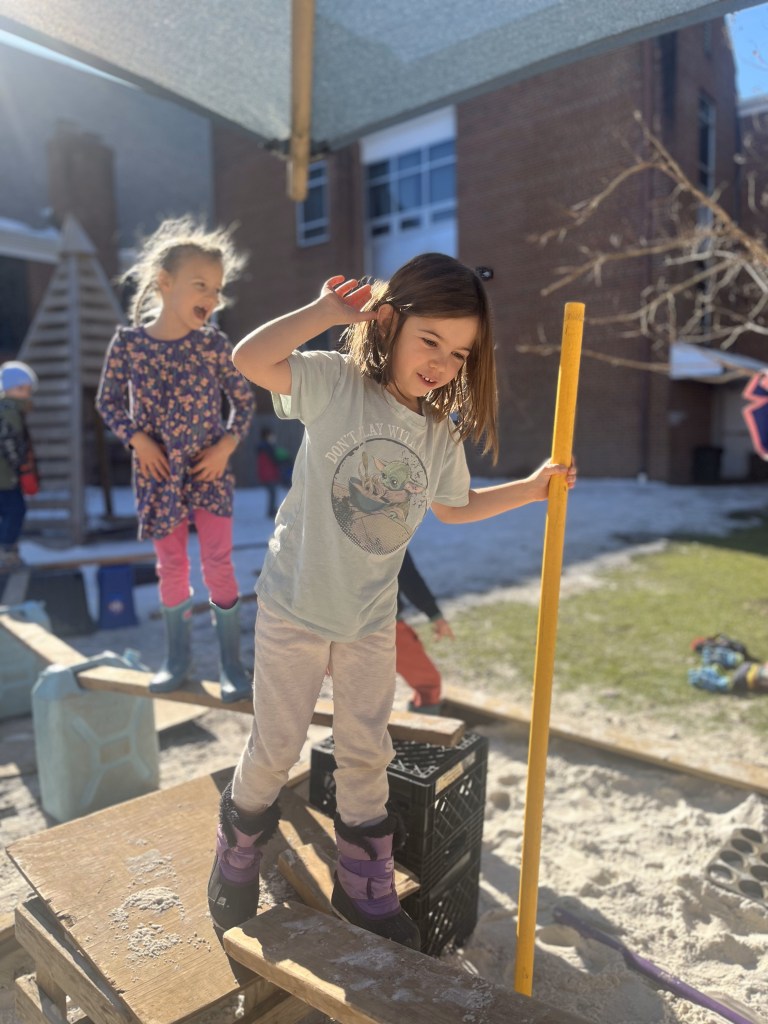
You see, at TVS, we value the power of “loose parts” – open-ended and interactive materials that children can manipulate to use in many different ways. The value of loose parts is based on the belief that children are creative and resourceful. Instead of classic playground equipment like slides, swings, or balance beams, our learners have boards, milk crates, tires, and PVC pipes. Some might look at the playground and think about all the dangers and “what could go wrong.” But our learners look at the playground with endless possibilities.

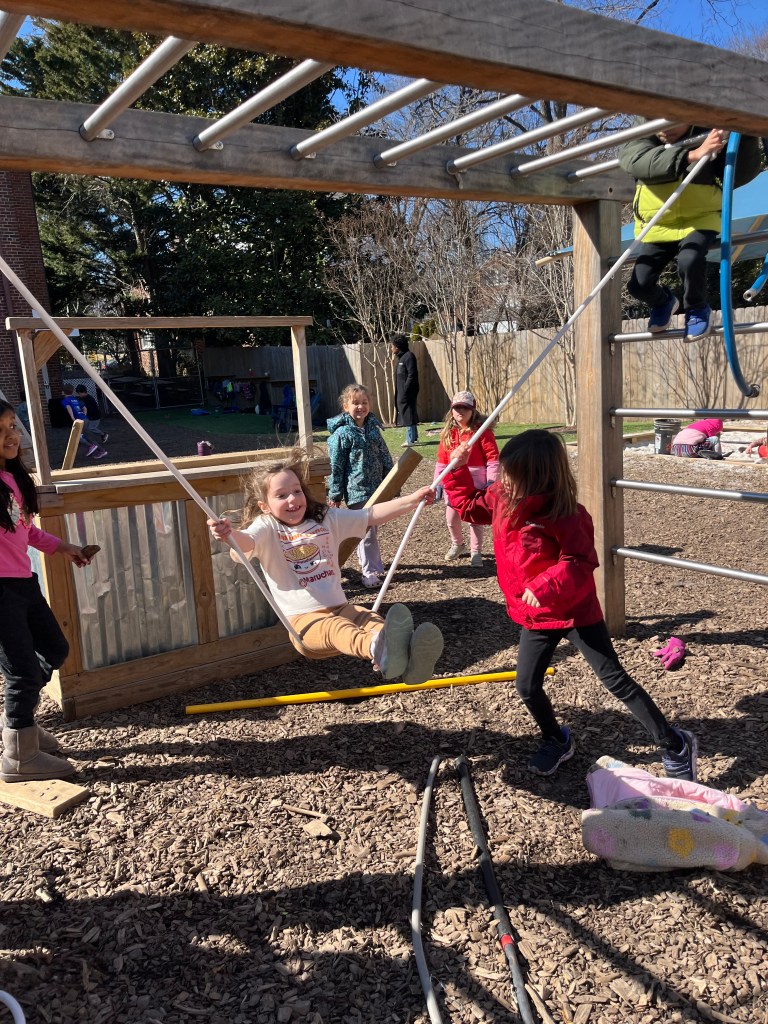
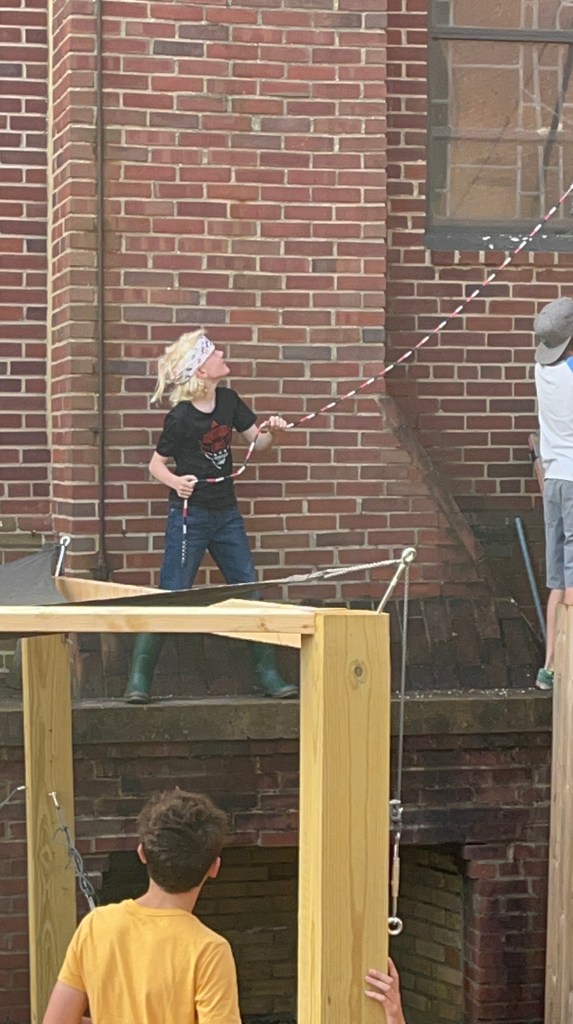
One day they might play a game of kickball, using boards as bases. Another day, they might create an incredible obstacle course using buckets, planks, boards, blocks, tires, and crates. No swing? No problem! Spark learners decided to put an old leaky hose to use. They tied it to the ends of the monkey bars so that one learner could swing while other learners worked to keep it safe and secure.

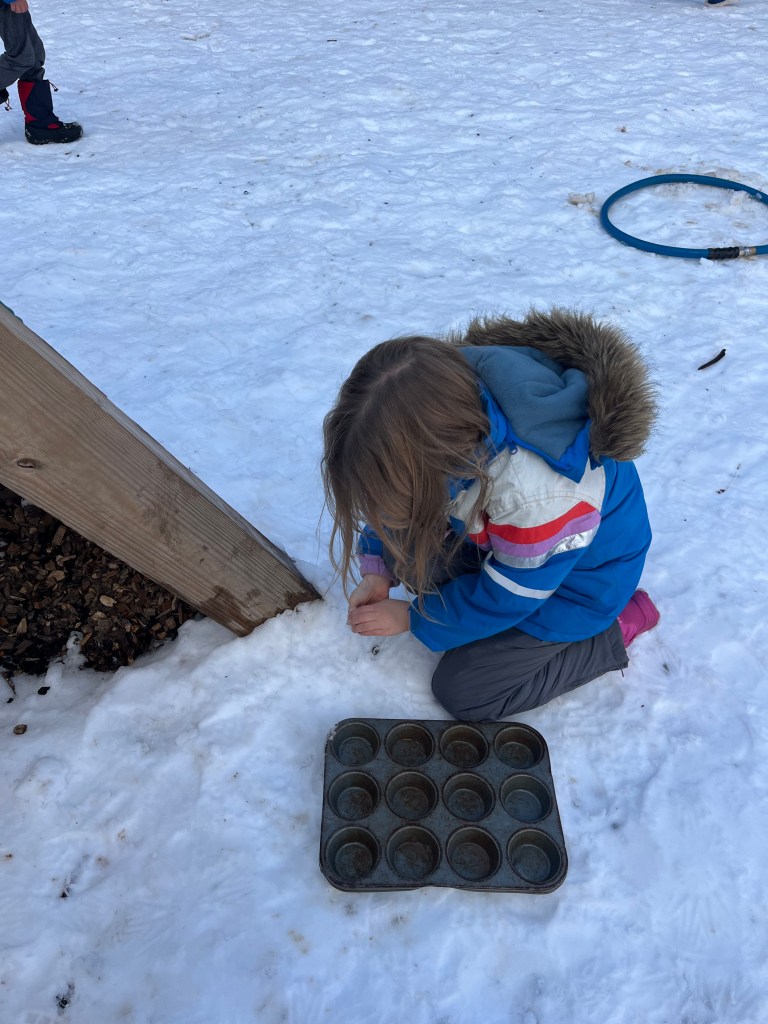
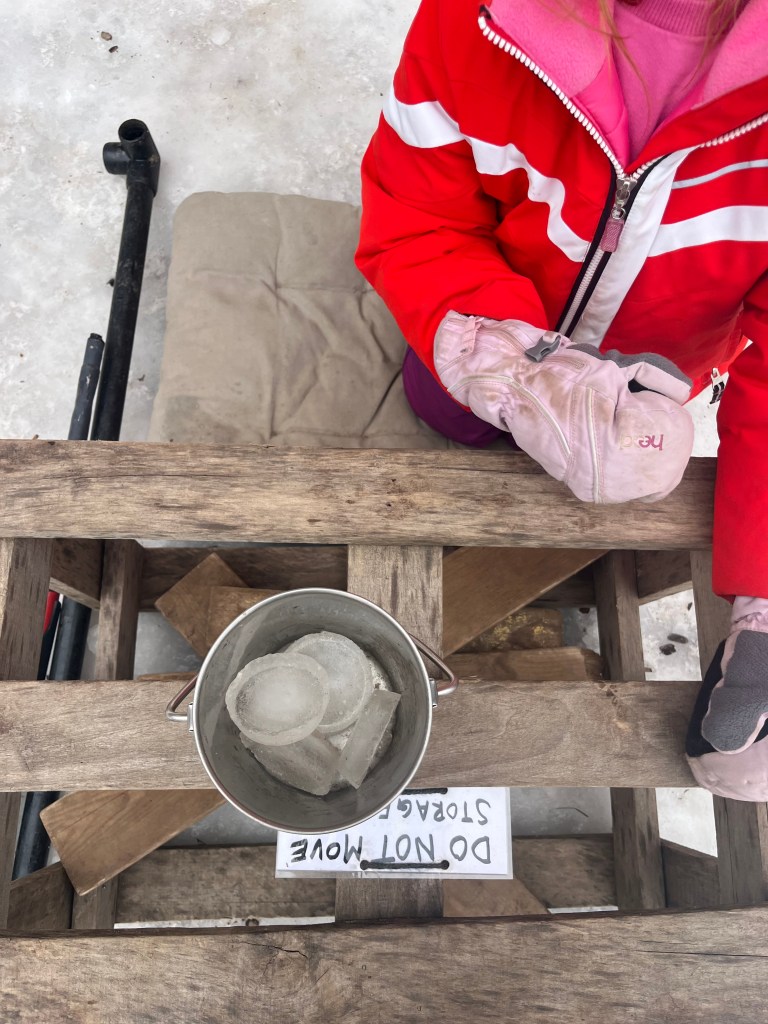
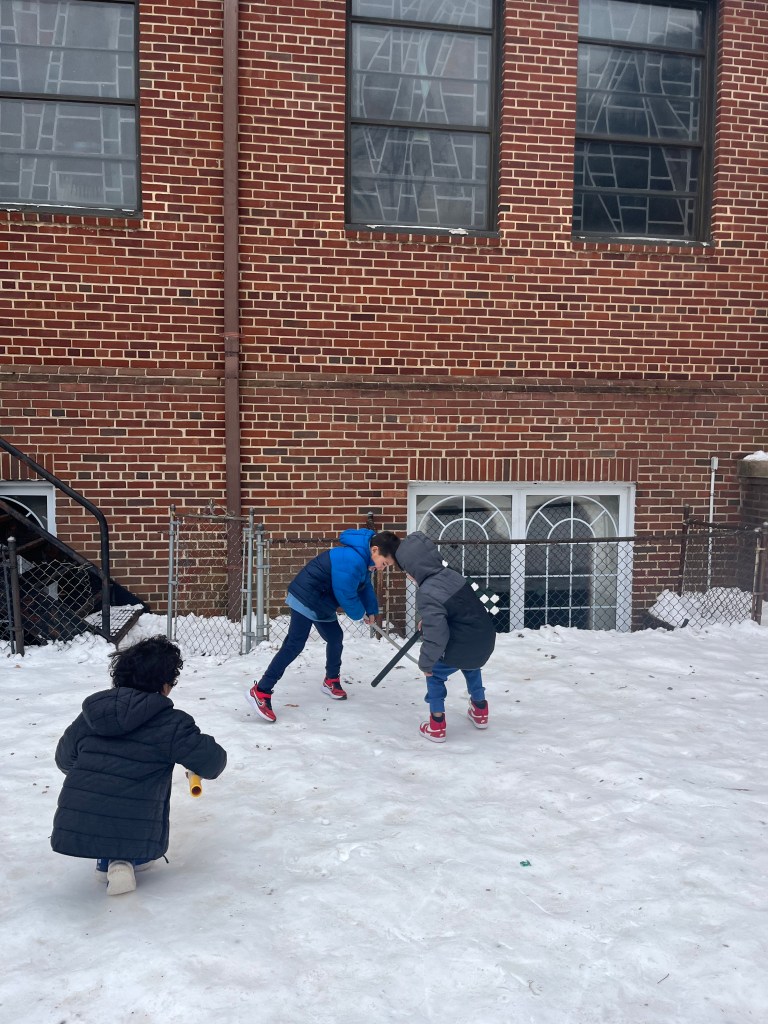
These loose parts on the playground are not just an opportunity for creative play but for learning. During a very cold January, and after some heavy snow, our playground was essentially an ice rink. Some learners discovered that water would freeze if left out long enough in cold temperatures. This inspired these learners to pour water into a muffin tin and freeze it overnight. The next day, they had some incredible “hockey pucks” made of ice! Using some PVC pipe as “hockey sticks,” some learners had a fun game of hockey, all created from loose parts found on the playground. I could share so many stories like this from the seven-short months I have been at TVS. From this time, my eyes have been opened, and I have found a new value of time spent outside.

Prior to working at The Village School, I taught second-grade in a traditional school setting. Each day my students got 25 minutes of recess, but it was never enough time. While my school had a large jungle gym to play on and lots of grass to run on, the 20 minutes served simply as a break, not as a vessel for creativity, imagination, building resiliency, or problem-solving that loose parts play brings. Here at TVS, our learners get about 5x the average amount of play in schools across the country. 

I’m not saying the traditional playground equipment is bad–our learners have big hopes for our playground, like having a swing set or slide. But children are innovative. They are resourceful. They are resilient. We must give them the opportunity and time to do so. 

Each day, a new idea emerges from learners looking at the loose parts in a different way. Each day, I leave The Village School feeling inspired by what I watch these four-, five-, six-, and seven-year-olds do with simple, random objects. My hope is that one day all children have access to this type of playful learning in schools. It is what they deserve.

Rubber Bands

This is a guest blog written by Jackson Rice, a Discovery Studio Learner at The Village School.

Hi, my name is Jackson, I am 11 years old. In this blog I will share a story that changed my life forever, and it might change yours. I am a fifth grader preparing for the transition to middle school. As I look at the values of The Village School, the most important character trait for me is that children can learn from their experiences and mistakes. The reason this stands out to me is because it means children can learn on their own accord and don’t always need someone patrolling over them and telling them they can’t learn that way, as a traditional school would.

The way a learner grows is by expanding their rubber band like a math rubber band or a history rubber band. The way you expand these rubber bands is by doing more of that thing. At The Village School you can work on anything at any time. Let’s say you are not the best at grammar, but you are good at math, you can decide if you want to work on math or grammar and not be forced to do something you already know. At The Village School, you have fantastic mentors and guides who not only teach you but also guide you in the right direction. I am going to share a story about when I had to stretch my rubber bands. 

Earlier this year I was not doing so well on my badge plan, and still had 30 badges left to do. I was nervous that I was not going to move up to sixth grade if things stayed like this. But with one guide meeting, where you meet with a guide and talk about how the year is going, I said I was nervous that I would not move up to middle school. The guide said not to worry, and if I took things one step at a time, I would get to the finish line: middle school. After that guide meeting, I started to look at my badge plan differently. I focused harder on my morning work. I started to work on stuff at home, and soon or not, I was almost done with my badge plan.

I crossed the finish line, and now I can start to work on my sixth-grade work early and get ahead so I won’t fall behind. There were a lot of lessons I learned from this experience, but the most important one was time management. You can do a lot more when you have a plan and know what you’re doing.

During the story I just shared, I stretched a small rubber band to make it bigger, in other words, I learned. Robert F. Kennedy once said “Only those who dare to fail greatly can ever achieve greatly.” This is one of my favorite quotes because it shows that mistakes are just another step to success and stretching your rubber bands is the only way to grow. When you are at The Village School, you will learn life lessons and skills that you would never learn at any other school but The Village School.

A Lesson Learned the Hard Way is Still a Lesson Learned

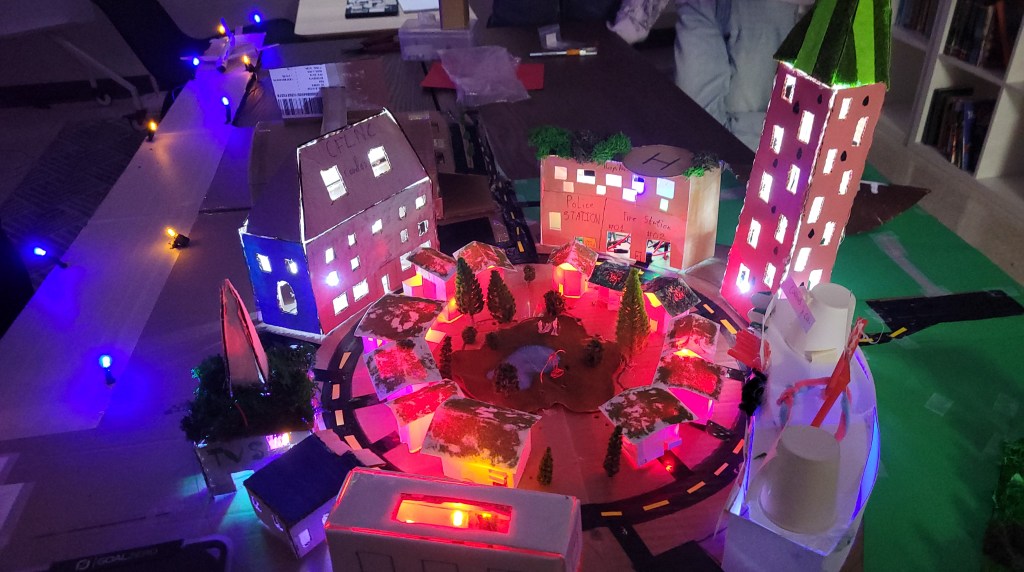
As I’m sure many of you have heard or even seen, Adventure took on an infamous middle school project during Session 4–building and lighting cities for tomorrow. I first heard about the electricity project last school year, when older learners would share memories of the challenge with haunted eyes and faraway expressions. From their recollections, I learned that they found the project to be difficult and frustrating, and in the end, no one earned the project badge. 

When the time finally arrived in our three-year project rotation to take on this same challenge, though some were excited, several of the learners who had heard about the project from graduated learners or older siblings responded with the same emotion: apprehension. To be completely honest, the nervous energy was totally fair. The journey from project launch to exhibition was a tumultuous one–and completely necessary. 

I have developed, prepared, and implemented many projects in my time as a guide. From Building the Team to Chemistry of Candy to Entrepreneurship, each project has offered its own challenges and lessons learned. The electricity project, however, stands out as the most difficult project to not only prepare for, but also observe learners engage with. Let me explain. At the beginning of the session, learners were tasked with creating a fully illuminated city for tomorrow within the timeframe of six weeks. To make this vision a reality, learners were challenged to experiment with different kinds of electrical circuits and circuit components, create team contracts, sketch blueprints of their cities, design and construct full city models, and plan and wire their very own electric grids. 

After the first few tasks, learners expressed excitement and optimism about their projects. Hands were covered in paint, a rainbow of LEDs blanketed the floor, and very few surfaces were left untouched by hot glue. As the exhibition date drew closer, hints of doubt gradually gave way to genuine frustrations. Entire sections of electric grids blew and had to be relit. Breadboards were scorched. Wire after wire came loose and had to be reconnected. For several project periods, the Adventure studio was…tense, to say the least. 

I remember circling up with the learners one afternoon and listening to their frustrations. Some asked if the requirements could be adjusted. Others asked if they could earn the badge even if their cities did not light up at exhibition. It would be dishonest of me to deny that I had also considered these same options. What if no learners earned the badge? What if they all worked so hard to end up with a room full of unlit cities at the end of the session? Was the project too challenging? Should I step in and ease their frustrations, just a little bit? 

Even as an educator who deeply believes learning occurs at the point of challenge, watching a learner struggle is still difficult. Nevertheless, as a guide—a partner on the journey—my role isn’t to remove the obstacle, but to acknowledge its difficulty and support each learner as they find their own way to overcome it. 

In the end, several cities lit up completely, others lit up partially, and some remained in the dark. Some learners earned the badge, some did not, and both outcomes are valued. Although this project was reported by many (if not all) as the most frustrating and challenging, it was also the project where the most learners were passionately engaged in the learning process. As two learners perfectly summarized, “This was the most difficult project I’ve ever done, and the one I learned the most from,” and, “Even if you fail, you should still try your best.”

Real Learning is a Real Messy Poster 

One of the primary jobs of a guide at The Village School is to curate the optimal learning environment. Loris Malaguzzi, the founder of the Reggio Emilia approach famously states “there are three teachers of children, adults, other children, and the environment.”  Those of you familiar with our school know that we are not the type of private school with rolling hills, grand columns, and a school campus that rivals an Ivy league university – we are, in fact, quite the opposite. Regardless of our humble and ordinary campus, we take our space and the artifacts that fill our spaces quite seriously. When people visit our school for the first time and make their way through each of our studios, they always comment on the space, mostly noticing how non-traditional it appears. There are no desks, no clear “front of the classroom”, flexible seating areas, rugs, plants, and learner-curated “walls that talk,” as one of our Discovery Guides describes. 

Creating a reflective environment is one intentional step that is often both overlooked and owned by adults in most classrooms and schools. Using materials, equipment, and decorations that reflect the voices of the learners and the community and culture they are building is arguably the most important role of a guide at The Village School or any learner-centered educational space. 

Close your eyes and imagine your own elementary school classroom, or the typical elementary school classroom as depicted on television or in movies. Keep your eyes closed and imagine yourself walking in the front office, down the hallways, and peeking into a classroom or two. Draw your attention to the walls in these spaces. Most likely, you’ll see carefully curated bulletin boards, perfectly cut out bubble letters, aesthetically pleasing images, all designed by the adult “in charge” of the space. 

Our goal at TVS is the opposite of this – our goal is that the walls of our studios reflect back the voices of our learners rather than the voices of the adults. This purpose and vision permeates our intentional design of the spaces, walls, and the products that our learners create. 

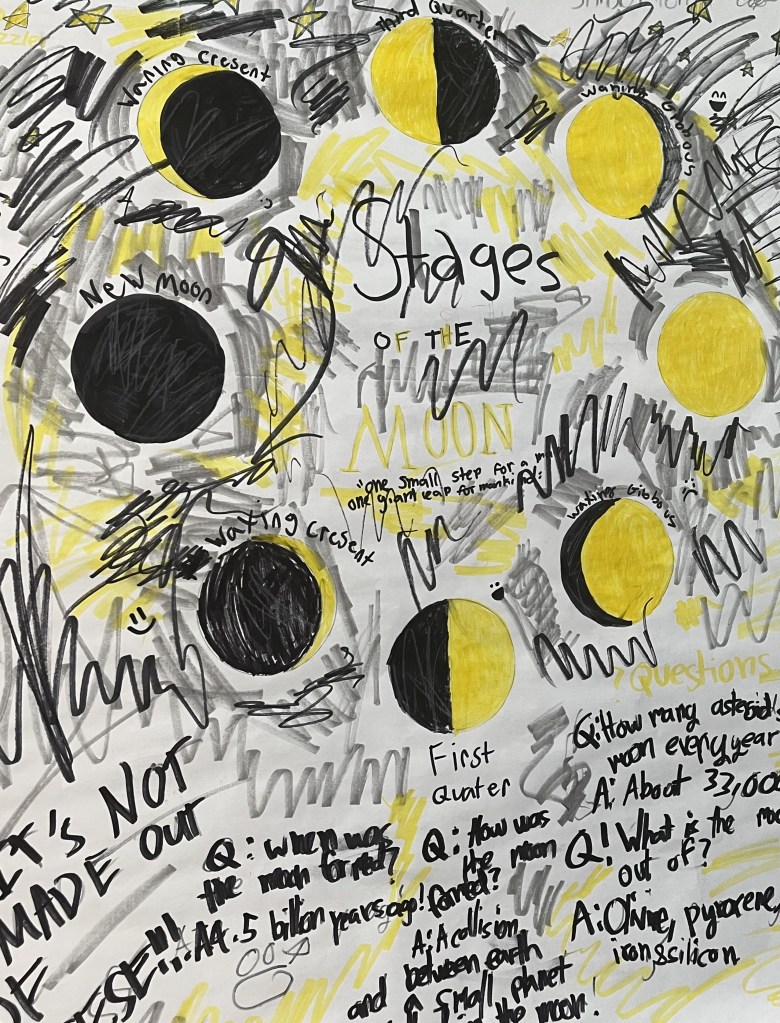
Think back to the last poster you saw your learner working on or the ones you saw lining the tables during the last end-of-session Exhibition. If you’re like me, you viewed them from an adult perspective with a highly critical eye for sloppy cutting and pasting, spelling mistakes, organization, and consistent font (anything but Comic Sans). If you’re like me you notice each place where they crossed things out, erased too hard, or wrote in pencil or yellow marker (why???) instead of a legible color. If you’re like me you wonder why they didn’t plan more before gluing things down. If you’re like me you smile through gritted teeth and force a compliment in the form of “Wow!” 

I used to think a perfectly curated poster was indicative of deep learning. Now I know that the opposite is true: real learning is a real messy poster. As a parent and a TVS guide, my assessment of learning is now reliant on those not-quite-erased pencil marks and the not-quite-glued scraps of paper. The more imperfections, the more likely the poster was created entirely by a young person, and this is the goal. With the exception of a few detail oriented learners, I’m suspicious of any learner-created product that appears too perfect. The Village School is a learner-centered, self-directed school, after all. We purposefully create agentic learning experiences  – including opportunities to create a (messy) poster. At The Village School a messy poster is a meaningful expression, not something that needs straightening or correcting. 

Our goal is that the walls, posters, and any products our learners create to communicate their voice, not ours. A reflective environment is one in which the walls talk – and at TVS it’s the learners who are doing the talking. 

The Myth of Work Hard, Play Hard

Work hard, play hard is a mantra that’s been repeated in our school community for years. Fun can only be had after the hard work is done. As parents, we’ve preached this to our families, too. You want to watch tv? You better do the dishes, first. You want to play with your friends? You better clean that room of yours! Work hard, play hard applies to many situations at school and at home, but should it? 

At The Village School we believe in play. In fact, we believe in Maria Montessori’s belief that “play is the work of the child” so much we label ourselves play-based and we mean it. We pride ourselves on providing all learners, no matter what age, extensive time for free-play, as well as cultivating a playful learning mindset around our academic learning design. At The Village School playing hard is our hard work, not the reward we get after. 

Despite the fact that educators across the country place a high value on more playtime for students, the average elementary age student has access to 25 minutes of free play and middle schoolers only get 15 minutes per day, if any. Project Zero, Harvard Graduate School of Education’s research group supports the high value on more playtime for all young people, and suggests a Pedagogy of Play is a necessity when it comes to both childhood development and deep learning. 

According to their research, Playful learning occurs “when the learning goals of adults and the interests and curiosities of students align.” Playful learning draws on what we know from years of research about the nature of deep learning: Learning is a complex process that involves cognition and emotion. These facts are the underpinning of the learning design at TVS. We rely heavily on experiential learning and work hard not to deliver content, but to create rich learning experiences from which young people will make their own meaning.  

All of this meaning-making occurs in both structured and unstructured environments where learners and adults are co-creating a playful mindset and approach. A “playful” approach to learning is necessary, especially in a learner-centered and self-directed school environment when learning is not linear and surprises occur often. 

These playful surprises happen often across all of our studios. There was The Great Bunny Rescue last year in our Spark Studio, or the Sandbox Situation featured on this back to school blog. One of my personal favorites is the Rescue-Balls-from-the-Roof day. It began towards the end of our hour-long outdoor lunch and recess block in the middle school studio when the last of the remaining kickballs got lodged (with several others) on the roof of the school building. There was still a precious ten minutes left in free time and the middle schoolers were committed to retrieving the ball in an attempt to savor those remaining minutes. I spent the next sixty minutes observing a youth driven pedagogy of play. The entire middle school studio proceeded to work together to create a contraption that was able to reach the roof and successfully retrieve the ball. Yes – we skipped our regularly scheduled afternoon of “work”, and it was worth every second. As I observed, I did what any TVS guide would do: I documented. I took photos and videos which I played back for the learners during the day’s closing circle as I posed the question: Where in these images do you see evidence of our studio values? The learners responded with overwhelming evidence of collaboration, trust, self-direction, and joy. 

We know that valuable learning moments flourish through free, open play. As educators, it’s our responsibility to protect these spaces – especially in a world that increasingly values over-structured experiences for kids. At TVS, play isn’t a reward – it’s the cornerstone of deep learning. We don’t work hard to play hard. At TVS, we simply play hard.

Session 5 Sneak Peek

Spark Studio

Have you ever had an idea for a business or product, but weren’t sure where to start? Spark has too! This session, learners will explore the ins and outs of starting a business. Learners will think about different businesses and products, both that were a success and failure. They will look at what qualities make a successful businessperson before designing their own business, writing out a plan to follow. 

In project time, learners will split into groups where they will decide on a product to sell, list out and purchase materials, and create their business and products. They will get real-world, hands-on experience with a budget to work out how much to charge for their products, how to give change, and even decide what to do with their earnings. 

To conclude the session, learners will become young entrepreneurs in action as they market their products to sell with their business logos and posters for exhibition. 

Discovery Studio

Project

Discovery is T-minus 2 days away from an exciting Launch…literally. This session, Discovery will be setting off as space explorers! In Project, learners will begin by discussing what an Astronaut’s daily life entails. Then, they will research the solar system to create a map and prepare their own trip to space! After exploring stars and constellations, they’ll finally  plan their own lift off by putting their rocket designs to the ultimate test! 5-4-3-2-1, get ready to reach for the stars as Discovery embarks into Astronomy!

Writer’s Workshop

Have you ever sat down and been transported to another world with a nail-biting, thrilling science fiction story? In this session’s Writer’s Workshop, learners will dive into the essentials of sci-fi storytelling, exploring key elements like world-building, futuristic technology, and compelling characters. From there, they will brainstorm imaginative concepts, develop engaging plots, and refine their writing through peer feedback and revision. The best part? They’ll get to share their original sci-fi stories with our fellow learner “editors”! Let’s get ready to write about the future!

Adventure Studio

Curious to know what it takes to design a roller coaster? In our upcoming Project, learners will step into the shoes of engineers, crafting their own marble coasters while diving into the physics of motion! Using everyday materials, they’ll experiment with potential and kinetic energy, acceleration, and Newton’s laws to create loops, drops, and turns that keep their “riders” on track—powered by gravity alone! Stay tuned to see how creativity meets science in this hands-on engineering challenge. 

For Communications this session, learners will step up as trailblazers, using their voices to ignite ideas and spark action in their communities. Through their 10-minute ‘I Have a Dream for My Community’ speeches, they’ll take bold stances, share stories, and propose real-world solutions—proving that leadership isn’t just about having a vision, but about having the courage to stand up and make it happen.Get ready for powerful ideas, courageous voices, and the first steps toward real change! 

Health & Wellness

Have you ever had a moment of embarrassment or feeling incredibly awkward after leaving a conversation and you just relive it over and over again? “Why did I say that?” “I wish I had done that differently!” We all have these moments! This session we will be exploring awkward moments and how to turn them into learning experiences. We will practice social skills such as how to enter and exit a conversation, how to read body language, how to read a room, and how to make a dreaded phone call! Let’s get ready to have some fun with feeling awkward!

Building Innovators through STEM: The Big Challenge

This session, Spark learners have been immersed in STEM (science, technology, engineering, and math). Learners have explored how electricity works, experimented with water solutions to make a bubbly potion, discovered what makes an airplane fly, and learned about how science can save the day. Amidst this deep investigation, the learners eagerly and excitedly accepted the challenge of building a structure to withstand the heaviness of books. 

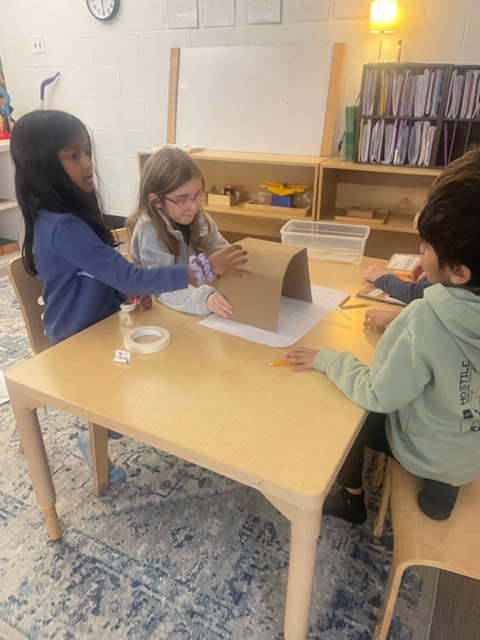
Learners were given cardboard, paper clips, drinking straws, popsicle sticks, and masking tape. Each group set out to brainstorm their bright ideas first within the first five minutes at their places and then began the building process.  Learners asked each other questions, practiced their magnificent math skills to determine height or take something away. They also checked in with their group members to see if they felt progress was being made and confidently questioned whether or not their structure would be able to hold the heaviest weight. 

Learners collaborate to build their structure as a team.

“That’s a great idea. Really good idea”

“Let’s test this.”

This is taller than anything in Spark.”

“We have good news. Nobody has a roof yet.”

“Wait! We have a problem”

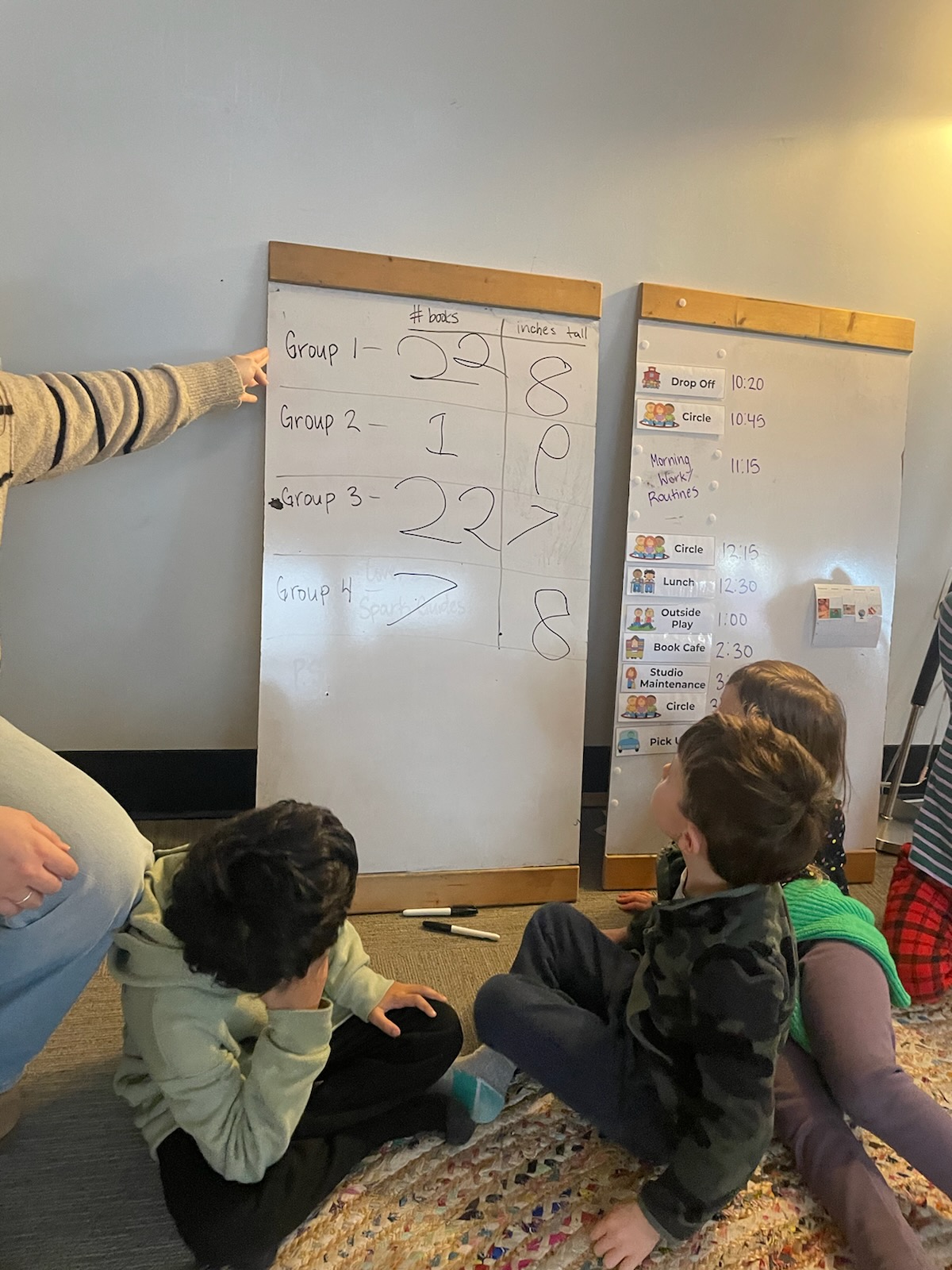
When it was time to test their structures, the excitement and nervous anticipation could be felt within the room. Each groups’ structure height was measured and recorded by a learner before piling books on top. Each time a book was added, the room buzzed with suspense. Was it going to fall or would it stay standing? How many more books could it hold? 

As books kept stacking higher, the energy in the room grew even more intense. Some structures collapsed under pressure, while others stood strong. The real test would come when the final book was added. Out of four groups, there were two groups whose structures defied all odds, withstanding the heaviness of twenty two books.

In the end, no matter whose structure held the most books, every group learned valuable lessons about teamwork and problem-solving. Learners took risks, experimented, and created something amazing. The big challenge wasn’t just about building with materials; it was about curiosity and having confidence in their team. This burst of creativity has the potential to ignite their journey as future innovators.

And who knows? Maybe next time, learners will happily take on any challenge that comes their way!

Learning Occurs at the Point of Challenge

At the heart of all passionate educators is a deep desire to see young people succeed. As an educator (and a parent), I can relate. Watching a student’s eyes light up after a newly found realization is a dopamine hit like no other. It’s probably why I can remember most of the 150 high school students who I had the pleasure of getting to know during my first year of teaching almost 20 years ago. Like so many first year teachers, I spent all of my time considering new ways to support them in their success. Despite the changes the field has endured since my early years, one thing hasn’t changed: the heart of educators. They show up each day because they care so deeply – which is exactly why it is so difficult for them to see their students’ “fail.” 

This desire to help is the Achilles heel of all educators because learning occurs at the point of challenge. I know this to be true from my life experience, but also because Ron Ritchhart said so. Ritchhart and his research at Project Zero, Harvard Graduate School of Education’s Research Group, has been a lightpost for me (and so many others) over my entire career. I was recently at a conference where Ritchhart was a featured speaker and he shared more about how learning and challenge go hand in hand. I couldn’t help but think about how his research focused on teachers and students applied to parents and their children and our TVS belief that failure is essential to learning. 

Ritchhart shares that despite the fact that we can all acknowledge that in order to learn we must face challenges, make mistakes, and even fail, we do all that we can to prevent our students from experiencing those things. I think many parents (myself included) fall into the same trap. Ritchhart offered not one, but eight reasons why we avoid the challenge zone with our students. As you read through the list, replace the word teacher with parent and the word student with child, and notice how many you can identify in your own practice as a parent: 

  1. Teachers don’t see the benefit from learning from mistakes and we aren’t rewarded for them. 
  2. Teachers want all our students to be successful…all of the time.
  3. Teachers fear student frustration. 
  4. Failure of any kind is seen as a negative reflection on us as teachers. 
  5. Teachers are used to procedural explanations and giving good explanations to reduce grappling and increase efficiency. 
  6. The benefits of direct instruction have been oversold. 
  7. Mistakes and challenges feel inefficient and messy. 
  8. Teachers are outcome driven, looking for correctness above all else, so we value products over process. 

If you’re like me, you were nodding your head at just about everyone on that list. Don’t feel too humbled, yet – learning occurs at the point of challenge, remember? All of these resonated with me as I listened through the lens of an educator- but two really stuck out to me when I considered the list through the lens of a parent. 

Number 3: Teachers have a low tolerance for student frustration. I am way more comfortable with other children’s frustrations than the frustrations of my own – mostly because I don’t have the time or patience. (I really hope you’re nodding your head here, and I’m not revealing a deficiency in my parenting because you’ll read more about that in a few paragraphs). Lisa Damour offers a reason for this low tolerance. She claims that being the parent of a tween or teen requires one to be an “emotional garbage can,” there to collect all of the feelings of your child as they learn to deal with, react to, and process their feelings. Lately, I find this to be one of the most challenging aspects of parenthood (specifically when rushing out the door in the morning, or after a long week at work). 

Educational research indicates that educators share this low tolerance for struggle and frustration and often define their role as someone whose job it is to remove discomfort from students. The issue, as Ritchhart points out, is that when teachers remove the challenge (emotional or academic) learned helplessness and low self-esteem ensue. The reality is, that if deep learning is what we are after, discomfort is a prerequisite. Teachers (like parents) need to learn to deal.

Number 4: Failure of any kind is seen as a direct reflection of me as a parent. Is it not? This reminds me of one of our recent parent book club picks, Never Enough, where the author references the immense amount of pressure parents (especially affluent parents) put on their children to be the best at whatever they attempt – all because our children’s success are a direct reflection of us and our ability and competencies as parents. Dr. Becky would call this co-dependence and Krissy Posatek would call this enmeshment, and they both would agree that this is unhealthy and severely misguided. 

Educational researchers also suggest this to be misguided. In fact, several studies have shown that explaining too much or even providing too clear directions can actually be detrimental to learning. Bjork’s research on this topic posits a strong connection between “grappling” and deep learning. In a world that prioritizes ease and convenience, what we actually need to learn is to grapple more, because ease and convenience do not, in fact, improve human performance – or learning. 

Despite our propensity to avoid challenges for both ourselves as parents and for our children, there are some things Ritchhart suggests we do to encourage and support what we are all after: deep and meaningful learning experiences. Most encouraging to me as a TVS parent and guide is that according to the experts, the best way to lean into challenges is to ensure that the decision making power is in the hands of the learner. 

At The Village School our learners are always chasing their “challenge zone” whether it’s a new badge book they are reading or a new math skill they are learning. Guides across all of our studios often lead discussions focused on the challenge zone and learners are well versed in how to identify what is challenging to them, what’s too easy, and what feels too difficult. Our school and studio culture values challenge and failure despite how uncomfortable it might make the adults, because we know the powerful learning that always results. 

What we (the adults) must focus on is building up our tolerance for challenges, recognizing the powerful impact it will have on our kids. Ritchhart suggests that an indicator of an educator’s effectiveness should not be how many students in the classroom are “succeeding” but rather how many learners are encountering a struggle, because this is an indicator that deep learning is happening. As a parent, I’m going to work on my tolerance for this. The next time one of my kids is grappling with what to pack for lunch or how to divide fractions I’m going to do my best to resist the urge to remove the challenge and instead lean in (while hiding from them in the bathroom).  

Building the Root System

Recently, I had the privilege of visiting a local preschool to deliver a workshop to parents about the importance of play. As I shared a vulnerable story about my own child and her journey to rediscover herself through play, it occurred to me how often this is the story of our learners at The Village School and how rare and unique our little school truly is. 

In a previous blog post, We Choose Dirt, I shared about how unstructured play is an essential component to our learning design. This uninterrupted free play experience allows our learners to explore their imaginations, take risks, deeply engage with their peers, and as Jonathan Haidt shares in The Anxious Generation, allows them to grow their root system – their ability to deal with the unpredictable challenges that life inevitably will bring their way. He refers to these challenges as “the wind” that pushes the trees, enabling them to build a strong root system.

In Spark Studio, I have seen this root system being built during outdoor play in the recent fascination with obstacle courses. Each day, the learners have worked together to create taller towers, more challenging road blocks, and much bigger gaps to jump from section to section. The other guides and I often catch ourselves holding our breath as we watch the learners try out their next challenge. After they make a big jump, the learners chant “YES!” and “I did it!” The guides and I all find ourselves finally exhaling and chanting quietly “the wind, the wind, the wind”. It is hard to watch our children do things that may seem “dangerous” or “risky” but in these moments, it is important that we remind ourselves of safe risk and the self-confidence that can be built when we let go and let them grow their roots. 

In Discovery Studio, I have observed their growth through a different lens. In Health and Wellness, we have been exploring conflict resolution. This has been a popular topic in the past because we often engage in role play, playing out what conflict looks like and analyzing how fictional characters could stand up for themselves, find a compromise, and make amends. The real work for Discovery learners comes out in play, once they leave the safety of fictional characters, and spend the next 2 hours engaged in unstructured play. 

As I wander the park, observing learners with their peers, conflict inevitably arises. I’ll hear something like “you always do this!” or “you never let me play!” As an adult and a highly empathetic human, these words tug at my heart. My instincts are to jump in and remove any hurt that could possibly take place. It is in these moments that I have to remind myself that if we rescue our learners from any conflict that could be hurtful, they will never grow their root system for dealing with conflict later in life. As the adult and guide, I walk alongside them, listen and support our learners with navigating conflict with their peers. As a guide, my  role is to take a step back and support, allowing our learners to use their language to work through conflict. We cannot rescue them from the hurt but we can give our learners the tools to handle the hurt. We cannot give our learners self-confidence and resilience but we can curate an environment where these life-long essential skills can flourish. 

Adventure Studio brings a whole different level of uncomfortability in building a strong root system. As a guide, I find my role constantly challenged as the studio ebbs and flows through challenging life experiences. Recently, we all embarked on the Billy Goat trail. The guides and I scoured the internet looking for whether the trail would be safe after the ice and snow leftover from our most recent winter storm. When we couldn’t find a solid answer, we all found ourselves thinking – we can do this, they can do this, we will all be together and it will be okay! As we started our hike, it was indeed one big ice sheet. We all found ourselves looking at each other, knowing what each of us was thinking – can we really do this? We all took it one step at a time. There were many falls, slips, and  catches from fellow peers. At one point, myself and another learner even found ourselves off the path, stuck between two big boulders. Three learners immediately came to our rescue and guided us down. They beamed for the rest of the journey, chanting to the rest of the group “We just saved Ms. Bridget!”

Later on in the hike, we had to work together to climb up to the top of a rocky slope. The phrases, “you can do it!”, “you’ve got this!”, “I’ve got you”, and “I won’t let you fall” were countless. Every single learner and guide helped each other to reach our destination. Many of the learners were scared but when we all reached the top together, the looks of pride and accomplishment were heartwarming. 

The next time your learner takes a risk and you find yourself holding your breath, breathe out and chant to yourself “the wind, the wind, the wind” and know that you are supporting your learner with building a strong root system that will support them with whatever life brings their way.