The Sounds of Expression in Discovery Studio: Learners use their Voice

For this week’s blog post, I was inspired by the podcasting Writer’s Workshop the learners in Discovery Studio have been working on this session. You can listen to the podcast and read the transcript below.

1, 2, 3. Testing, testing, testing.

 If you were to walk through the halls of Discovery Studio, you would hear a lot of sounds. You might hear the voices of learners with their project groups, heads bent toward each other, collaborating and exchanging ideas. Or maybe you’d hear the sounds of feet padding through the hallway as learners find their focus area to work in the studio. You might hear learners engaging in thought provoking discussion while they sit in a circle, providing their input and listening to others’ perspectives in launch. You’ll likely hear a little laughter, or the tapping of computer keys as a learner focuses on morning work.

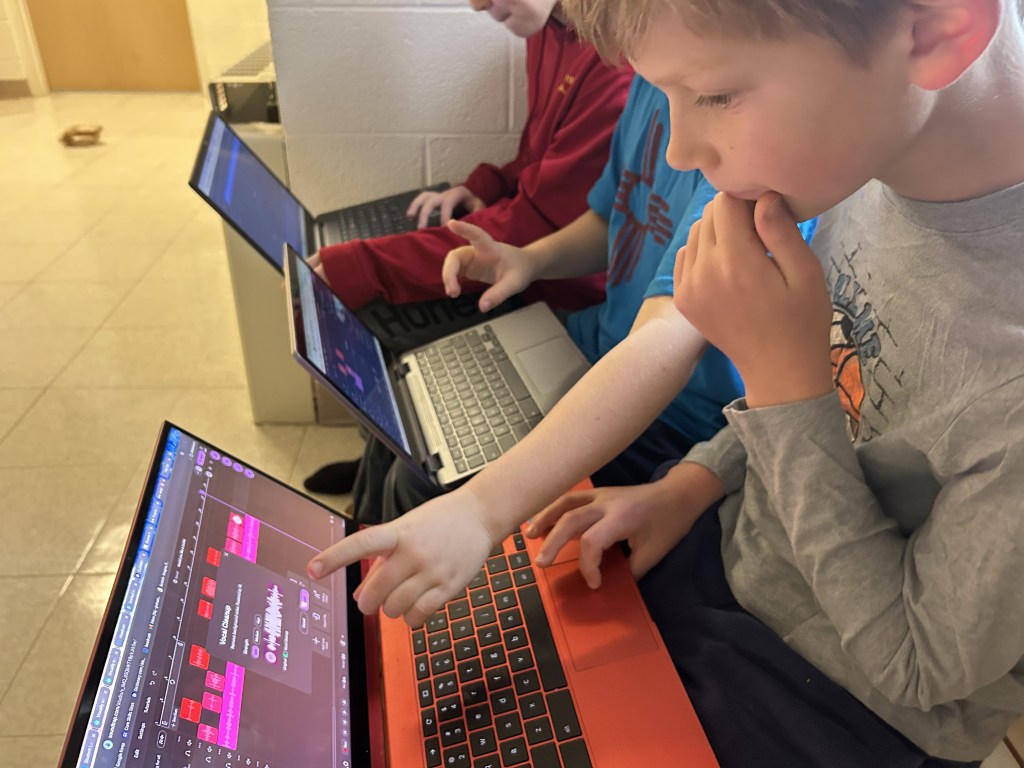
 Lately, you might hear something like what you heard earlier, or the sound of learners talking into their computer microphones as they have begun recording their own podcasts in this session’s writer’s workshop, which inspired me to create a podcast for this blog post. With these podcasts, learners are given an opportunity to share their thoughts, stories, and experiences with their peers and with our greater community. All while honing their communication skills.

It’s amazing to see how they dive into the editing process, carefully crafting their message and adding personal flair to each episode. From hard hitting debates to a deep dive into their town, to informative podcasts about things like Mount Rushmore, learners explore and share their own interests and passions in a new, creative way. 

Through this podcasting project, learners not only develop new skills in interviewing experts, recording and editing, but they also build a deeper sense of confidence and self awareness. They learn to share their voice. It’s truly incredible to witness how the learners can come together to create something that reflects their individual creativity and uses their voice to share their stories.

The podcasting Writer’s Workshop is just one of many avenues a learner can use to express themselves at The Village School. I asked one learner to tell me if he feels he has opportunities to showcase his individuality at school. 

Yeah. I do because we get to choose our own work, and, like, we get to hold each other accountable. And, yeah, it’s it’s nice to be able to choose what you work on. And I feel like also we can express ourselves when we’re working together or doing creative projects. 

Beyond Project and Writer’s Workshop, there are endless options for learners to use their voice and express their individuality. I asked two learners about some of the ways they get to be creative at The Village School.

Oh, Art! Art! Art and the Makerspace! 

Yeah. Makerspace! 

Yeah. They’re always, like, places that, like, that, like, you can express your creativity. They’re something fun. You don’t have to do them, but they’re fun. 

I like expressing my creativity in, like, art, and I like sewing. And I also, like building stuff. 

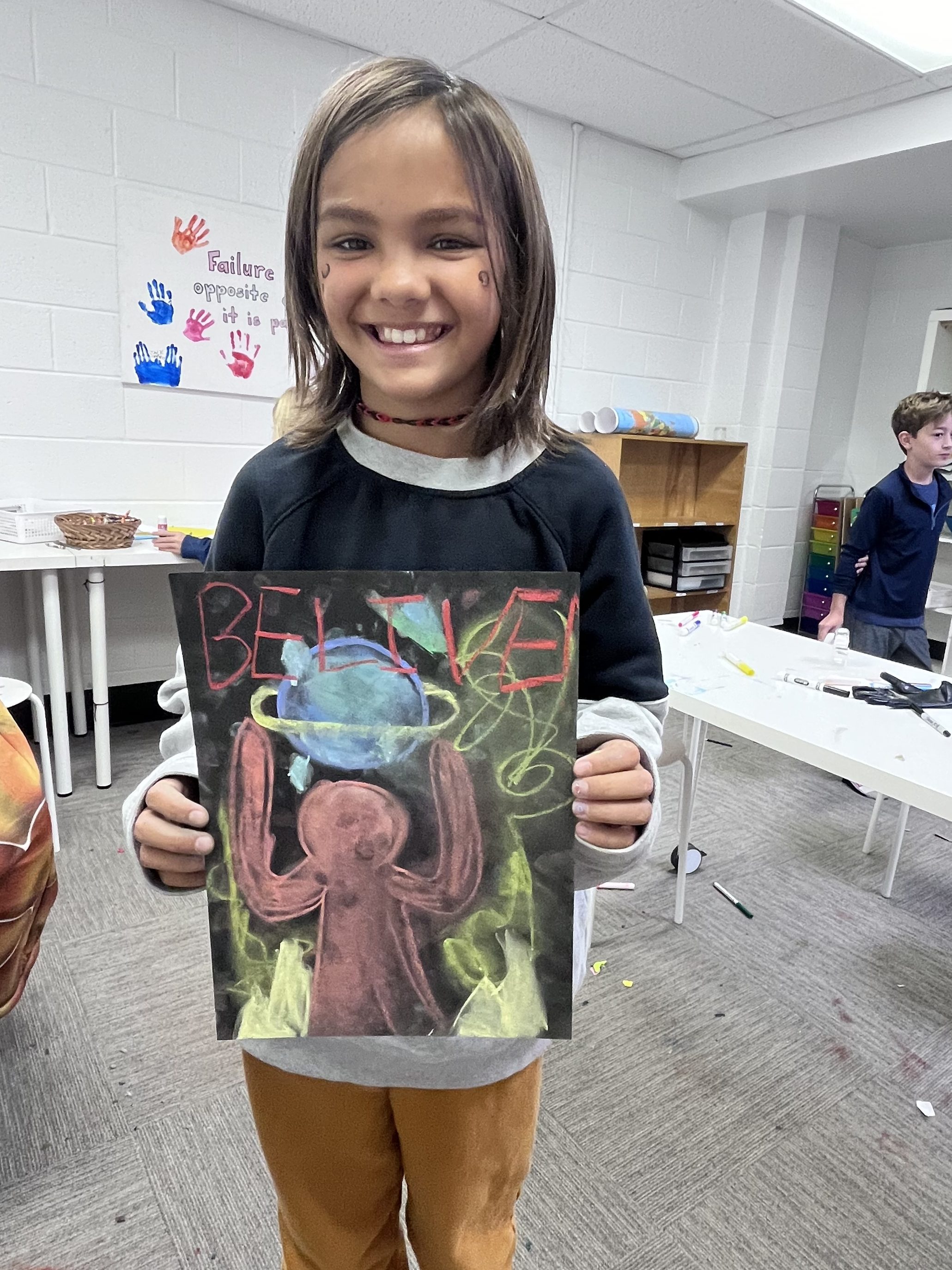
Fridays provide dedicated time for learners to engage in creative expression.On Fridays, the sounds of expression in Discovery Studio really come to life. You may hear music coming from the project room, or even maybe my voice asking learners about what they are creating in art. During this time, learners create open ended art projects that give them space to express their emotions, ideas, and creativity without constraints. As one learner describes. 

 I really like art because like whenever you do it… There’s no rules to do art!

On Fridays, you might also hear the sound of sewing machines, 3D printers, or tinkering with tools coming from the Makerspace. A dedicated space created by learners for learners to let their creativity run wild and learn about engineering and design. 

Like, that’s just, like, all your own choice. Like, you well, other than, like because we have, like, a project and then you can kinda, like, go wild, make, like, what kinda resembles you. And during the Makerspace, you have, like, a lot of of resources that you can use and a lot of, like, ideas, and you can just really do anything. 
I asked a few learners about being creative and how they display their individuality at school. Several expressed to me that their different projects they’ve worked on here at the village school, they have been able to grow in their ability to express themselves creatively and confidently.

But, I never knew that I like really talking to people because I used to be a shy kid… And now I really like talking to people. 

This learner described her experience before coming to The Village School. 

I learned, but I didn’t learn about my passions. And I wasn’t like a leader. I wasn’t a trailblazer. 

But this learner would now describe herself as a trailblazer and a leader. And has found creative passions. And would even now say this. 

I really I like talking to people. Like, talking to people. 

You were the main talker! Whenever I was in your group and you were the main talker!

Yeah. I really like talking to people!

I asked this learner why she thinks The Village School has helped foster this ability to confidently express herself.

Here, they think of you as a learner who has passions that they want to let you go and to pursue, and yeah.

 Another learner told me about some nervousness she had around public speaking. But she described the practice she’s gotten throughout projects and the confidence she’s gained in self expression during her time at The Village School.

 I still – I still felt like I got over that fear because I’m not as scared anymore.

Another sound you might hear on a Friday is learners working on their passion projects, which will each sound vastly different from one learner to another. This session, there have been some exceptionally creative passion projects, as one learner describes. 

Passion projects, always, you can go creative. You can go all out on them. 

The same learner who described how she used to be shy and the learner who said she was previously nervous around public speaking have been working on a passion project this session where they’re directing their own play. They’ve been holding auditions where their fellow learners perform monologues. They’re choreographing dances, and will soon begin rehearsals and are considering costume design. 

Other learners were inspired by using the software we use to record podcasts and have begun creating their own music and beats. Where even when lyrics are not included, they get to showcase a part of themselves. 

Well, I feel like during making the song, when we, like, add different parts, it kinda maybe shows our personality. Yeah. Through what kind like, what it is.

It became clear to me in my interviews that the learners here deeply value the opportunities for creative expression and their ability to showcase their individual interests and talents or even to try a new creative endeavor. 

I think I love it because expressing myself is a thing that needs to, like, be happen because you need to learn about yourself a lot. Because then you can, like, really know what’s your hobbies and what you like. Yeah. 

That idea of learning about themselves was echoed by other learners.

TVS also lets us, like, do things that normal school wouldn’t let us do and let us express ourselves and our passions in different ways. In the makerspace, you can use a sewing machine, and maybe you find a new passion doing that. Maybe you want to sew more. Maybe that’s how you end up being a tailor or something like that. 

Fashionista!

Or something like that. 

That learner, who once described herself as shy, explained what it means to her to be able to express herself and learn to use her voice. 

You have to be brave. You have to, like, put yourself out there. You have to, like, you know, let them hear your voice or else no one will ever hear your voice.

The sounds of Discovery Studio are more than just background noise. They represent the diverse ways in which our learners are exploring and expressing their creativity. From podcasts to art, from passion projects to tinkering in the Makerspace, learners at The Village School are developing not only new skills, but also the confidence to use their voices in meaningful ways. Whether they’re sharing a story, building something from scratch, or creating art, each sound is a testament to their growth, their individuality, and their endless potential. Here, every voice is valued and every learner has the opportunity to let their creativity soar.

The Art of Studio Maintenance

Learning is messy—both metaphorically and literally. Walk into any studio at almost any time of day, and what you might first perceive as chaos tells a deeper story. Scattered art materials, stacks of books, laptops tangled with cords, snacks, and heaps of paper all reflect the learning happening daily. A cluster of laptops on a table signals collaboration. A pile of markers and cardboard reveals creativity in progress. A mountain of pillows holds the remnants of worlds visited during DEAR. Learning is messy, and that’s a good thing.  

The Village School model embraces this kind of messy learning, which makes one daily ritual indispensable: studio maintenance. During studio maintenance, learners team up to clean their shared space, ensuring it is ready to welcome everyone the next morning. While the process varies by studio, the goal remains the same: fostering a sense of responsibility, teamwork, and care for the community space. Along the way, learners practice practical life skills—cleaning, cooperation, communication, teamwork, and advocacy.  

For example, in Adventure this session, learners formed their own studio maintenance groups rather than being assigned. Unsurprisingly, they chose to team up with close friends. This decision gave learners the opportunity to hold not just their peers accountable but their close friends, too—a skill that is often one of the most challenging to master in middle school.  

Studio Maintenance in Spark  

In Spark Studio, guides often incorporate games to make cleaning up fun and engaging. One favorite is looking for “magic trash”—hidden pieces of trash lurking in sneaky places around the studio—or playing “I Spy.” For example, a guide might say, “I spy something shiny under a table!” and learners excitedly search for the hidden clutter. At other times, learners gather on a rug while guides read aloud a list of tasks that need to be completed. Each learner picks their task and together transform the studio into a spotless space.

Studio Maintenance in Discovery  

In Discovery Studio, learners work in groups, with each group assigned a specific space (e.g., the math room) to clean. After completing their assigned tasks, learners get the green light from a studio maintenance champion, the space is closed, and the group moves on to assist another team. This cycle repeats until the entire studio is spotless. Cleaning zones rotate each session.

Studio Maintenance in Adventure  

In Adventure Studio, learners also clean in rotating groups assigned to specific zones. Each zone has a checklist of tasks, and group members decide who will handle each job for the week. At the end of studio maintenance, one or two learners assess the zones and note any areas needing further attention. These remaining tasks are read aloud during Close, and learners finish them before joining free time outside.  

In a typical school setting, cleaning is usually left to the adults–the teacher, the janitor, the parent volunteer. Like so many parts of our learning model, allotting time and space for cleaning up after yourself is intentional, by design, and character-building. Studio Maintenance is more than a collection of chores; it’s a chance for learners to build agency, embrace shared responsibility, and develop essential life skills. As written in each studio’s contract, learners commit to taking ownership of their space–not just for cleanliness, but to nurture a thriving learning community. 

Taking Responsibility for Your Own Education

Have you ever had the feeling of awe while watching your child? Not pride or fulfillment or joy, but awe. Dashner Keltner describes awe as the feeling you get in the presence of something vast that changes your understanding of the world as you know it, like looking up at a sky full of stars or a first glimpse of the Grand Canyon. 

As a parent at The Village School for the past five years I’ve felt a lot of emotions: frustration, worry, pride, gratitude – and I’ve learned to lean into all of them. Each emotion is a vital part of parenthood, and  especially important during the parenting of a self-directed learner. I’ve also had the privilege of experiencing awe based on the learning experiences that my own children and others have as learners at TVS. These moments occur in all the expected spaces like the end of year Character Rock Ceremony, or the middle school I have a dream speeches, but my favorite experience of awe are the experiences that sneak up on you when you’re least expecting and create the kind of awe Kelter summons and changes the way you see the world. 

One of those moments happened just a few weeks ago when my 9 year old daughter tearfully shared a fear that she would never be able to memorize multiplication facts. Thankfully, I had some patience left in my tank from the day. I gave her a hug, affirmed her feelings, and asked if she had any ideas for how to overcome this worthy challenge. After a little back and forth, I showed her a strategy other TVS learners have used – a menu of online courses including some on multiplication. After several minutes of doing her own research, she called me over to show me a three night class that started that night. Fifteen minutes later she was live on a zoom class with a teacher and seven other 9 year olds. 

For the next three nights my husband, her sister, and I sat in the other room eavesdropping and meeting each other’s knowing gaze each time we witnessed her participation. The learner who was in tears afraid of the multiplication challenge was zoned in, engaged, raising her hand, participating on a zoom class (something she had never experienced before), getting questions right, getting questions wrong, asking for explanations and clarifications, and even completing “homework” in the traditional sense. Each night the class was just over an hour and she was locked in the entire time. 

Towards the end of the third and final class the three of us eavesdroppers looked at each other in awe. The determination to take responsibility for her own education and her belief in herself that she could do it was a moment of full of wonder for us – it didn’t matter if she learned any multiplication, what mattered was her ability to set a goal, follow through, and face a fear.

Taking responsibility for your own education is a throughline of The Village School experience. At the beginning of each year learners in all studios sign a contract that lists the promises they make to themselves and each other with the goal of creating and maintaining a healthy community. A line on each contract reads: I promise to take responsibility for my own education

Most parents share that this feels like a huge relief, and I agree. On the surface, I’m relieved to have one less thing to add to my never-ending to-do list, or maybe I’m just excited to add something to my list that I can immediately check off (if you know, you know). Short-term relief to my mental load as a parent is always a win, but when I think more about what the promise my kids and the other learners at The Village School make to themselves, I’m more curious than relieved. The recent experience of my 9 year old demanding to take an online class to help her with math is a tangible example – but my curiosity persists. How do other parents recognize it happening? What does it mean to other families – and what does it mean to the learners? Really, I’m mostly curious about what the young people themselves think about this promise. Forget what it means to me and the other adults, but what does taking responsibility for their own education mean to them? So, I did the obvious, and I asked them. 

Here are some of their responses: 

It means to be helpful and use kind words. age 7

To always make sure that you’re working hard. – age 10

It means to hold yourself accountable and look out for others, too. – age 9

Be ready to learn and keep track of your goals. – age 7

Finding a place to focus and find flow. – age 8

We take responsibility for our own education because we get to choose what we are working on and it’s up to us to not get distracted or distract others.  age 10 

I get to choose what I want to do and take my own time to finish it. – age 11

As expected, the learners’ were able to articulate their experience better than me. I posed the same question to our team of guides: What does it look like when a learner is taking responsibility for their own education in your studio? The discussion that followed was rich with examples of young people, but one story really stuck with me. 

A guide shared that during a routine guide meeting with a sixth grader, she noticed that despite completing a unit on Khan academy several weeks prior, the learner had yet to begin the next unit. Curious about why this might be the case, the guide inquired. The learner gave a knowing sigh and shared “Ah, yes. I haven’t moved on to the next unit because even though I mastered the percentage unit on Khan, I don’t feel like I have a deep enough understanding of percentages and how they work. I don’t want to move on until I understand it better. I think percentages are important in life and I want to really get it right.” The guide asked if the learner had any ideas about how to gain the deeper understanding she so desired. The learner shared a thoughtful plan that involved more practice and promised to follow up in a few weeks – once she felt more confident in her ability and understanding. Can you think of a time in your sixth grade life that you had this perspective on your school work? If you’re like me the answer is a definite nope. Never, ever. This is what taking responsibility for your own education looks like. 

As a parent (and a guide) taking responsibility for your own education means more than the relief of one less adult responsibility. The promise represents a manifestation of the value and trust that I have in my own kids. It communicates that they don’t need me to accomplish their goals – they can set goals and reach them on their own. Of course I’m here to cheer them on, support them, and guide them, but ultimately, it’s their responsibility. At The Village School taking responsibility for your own education is not just a concept, it’s a daily practice that when reflected upon can change one’s view of the world and activate a sense of awe. 

The Power of Collaboration

“I really liked all of the teamwork and the song”

Have you ever wondered how collaboration can foster engagement? Spark Studio is learning to show us how it works. Spark learners came together this past session to explore how their thoughts and ideas can transform into something bigger and better. Through teamwork during project time and throughout the day, they discovered the power of collaboration. This collaboration led to amazing creativity and their ability to problem-solve while letting all voices be heard.

Learners could see firsthand how communication helped play an important role in the planning process. Building off of each other’s strengths, learners excitedly drafted lyrics to inspire a growth mindset in those who hear their song. But it wasn’t made without conflict. Learners shared about disagreements that arose when writing out their song and how they learned to collaborate and put ideas together to make something beautiful. 

“teamwork makes the dream work”

“working together made me feel happy”

“you get things done faster because there’s more people”

This led to deeper connections between the learners and it transpired throughout the studio more and more each day. The engagement of the learners soared to new heights as they were motivated to speak more freely during discussions and advocate for themselves. This collaboration blossomed into acts of kindness and respect shown in the studio.

The magic of teamwork in Spark is evident as they proudly showcased their final result at Exhibition in front of our supportive community. As collaboration continues to grow in Spark, learners are proudly stepping up to take ownership of their learning. It’s remarkable to see the enthusiasm among the learners as they challenge themselves in their work and daily choices.

It’s teamwork in action that makes all the difference!

Session 4 Sneak Peek

Spark Studio

In this session, Spark learners will discover how Science, Technology, Engineering, and Math can be used to invent new things to solve real world problems. Learners will explore their wonders about inventions, such as “how does flying work?”. Learners will read and learn about historical figures in STEM and how they solved problems. They will get hands-on experience through science experiments and projects. By the end of session 4, learners will become an inventor themselves!

Discovery Studio

In this session’s Project, Discovery learners will explore how nature’s clever solutions can inspire new ideas to solve everyday problems. From buildings to technology, learners will discover how designs in nature have led to creative inventions around the world. They will also have the opportunity to dive into storytelling by creating their own podcasts, sharing their ideas and using their voice in a powerful way! 

Ever wondered what goes into making a podcast? In this session’s Writer’s Workshop, learners will dive into the essentials of podcasting, exploring different podcast formats and discovering what makes a podcast truly engaging. From there, they  will select a topic, conduct interviews, write compelling scripts, and perfect their editing skills to produce their very own episodes. The best part? They’ll get to share finished podcasts with our TVS community who’s eager to listen! Let’s get ready to hit “record”!

Adventure Studio

This session for Project, learners will design cities for tomorrow with working electric grids. Working in teams, they’ll explore electrical circuits, energy transformation, and sustainability. From simple circuits to complex grids, they’ll combine creativity and science to tackle big questions about innovation, functionality, and environmental responsibility in city design.  

Learners will also step into the world of science fiction by crafting their own original stories. Through discussions, text analysis, and peer feedback, they’ll explore what makes the genre unique and bring their ideas to life! This Communications challenge culminates in the sharing of their imaginative creations with the community.

Health & Wellness

The overarching theme for session 4 will be “Building Bridges”. All learners will be expanding upon conflict resolution strategies that we utilize everyday. Our Spark learners will be exploring what it means to have an argument with a friend, what it feels like, and how we can handle hurting our friend’s feelings. In Discovery, we will explore what it means to be a bridge builder. The learners will practice perspective taking, how they can benefit from different points of view, and how to repair relationships after conflict. In Adventure Studio, we will analyze our mindsets around conflict. Conflict can be an opportunity for change, growth, and transformation. The learners will analyze how they handle conflict and areas where they want to grow.

The Folds of Truth & Beauty

I’m drawn to bookshelves. Library bookshelves are fine, but I’m really more interested in the personal ones, the bookshelves in someone’s home. I’m drawn to them because of what they might reveal about the curator. What are the contents? How are they organized? What is the significance of the small treasures that are nestled between the spines? I’m drawn to the neverending stories hidden within the pages and the shelves. 

Recently my family and I spent the weekend at a rental house near our favorite lake a few hours north. The house was nestled right along the shore, but I didn’t choose it for the location – secretly, I was drawn to the bookshelves. The images of the house online included a few artistic shots of a bookshelf I couldn’t resist. Upon arrival, I dropped my luggage in the entryway in search of the shelves. I stood in awe before the floor to ceiling wall of well-loved and worn-in bookshelves glowing under two bright red spotlights just like the image online. So many books and stories to uncover. I carefully took in each shelf: a few familiar titles, some classics, one too many books about psychology, and more than a few New York Times bestsellers. In the corner of the bottom shelf, slid tightly between an illustrated version of Harry Potter and a neighborhood association handbook was a thinly bound book titled, “Origami for Beginners.” Further down on the shelf was a retro tin lunch box filled to the brim with origami paper – a lakeside vacation windfall.

Like any good parent, I suppressed my urge to share my discovery and excitement and left the book and materials nonchalantly on the kitchen table hoping one of the kids would see the possibilities and take the bait. (Thanks, mom for the expert parenting move). Hook, line, and sinker, it wasn’t long before the scene I hoped for was a reality. Origami paper was strewn all across the kitchen table, followed by mornings full of folding jumping frogs and one particularly rainy afternoon folding hearts and puppies. Our foray into folding reminded me that origami is not for the faint of heart. Following the written instructions is like solving a challenging math problem. You’re forced to sit in the confusion staring at the same seemingly simple instructions and folding and unfolding your paper until something clicks. Until things click the instructions stare back at you, and the longer you stare, the more it feels like they might be mocking you. 

Like many artforms, origami has a hazy history. Some claim its origin was Japan, others China, and some claim a German educator, Frederick Froebel gets credit for perfecting the art of paper folding. Froebel is also credited for inventing the idea of Kindergarten, with origami as an essential part of the curriculum. Froebelian Folding, as it became known, claims three different types of folds are essential to the art of origami: the folds of life, the folds of beauty, and the folds of truth. 

The final morning at the lake, I sipped my coffee staring out over the purple jumping frogs, orange puppies, and pink and red origami hearts that filled the kitchen table. I couldn’t help but think about the folds of a single pink origami paper crane that sits in a prominent spot on the well-loved bookshelf in my own house. 

That pink crane came to life because of The Village School onboarding challenge during the summer of 2020. I can still remember sitting down with my seven year old daughter as she clumsily folded the paper and looked with frustration at the google slide instructions. The challenge involved folding multiple paper cranes and noticing how each crane was (hopefully) an improvement from the previous. The lesson was less about cranes and more about growth mindset. 

It wasn’t until that quiet morning at the lake surrounded by origami that I made the connection that her pink paper crane still lived – on our bookshelf. I assure you that keeping the crane was not intentional at first, but like many things, the longer something sticks around the harder it is to release. Over the years the crane has flown from shelf to shelf, been found in the bottom of the kitchen junk drawer, and was once even rescued from the slobbery mouth of our golden retriever – a little wet, but still intact. Enough time has passed that I’ve grown attached to her.  

When I brush my own hands along her edges and folds I feel that kind of bittersweet longing parents feel as children grow. I imagine her six year old hands brushing over those same folds, and now I will save this pink paper crane for life. When you come to our house and are drawn to our bookshelf, you’ll see the perfectly imperfect pink paper crane prominently displayed. Every once in a while when I walk past, I gently pick her up and wonder if these are the folds of life, the folds of beauty, and the folds of truth that Froebel had in mind. 

As we close out this calendar year, I’m reminded that like origami, life is a series of careful folds, unexpected creases, moments of frustration and revelation. We collect these folded memories on our shelves, in our hearts, watching how they transform and persist. Some, like my daughter’s pink crane, become talismans of growth, reminders that our most treasured stories are not about perfection, but about the patient, persistent act of becoming. 

Here’s to a new year full of life, truth, and beauty on all of our bookshelves.

The Possibility of Politics


People always say there are 2 things you don’t talk about: politics and religion.” How many times have we heard someone say this? How many times have we been asked to avoid anything too “taboo”?” As someone who majored in Political Science and Religion, I have been often subject to unsolicited advice telling me to avoid discussing any topics related to my intellectual interest. When it came to these forbidden topics, the message was the same:  don’t talk about it, don’t question, don’t implore. But if we don’t talk about it, how will we ever learn? 

Here at The Village School, we believe learning is unavoidable. Learning occurs in our mistakes and our failures, the small and the big, the intentional and the unintentional. Learning occurs with our experiences. One of the ways we cultivate our unique experiences is through Project. Project time is essential to our model, it allows learners to explore, reflect, create and learn with endless possibilities. Projects are designed intentionally, using the framework of Universal Design as a guideline. With the then approaching election, I saw an opportunity for our learners to engage with one of the most feared topics of conversation: politics. 

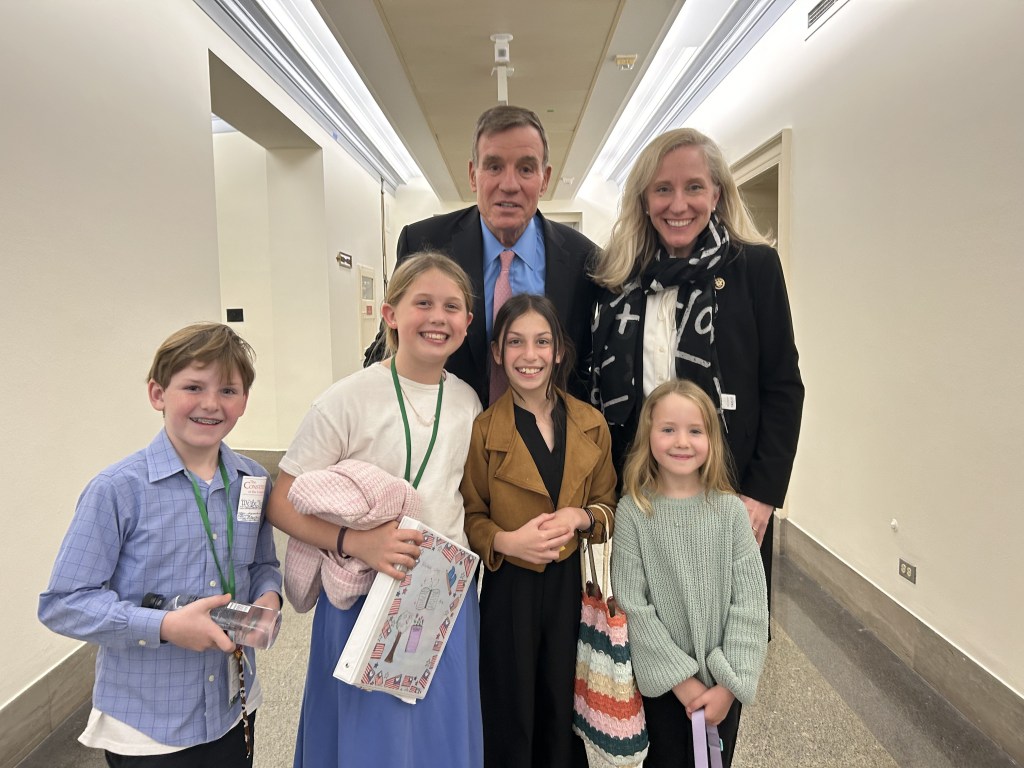
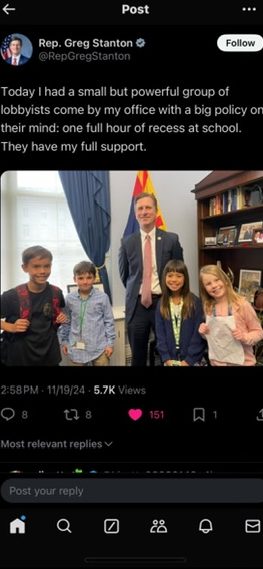
Over five weeks, we embarked on a civic journey. Our learners discovered the legislative process, weighed the pros and cons of an electoral college, created art used for activism and designed a policy flier imploring our Legislators to act now. We watched as our learners took charge and discovered policy issues impacting young people – not just adults. The ultimate goal? Journey to Capitol Hill and share their passion to Representatives. In groups of 4 – 5, our learners became lobbyists determined to spark change. Using the UN Rights of a Child as a guide, we asked our learners – what change do you want to see in our country? What Call to Action do you have for our politicians? 

The answers both supposed and inspired us: 

“No More Silence, Stop Gun Violence” 

“Raise the Refugee Cap” 

“More Play in the Day” 

“Free Health Lunch in School”  

“Affordable College for All” 

Often, as adults, we assume that young people are disengaged with politics. We talk around the issue, operating under the false assumption that politics has little impact on them. This is done with the best intentions, it is the desire to shield them from the familiar vitriol and hate that has seeped into our political landscape. But as I watched our learners take charge of this project, I am reminded of the energy of young people. There’s something profoundly moving about watching a group of learners all under the age of 10 step into the realm of politics. As I chaperoned my group, I watched Discovery go from office to office – speaking to both Congressional staffers and Representatives. I couldn’t help but be in awe of the courage our learners exhibited when demanding change from our elected officials. Pride swelled in my chest as I watched each person we met exhibit the same expression of admiration and wonder as our learners delivered well practice speeches about their policy issue. Each interaction ended the same – a call to action and a tough question – what is your Representative doing to enact positive change in the community? 

Screenshot

As I reflect on our Project, I am reminded that it’s not just the learner’s energy or courage that inspires us  — it’s the audacity to hope. In a world too often bogged down by cynicism, conflict and division, learners’ engagement serves as a reminder to us all that politics is not just about power; it’s about possibility. I believe this possibility is endless, and can be found in our future generation of young learners.

Defying Gravity with Physics!

Have you ever wondered why you don’t fall off a roller coaster when it goes upside down? Have you ever wondered how airplanes stay up in the sky despite being so heavy, or why you feel heavier in an elevator when it starts moving? Have you ever wondered why your shadow changes size throughout the day, or why the sky changes colors at sunrise and sunset? Have you ever wondered what makes a car speed up or slow down, or why a ball bounces back when you throw it on the ground?

If you have asked yourself or someone else these questions, you are not alone! Thanks to the curiosity of scientists, architects, artists, engineers, and others, we have a better understanding of how the world works–and it all comes down to one thing: physics.

We kicked off our exploration of physics on Monday with the introduction above, followed by a discussion about several different branches of physics and its relevance in everyday life. Of course, at TVS, merely talking about the wondrous world of physics isn’t enoughwe must theorize, experiment, create, celebrate, and have fun!

On Monday, learners experimented with Newton’s laws of motion through a series of balloon races. They manipulated variables like volume, mass, and force, observing how each affected their balloon’s speed and distance traveled. On Tuesday, learners expanded their scientific understanding by building their vocabulary and learning fundamental physics formulas. These experiments and research activities set the stage for the adventure to come. 

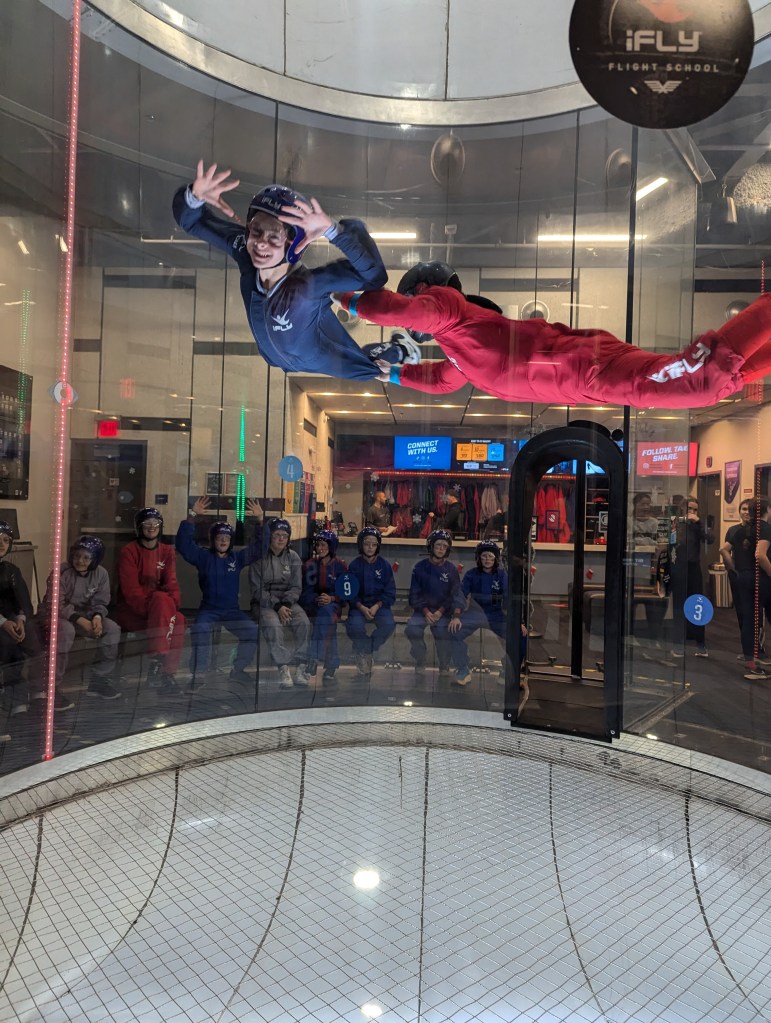
On Wednesday, we embarked on one of the most highly anticipated field trips in TVS history: iFLY Indoor Skydiving. When I say the learners screamed with excitement upon hearing about the surprise field trip, I mean they screamed. You could feel the electric mix of enthusiasm and nervous energy buzzing through the air. And you know what? Their joyful screams were completely justified. Speaking as a first-time flyer, I can confidently say that at iFLY, physics is magic. I did my fair share of exuberant screaming in the wind tunnel!

At iFLY, we spent the day immersed in physics. We participated in a lab activity, building, experimenting, and making predictions using differently shaped parachutes. We explored the physics behind the wind tunnel and discussed real-world applications. We also watched expert flyers manipulate their bodies to create exhilarating shows of flight mastery. Most thrillingly of all, zipped into flight suits and donning pointy goggles, we flew

Reflecting on the experience, one learner shared, “The most interesting takeaway was how, if you move your hands just a little bit in a direction, you’ll completely move in that direction.” Another learner humorously concluded, “I did well and didn’t die. The smallest adjustments make the biggest differences.”

At the end of the experience, an iFLY instructor pulled out a tub filled with various objects and invited us to predict which items would fly up first in the wind tunnel. The items were thrown into the tunnel and, one by one, we watched them soar.

“The most interesting take away from the field trip was when they put all the different objects in the wind tunnel. Even if our hypothesis was wrong, it was still cool to realize our mistakes and learn from them, like which one we thought would fly first.”

-Adventure Learner

Over the next two weeks, Adventure learners will put their physics skills to the test. They’ll design, build, test, and finalize a protective structure that will safely deliver an egg from a high drop. The culmination of their efforts will be showcased at our “Eggshibition” at the end of the session. We hope to see you all there! 

Session 3 Sneak Peek

Spark Studio

In this session, learners will explore different cultures. They will imagine themselves in another country and learn about different languages and traditions (foods, drinks, clothing, and how things are made). They will also discuss how those differences and similarities play a part in our everyday lives. Learners will have the opportunity to engage in hands-on materials in each area of the studio that reflect our theme.  Spark will conclude the session with an international celebration for Exhibition that features handcrafted drinks and treats. 

Photo by Porapak Apichodilok on Pexels.com

Discovery Studio

Discovery will be deepening their understanding of identity, culture, and self-expression through mask making in this session’s Project.  Learners will make connections between their own crafted masks to traditions across the globe. Learners will take away that masks can symbolize protection,  or enhance, or disguise appearance in some cases such as battle, theater, film, and more. By the end of the session, learners will be able to write an artist statement that conveys the deeper meaning behind their art.

Writer’s Workshop: Every hero’s journey encompasses a narrative that outlines the experiences that encompass their lives. This session, learners have the opportunity to write an autobiography that includes background information, their triumphs, and climactic events. Through sharing beautiful and unique anecdotes about themselves, learners will become authors in their own right, championing them to share their stories with the world.

Photo by Artem Podrez on Pexels.com

Adventure Studio

Project: Get ready to dive into the thrilling world of physics! During this session, Adventure will team up to unravel the secrets of acceleration, force, momentum, and energy. With hands-on experiments and a secret mystery project, they’ll channel their inner scientists and embrace the excitement of the scientific method through trial and error to create innovative prototypes. Our experimentation culminates in a high-energy Exhibition, where learners will showcase their finished product in action. 

Communications: This session learners will explore the transformative power of gratitude and discover how expressing their gratitude can enhance their well-being. Using the pastiche technique, they’ll focus on expressing their appreciation rather than simply reflecting on it. At the end of the session, learners will share their thoughtfully composed letters with their recipients, deepening their relationships and experiencing the joy and fulfillment that comes from meaningful expression.

Photo by Pixabay on Pexels.com

Health & Wellness

“Nutrition is a critical part of health and development. Good nutrition means your body gets all the nutrients, vitamins, and minerals it needs to work its best… Healthy eating promotes stable energy, strong bones and teeth, improved mental health, healthy weight, and prevention of chronic diseases.” – American Academy of Pediatrics

Spark Studio: It’s back – Be Your Own Food Critic! Spark learners will try different fruits and vegetables and learn about how they  impact our bodies in amazing ways. 
Discovery & Adventure Studio: Learners will be reflecting on healthy nutrition habits, dental care, and sleep habits. We will also have a chance to try fruits and vegetables that can have positive benefits to our dental health and aid in getting a good night’s sleep.

Photo by John Finkelstein on Pexels.com

Learning to Learn: Middle School Civilizations

Middle school Civilizations, or “Civ” as the learners call it, is one of The Village School’s signature learning experiences. The curriculum is a rich task built with intention and backed with research. Learners are asked to engage with most of the topics and character traits listed in our school Profile of a Learner as well as meet each strand of Project Zero’s Understanding Map, a research based framework for designing powerful learning experiences.

Twice a week learners are presented with a Civ Challenge that is composed of three parts: research, writing to learn, and socratic discussion. Each challenge is centered around a list of approximately 10 socratic questions, with a focus on what is known as the “big question”. The big question is about a specific time or person in history. Learners are challenged to come up with their own answer to the big question based on their own research. Each Civ Challenge is accompanied by a bank of sources that may include primary sources, images, graphs, videos, and articles that are relevant to the big question.  Additionally, each challenge weaves in current events that connect to the historical topic. There are current articles, news clips, and primary sources that highlight these connections. 

Learners are challenged to do at least 30 minutes of research using the sources provided, and take notes on the information they are gathering. After their research is complete, they begin writing to learn. Writing to learn is different from the purpose of most academic writing, and research shows that the older a learner gets, the less opportunities they have to write to learn in school. Writing to learn is to help learners process their thinking and determine their own ideas and thoughts – or as one researcher explains, “Writing to learn is learning to think.” This is exactly the purpose of the writing task in Civ. 

Learners must submit their written response by the deadline in order to participate in the final aspect of the challenge, a peer-led socratic discussion. Learners arrange themselves in a circle, nominate a discussion leader, review the discussion guidelines and begin. The conversation starts with sharing responses to the big question, followed by the discussion leader’s guidance through the rest of the questions.

This session’s CIV, “The People Who Made America” included ten challenges focused on one or two individuals who helped shape the country. One of the challenges focused on Mary Tape, a desegregation activist who fought for Chinese-Americans’ access to public education. Here is an excerpt from the challenge followed by the “big question” followed by a snapshot of some of the learner responses and discussion:

Mary Tape was a Chinese immigrant living in San Francisco in the 1890s. She became an important figure in the fight against racial discrimination in education. After her daughter was denied entry to a public school because of her Chinese descent, Tape took a bold stand against the schools. She wrote letters and took legal action that led to a landmark court case. 

Was Mary Tape a hero for her family and other Asian Americans or a failure?  Should heroes be defined by personal victories or by the ability to inspire and effect larger change? 

“I don’t think you have to succeed to be a hero.” 

I think she was a hero to her family and to the people that she inspired. I think you can fail and still be a hero in some people’s eyes.” 

“I disagree – I think she was a failure because she did actually fail at what she was trying to do. I think what she did was heroic, but it doesn’t make her heroic.”

“I actually completely agree with Charlotte because I think calling her a failure is a bit of a stretch. I also agree with something Jude said that being a hero or a failure depends on the standard. I think for Mary Tape the standard was heroic – she was fighting a similar fight as MLK, because she was fighting against racial discrimination. MLK is one of the most influential heroes in the world.”

“I agree with Charlotte. It’s hard to categorize someone as a complete hero or a complete failure. I do think that she failed in her goals, but she certainly didn’t fail in being her. She was a success in that she brought the injustice to light and made people aware of it. Generally I think she was a hero because she did more good than bad. 

I wouldn’t describe her as a failure. She stood up for her family and that’s heroic to me. 

“Wait -can someone explain what she did with the school?”

“She went to the Supreme Court and advocated for her children to be accepted into the local public school, but the Supreme Court l,et everyone know that segregation was still okay, so they had to make a different school for her children. 

“All last year in Health and Wellness we talked about what makes someone a hero, and I remember talking about how a hero is someone who positively influences others, and she did that.” 

“Along the way to your goal, you’re always going to have failure. Just like us in our journey at TVS, we’re going to fail sometimes.”

“I agree with Amira. I think she was a hero because even though she encountered failure she still did something incredible. Her argument made it all the way to the Supreme Court which is a big deal. Even though it didn’t turn out how she wanted, she brought awareness to this important issue. I definitely think she was a hero.”

“Hey, can you read the second part of the question again? I noticed no one is answering that part.”

“I think if someone is a hero their actions need to affect more than just themselves. You can be a good person, but that’s not the same as being a hero. I don’t think that your reach has to be huge. You could do something to benefit your school or your neighborhood and that can be heroic.”

“I think that heroism should be defined as the ability to inspire others. Inspiring others is good leadership. If you’re being a leader, you’re being a hero – and if you’re being heroic, you’re inspiring others to be heroic.”

I think it matters what your intention is. Her intention was to make a positive impact and in that sense she succeeded.

Below is one of the learner’s written responses: 

A hero is a person who is admired or idealized for courage, outstanding achievements, or noble qualities. And by that definition, Mary Tape was a hero. She might have failed to get her child into public school, but she inspired others, not just to follow the law but to do what is morally right. 

When Mary Tape sued the school and the case went to the Supreme Court, the case was not just for her daughter but for all Asian Americans. She might have failed to get her daughter into an American school, but she put action in the movement and took a step toward equal rights. 

You can’t be a failure if you inspire millions. You can still be a hero if your goal fails. Failure is a part of learning, and failure is a part of changing the world. Martin Luther King Jr. was arrested multiple times, and he may have failed at that moment, but he is still considered a hero. Mary Tape is the same—someone who, in the immediate future, may have failed but, in the long term, succeeded. 

Learners go through this entirely self-led process twice a week. They learn to read critically, write thoughtfully with evidence to support their ideas, consider other perspectives, connect history to current events, and to their own experiences, And, most importantly they are trusted to engage in this process as independent learners, writers, and thinkers. This learning task is something most high school students wouldn’t be trusted to attempt. In a traditional, highly competitive high school environment there isn’t room or time for learners to struggle or fail.  Like so much of the learning design at TVS, we choose to trust over control. Civ requires the adults in the room to really lean into our Constructivist approach to learning and our belief that young people can be trusted to learn from their own experience. 

As expected, the learners capture the heart of Civ best, as one learner put it: “…Civ is definitely the most challenging part of being in Adventure, but it’s also the most fun.” And, of course we agree: the more epic the challenge, the sweeter the victory.