A Day in the Life of a Spark Learner

Imagine a community where learners help each other navigate an outdoor play space with climbing structures that they’ve never challenged themselves to before. Imagine the excitement of going to new heights while keeping safety first for all. The usage of building materials such as wooden planks have endless possibilities that lead to careful planning and successful problem solving. The sandbox provides an area where creativity has the opportunity to grow. Cakes are baked, holes are dug, sand is sifted, tiger statues are designed…there is no end to the imagination.

Think of thriving older learners walking alongside younger learners to help them acclimate to their learning environment and inspiring joy deep within from their responses that illuminates throughout our circle times.

Imagine perfecting the sounds of individual letters as they roll off of the tip of their tongue. Learning each unique sound brings laughter and smiles to small group lessons.

This is just a glimpse of the joy found in Spark Studio. Read along to see what a learner-centered, self-directed, play-based environment looks like with our youngest learners.

Following the morning circle, learners jump right into their learning by focusing on literacy. Some learners choose to focus on their writing while others choose to go read and spell with the infamous reading drawers.
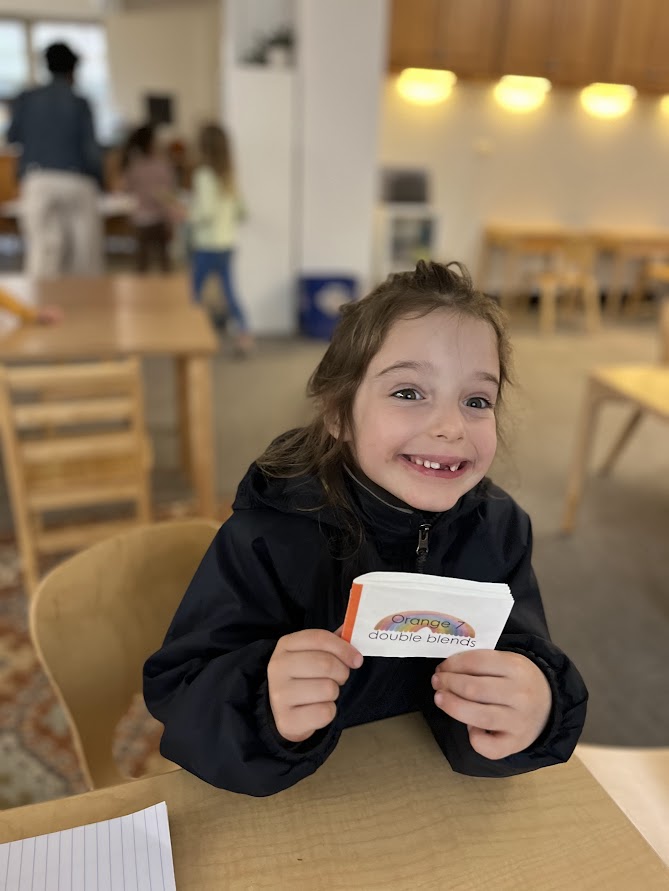
“I can’t believe I mastered orange drawer seven!”

The beauty of our learning design is that learners get to work at their own pace. If a learner needs more time practicing a skill or is just too excited about the story they’re writing, there is no rush to move on before mastery has been achieved or imagination has had the chance to be written out. Spark learners are learning how to learn and learning how to balance their learning. 

After an hour of non-stop reading, writing, and spelling, learners get to switch gears from being readers to being mathematicians. Using a mix of Montessori and standard hands-on math materials, learners go choose a ‘work’ to focus on. Sometimes, they pick something in their challenge zone right off the bat, and other times they engage in a warm-up game with another learner or two before seeking out a challenge. Some learners prefer the hands-on materials while others like worksheets to apply their knowledge. Our math corner has all of these available for learners to truly be self-directed. But of course, a guide is always nearby to introduce a new skill or material and help talk learners through their thinking process. 

“Last time it took me two days to do my hundreds chart. This time it only took me one day and I did even more numbers!”

The magic of the mixed-age studio is that learners get to not only learn from one another but guide one another. During morning work, older learners are eager to read to a younger learner, help a friend sound-out a word, demonstrate how to skip-count using a bead chain, or teach a new game.
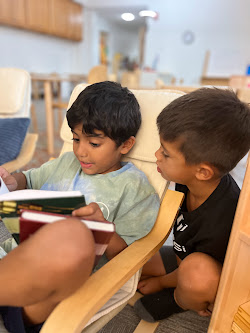
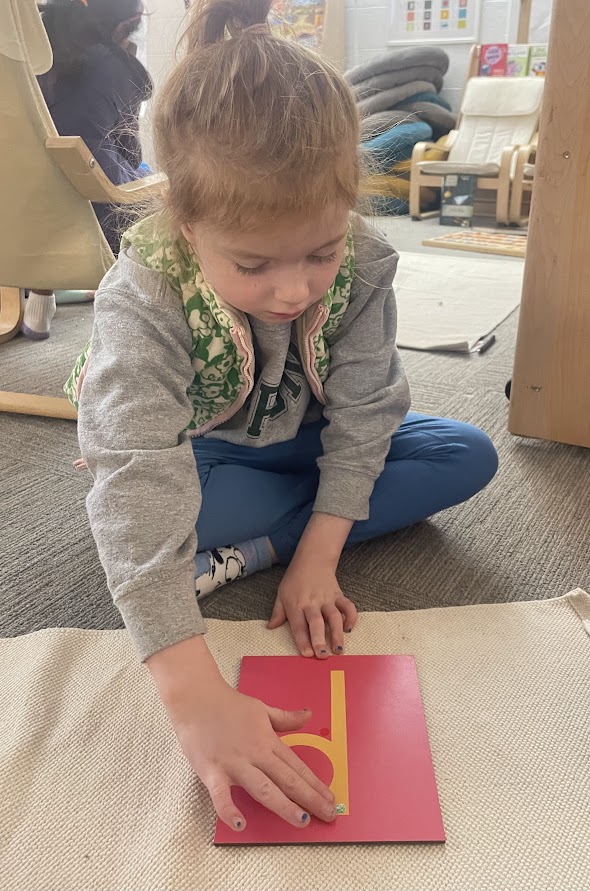
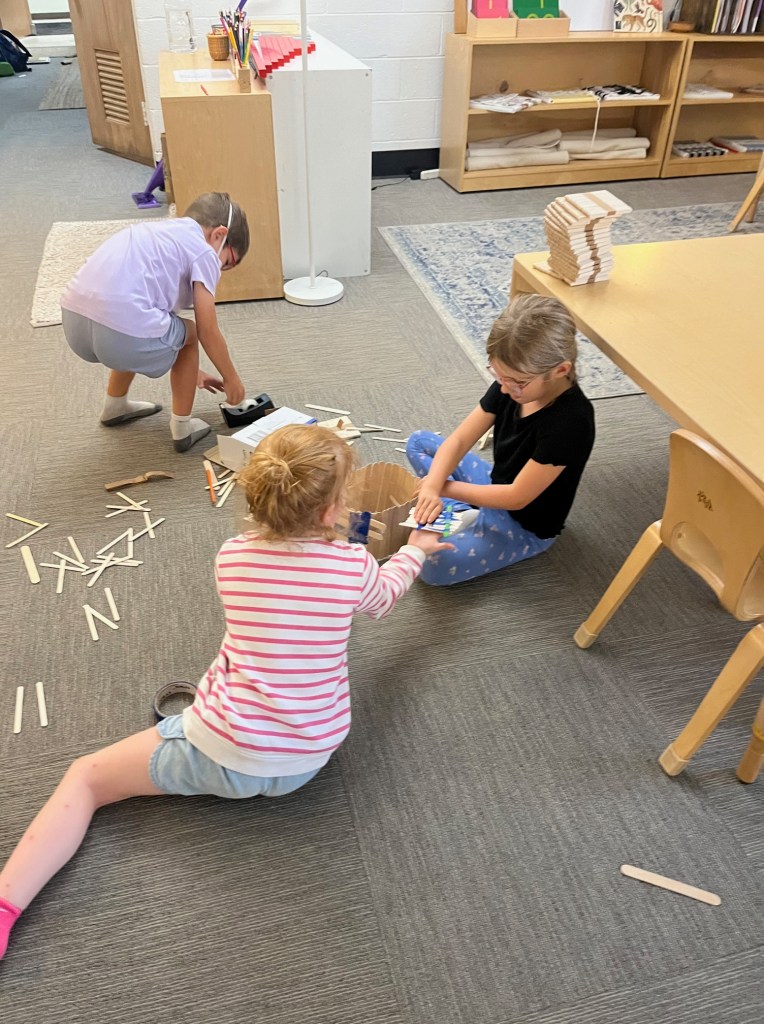
It wouldn’t be a typical day in Spark without project time. Spark learners get split into a smaller group where they lead the investigations. Using the Reggio Emilia approach, learners lead the projects following their interests and curiosities. It starts with provoking thinking through loose parts, such as blocks, old cork, recycled applesauce tops, and even trash! From these provocations, ideas have been born that led to learners creating their own business, designing their own zoo, and building a model of the Washington Monument. Project time is not just for creating, but for learning how to collaborate and problem solve with other learners.

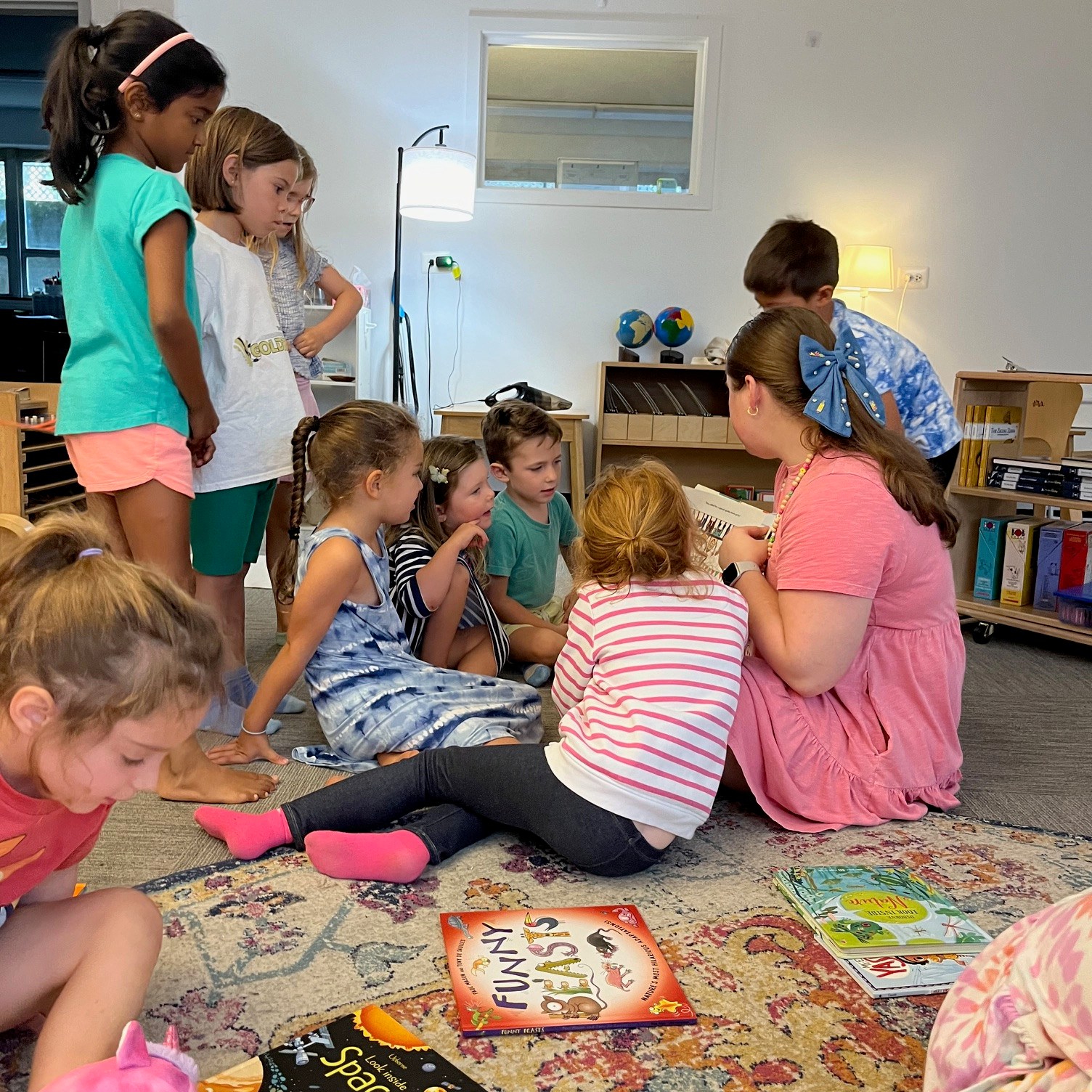
At the end of the day, Spark learners gather in our cozy ‘Book Cafe’ corner, anticipating the new book that will be read. This time is intentionally designed to spark thinking and inspire creativity. Learners study topics, ideas, or questions through the books, engaging in hands-on projects like churning fresh butter, making homemade applesauce, or sprouting seeds in plastic bags that hang in the window. But sometimes, we just enjoy simply reading with some of our favorite book characters, like Nibbles or Elephant and Piggie. Book Cafe time is extra special when Spark gets to read with their Adventure reading buddies or hear a favorite story from a “Mystery Reader.”

Every day in Spark Studio is different and brings new challenges but one thing remains the same: learners learn.

The Power of a Learner Centered Community 

In a learner-centered school, every day presents moments of discovery, growth, and connection. Watching Discovery Studio in action these past two sessions, I’ve seen firsthand the responsibility, care, empathy, and strong sense of community that we foster here at The Village School.

An example of this happened recently during our afternoon project time. I was helping a learner who had hit their head and needed an ice pack. As we were transitioning from project time to our debrief—where we come together to reflect on how our project time went—I found myself worried about how the launch room might manage without a guide there to lead the discussion. But when I got to my launch room, I saw the magic of our model working.

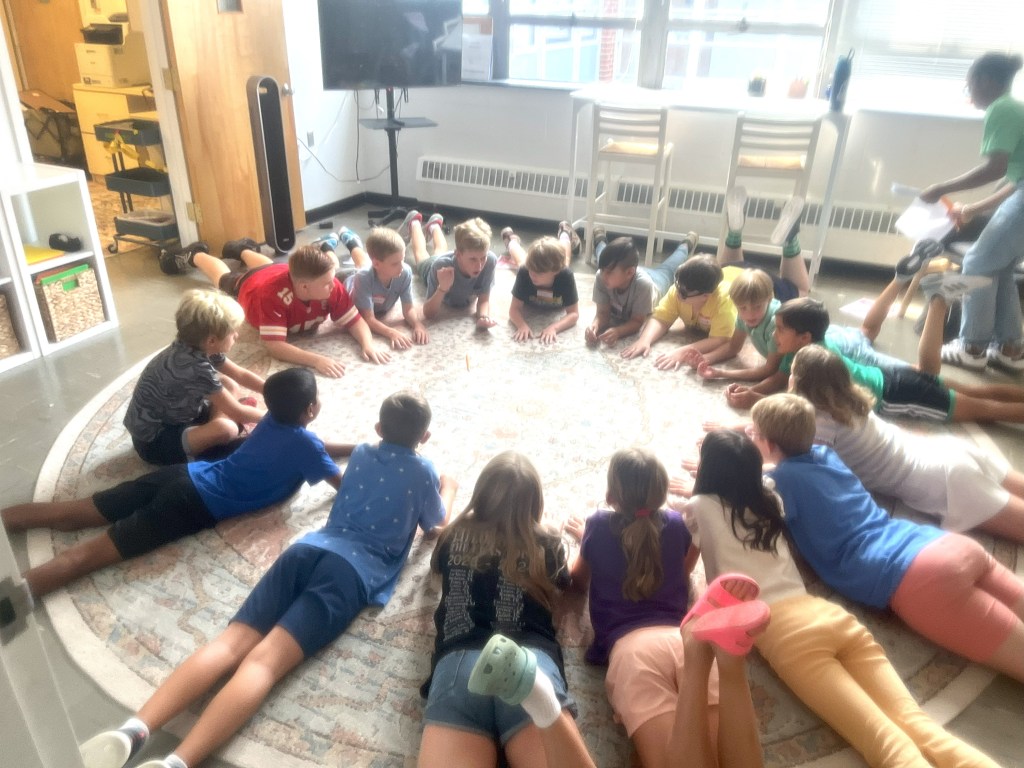
The older learners, who had seen an opportunity to step up, had already circled up the rest of the launch room and were leading our group in the debrief discussion. Without being asked, they had circled up in our launch room, and began asking thoughtful questions about our project, how it could be better, and how they could support each other through the challenges they are facing as a group. 

While this is just one story of leadership, it reflects the heart of our model. As a guide, I have had the opportunity to watch this happen every day in our community. What I have noticed is that, in a mixed-age, learner-centered environment, there is a continuous cycle of nurturing and being nurtured. Older learners step into leadership roles, guiding their studio mates and creating space for younger learners to contribute. This act of leadership not only supports the younger learners but also inspires them to take on leadership themselves as they grow. Learners here understand that they are not just individuals in a studio but active, contributing members of a community where they support and uplift one another. They recognize that each of them plays a significant role in the learning journey—not only for themselves but for everyone around them. This allows for them all to appreciate their unique strengths, recognize the challenges they face, and know that they can offer help and support, regardless of their  age. 

What stands out to me the most is how this shared responsibility extends beyond academics. It creates a culture of kindness, resilience, empathy, compassion, and independence, where the act of leading and being led continuously nurtures growth in both directions. 

In moments like these, I am reminded that a learner-centered community does more than teach—it transforms. It empowers learners to take ownership of their growth, to support one another, and to recognize the value of their unique contributions. Through leadership, empathy, and shared responsibility, each learner develops a deep sense of belonging and purpose. This environment fosters not only academic growth but the kind of character and resilience that will carry them far beyond the classroom. As guides, we are privileged to witness how these learners inspire one another every day, creating a cycle of care and leadership that continually strengthens our community. And it’s in these moments—when learners step up to lead, when they nurture each other’s growth—that we see the true power of a learner-centered model in action. It is a place where each individual’s success is tied to the success of the community as a whole.

Young Leaders in Action: Reflections from SparkHouse

Last week, I had the privilege of attending SparkHouse, an event hosted by Education Reimagined with a mission to connect, equip, and ignite both learners and educators in learner-centered environments across the country. One of the most anticipated parts of SparkHouse is the sharing fair, where learners have the opportunity to present their learning environments, answer participants’ questions, and learn from one another. As the five Adventure learners representing TVS prepared for their presentation, quickly adding categories and phrases to their chart paper visual, I couldn’t help but step back and take it all in. I saw a small group of middle schoolers working calmly and efficiently toward a common goal. Each learner contributed naturally, without prompting. Each added their own ideas of what makes TVS special, and each understood the role they would play in the presentation.

As a guide in a small learning community, I get to observe growth every day. Moments like these, however, allow me to truly reflect on how far the learners have come since we first met. Each learner, though unique in their delivery, displayed ease and clarity in their communication. They answered every question—whether from children or adults—with knowledge and confidence. These young people carried themselves in ways few would expect from middle schoolers. Thankfully, we know better. Was I surprised to see the learners speak with eloquence and poise? Not at all. Was I engaged, encouraged, and a bit nostalgic for the passing time? Absolutely. What I enjoyed most, though, was hearing the passion with which they spoke. What are they proud of? What do they love about their learning environment?

The learners began by sharing insights into several aspects of the TVS Adventure learning design, including apprenticeships, skills badges, civilizations, projects, communications, and unstructured play. They talked about Health & Wellness, the valuable time spent outdoors at the park, and living in community. They spoke about the freedom of choice. For each subject they shared, the learners articulated real-world applications. For example, when discussing apprenticeships, one learner noted the similarities between securing an apprenticeship and a job. She explained, “You may apply to one hundred and hear back from one. That’s real life, and you just have to keep going.” When talking about Civilizations, another learner shared that in the Adventure Studio, they hold discussions each week and learn to think critically and from multiple perspectives. Another shared that TVS middle schoolers deliver speeches for change each year, lead service opportunities on Fridays, and are currently writing to politicians about their ideas for a better future. 

It’s not just the five learners who attended SparkHouse who have taken ownership of their journeys; in one way or another, all of our learners have. They aren’t waiting for tomorrow to shape their futures; they are actively shaping their lives and who they are now. SparkHouse left me feeling hopeful, once again proving the incredible power of learner-centered environments. When we trust learners and put them in the driver’s seat, giving them both freedom and responsibility, they are empowered to learn, grow, and change our world.

Learning to Learn Math in Spark

If you have school-aged children, you might have noticed that learning math today looks nothing like it did when you were in school. Unlike the approach we experienced as students and the approach that still persists in many conventional schools, The Village School learning design prioritizes deep understanding over rapid rote memorization. Our goal with math (and other subjects!) is that learners are equipped with a sense of math efficacy that comes from learning to learn instead of simply learning. Spark Studio Guides have designed a math curriculum that nurtures a growth mindset creating space for young learners to feel capable and excited as they deepen their numerical fluency. 

Learning at TVS in Spark Studio and beyond is based on mastery and not bound by age or time. Similar to the literacy curriculum in Spark, the Spark math curriculum is highly-structured, multi-sensory, and research-based. The Spark Math Map is a visual representation of the most important mathematical skills that Spark learners work to master, and are foundational for any young learner in providing them with both the understandings they need for our elementary math curriculum and equipping them to learn how to learn math as they encounter it in their daily lives.

You can probably remember seeing a toddler determined to hold the right number of fingers up to show their age demonstrating their earliest counting skills. Hands and toes serve as everyone’s first math manipulatives. After fingers and toes comes blocks, and in Spark Studio we introduce an engaging collection of Montessori math manipulatives. The intentionally designed manipulatives allow our youngest learners to learn math through natural play – a pedagogy we lean heavily on here at TVS.  

One of the most memorable math manipulatives in Spark is called the long bead chain. Visit any Montessori classroom and you’ll see the beautiful wooden display case of carefully hanging colorful chains of beads. These color-coded beads are used to master several basic mathematical fluency skills including linear counting, skip counting, multiplying, and squaring and cubing. By physically holding and counting the beads, learners are able to internalize the idea of quantity and pattern recognition, two foundational math concepts necessary for developing math fluency. As learners string together bead chains of various lengths, they visually and kinesthetically experience mathematical progression. This process fosters independence and encourages learners to approach math as a logical, engaging journey rather than just memorization.

The bead chain is just one example of how the math curriculum in Spark Studio is both playful and purposeful. In addition to the available manipulatives, Spark learners often engage in math games that promote numerical reasoning and thinking. The benefit of multi-age learning really shines through when learners are engaged in math-based games: older learners are able to model and articulate their thinking about math in a way that inspires and influences younger learners more than any adult could ever achieve. 

However, most central to our math curriculum in Spark Studio is the development of a growth mindset. We know from research and our experience at TVS that a learners’ belief in themselves when it comes to learning math is the most powerful lever in shaping their experience and success. We also know that young people – especially our own children – will internalize and model the attitudes that are modeled for them. Do you talk about math fondly – or do you proclaim yourself “not a math person”? Expressing confidence about your own mathematical abilities will help your learner (and maybe even yourself!) realize that learning math is all about attitude, effort, and practice. Even when things get tricky – just take one bead at a time!

Session 2 Sneak Peek

Spark Studio

Photo by Sara Free on Pexels.com

It’s fall y’all! Learners will get to explore how food gets to their table by reading about and discussing all things harvesting. From learning about plant life cycles to understanding how food fuels their bodies, learners will try new foods, challenge their math skills using pumpkins, read and write about fall activities, and perhaps even learn to make their own lunch! During project time, learners will work in new groups, practicing team building skills while exploring interests and brainstorming project ideas. Amidst all this, Spark will take a trip up into the Washington Monument after the first sessions’ rich exploration of the structure. See you in session 2!

Discovery & Adventure Studio

Photo by cottonbro studio on Pexels.com

It’s Election Season! Learners in Discovery and Adventure Studios will engage in a deep dive into the Democratic Process exploring the different ways they can share their voice, inspire positive change, and participate in the democratic process before they are old enough to vote! The Project and Writer’s Workshop and Communications challenge will create opportunities for learners to explore the three branches of government and their function, analyze the UN Rights of the Child, investigate the legislative research process, examine how art can be used in activism, and develop their persuasive letter writing techniques. At the end of this session learners will journey to Capitol Hill to deliver one pagers to Congressional Staffers and send a persuasive letter to a politician both advocating for a policy issue advocating for children’s rights.

Health & Wellness

Photo by POI * on Pexels.com

“Beauty begins the moment you decide to be yourself.” – Coco Chanel

Throughout session 1, we focused on belonging. Session 2 will be focused on “becoming”. The learners will take an introspective look at who they are through a values game, reflections on goals, abilities, and dreams.  We will visualize the parts of ourselves that make up who they are. Then, we will take a “vibe check”, asking ourselves about the energy we put into the world and what energy we hope we are expressing to others. At the end of the session we will take a look at the story of our lives so far and make predictions about what is to come. 

The Feeling of Belonging

The beginning of the school year is always a chaotic time. This is my 17th beginning of the school year and even though society has changed in many ways, the behaviors and feelings of children remain much the same. As I observe learners in their first few weeks of school, I notice an underlying question of: Where do I belong?

Belonging is vital to our ability to thrive as human beings. In Health & Wellness we have been exploring the science of belonging and asking ourselves what is important to each of us to feel like we belong. Across studios, the learners have shared stories about moments when they have felt lonely and someone made them feel welcome. They have explored ways that they could help others feel a sense of belonging such as inviting others to play or noticing when someone is alone at lunch. We have also explored what behaviors and actions contribute to belonging – what do each of us need to do to ensure that everyone has a place in our community? 

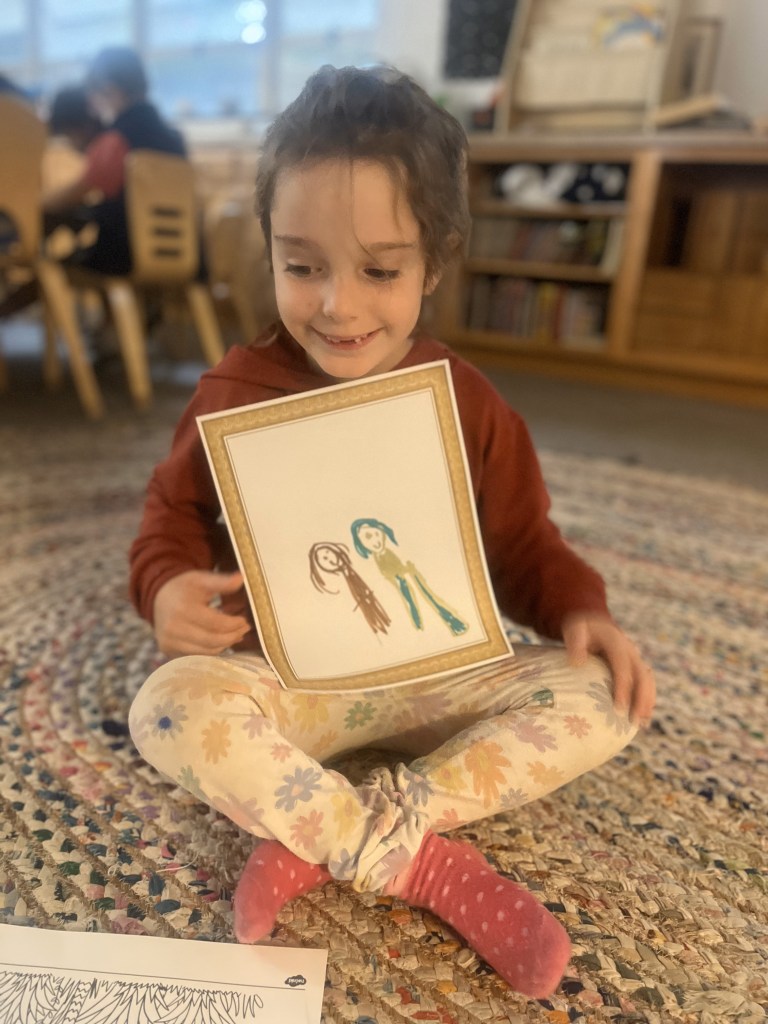
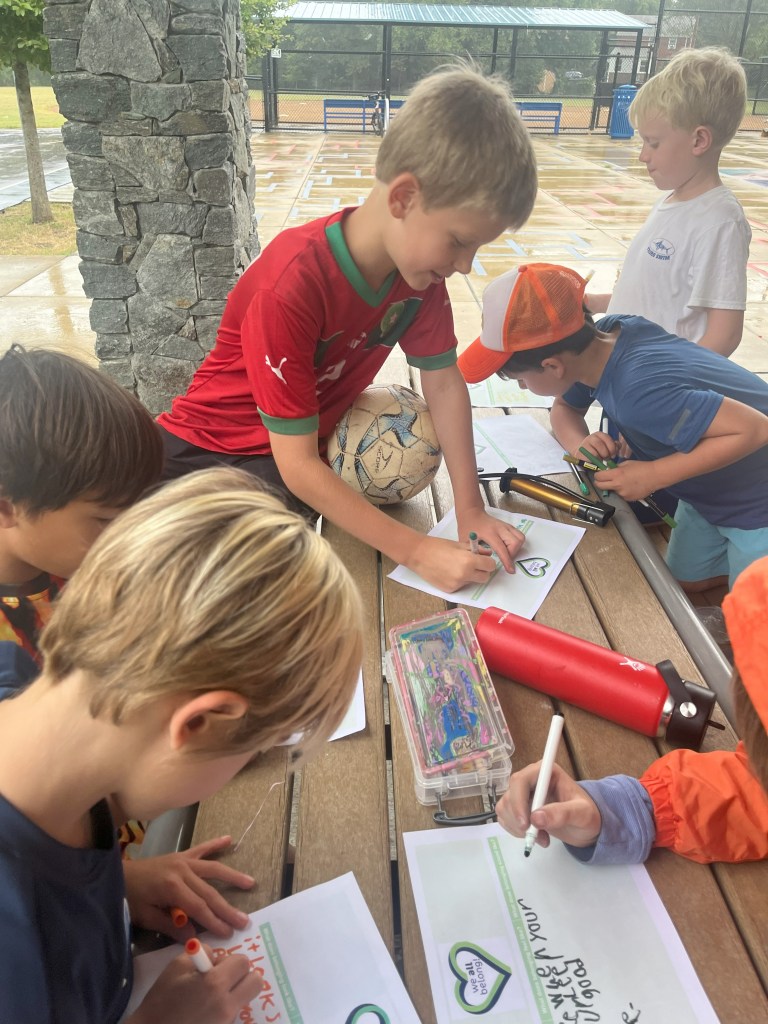
Spark studio has been focused on understanding the “feeling” of belonging. What does it feel like to know that someone cares about you, is your friend, and includes you in fun activities? We explored this through a captivating tale of a creature known as Rumple Buttercup. There were many gasps, smiles, oohs, and ahhs, as I read the story and they began to realize that Rumple Buttercup does have people who care about him and want him to belong in their community. The Spark learners then created portraits of the people who make them feel like they belong, that they are loved, and cared for. 

Adventure learners engaged in a heated discussion about FOMO (Fear of Missing Out), FOBLO (Fear of Being Left Out), and JOMO (Joy of Missing Out). Many learners found themselves debating whether it is ever possible to reach JOMO… will I ever be okay with my friends not inviting me to something? Will I ever feel confident in myself enough to be okay with missing out? Be secure enough in my sense of belonging that it is okay to watch my friends enjoy something without me? In Adventure, this debate is far from over with most learners admitting to pings of envy when they know their friends are getting together without them. 

Discovery studio learners have listened to stories of others where the main characters were unique, different, and didn’t quite feel like they fit in. They made connections about moments when they felt uncomfortable, embarrassed, or left out. Then, they shared about the people in their lives that helped them to feel better, feel included, valued, and cared for. Each learner created a puzzle piece to symbolize why they belong in our community or how others help them to feel like they belong. We are continuing to explore stories of belonging through journaling and reflecting on the community that they are creating every day at The Village School. 

Belonging is an essential part of being human and being a part of any community. What steps will you take to connect with others? What steps can you take to reach out to others that you notice are taking a step back? What impact will you make on The Village School, in your community, and in our world? 

At TVS Learning is Real, Not Artificial

If you’ve read something recently about how AI is going to transform education as we know it, you’re not alone. If you’re like me, you ignored the click bait for a few months, overwhelmed by the thought of trying to deeply understand yet another seemingly “unprecedented” story of our times. Then, if you’re also like me, after several months of playing ostrich, you decided to finally click and begin the process of understanding just how AI was going to change your life. 

After reading article after article, watching an Oprah special, scrolling my LinkedIn feed for fodder, and even reading a book, I have my own hot take on AI in education – that starts with rejecting the premise. Yes, AI has the potential to radically change education as most of us know it. However, if AI has the power to drastically change education, this says more about the current state of education than the power of AI. Despite the rapid advancement of technology over the past 100 years, schools as we know it still look the same: rows of desks, rote memorization, quizzes, tests, and compliance valued over creativity. The important question to consider isn’t how AI will transform schools, but how we should be rethinking the very concept of school itself.

At The Village School, AI is embedded in our learning design because it is a new and useful tool. As new technology emerges, part of our learning model is to learn to learn about them. AI is not fundamentally changing our TVS learning design because we are focused on the act of learning, skill development, and character education – we aren’t in the business of checking boxes. If we were a school that cared more about what our learners know – then for sure, AI would radically change our approach. The good news is that we’re not. One of our school community’s core beliefs is that we care more about who a learner becomes than what they know. We also believe that young people can be trusted to learn from their own experiences. 

While many schools are frantically searching for ways to keep AI out of their classrooms, this session we put AI into the hands of our middle schoolers. Their deep dive into the world of AI included: creating their own chatbots, considering how using AI aligns with their core values, and determining how AI should or should not be used for their learning. The lessons were inspired by resources from Common Sense Media, WISSIT, and our own team of educators.

Middle schoolers spent time understanding what AI is, how it’s trained, who’s behind the scenes, how AI is or isn’t biased, how AI algorithms can get to know you (really well!), and most importantly, how AI should or should not be used, if at all, in school. They even debated the question: Is AI the future of education – or not? 

This session’s focus on AI won’t be the last time learners at The Village School use, consider, and question AI. As a school, we will continue to explore the possibilities and limits of AI and any other relevant technology that emerges during this “unprecedented” time. And, rather than hiding from it in fear of change, we will continue to intentionally run towards it with curiosity, embracing the unknown and transforming it into opportunities for growth. 

I’m glad I finally decided to get my head out of the sand, learn as much as I could, and make my own decision about AI and the future of education. I learned a lot, had some fascinating conversations with other educators, with learners, and with a few AI chatbots themselves. (One even helped me fine tune the title of this piece – thanks, Khanmigo!) Most importantly, my deep dive reinforced my belief in the learning model at The Village School. Even AI can’t disrupt the power of project-based, character-driven, authentic learning experiences. 

Photo by Junior Teixeira on Pexels.com

Spark is on a Roll: You Butter believe it!

The beginning of a new school year brings so much to the table; seeing old friends and meeting new ones, learning rhythms and routines, setting goals, and in Spark, butter! 

Book Cafe has become a part of the routine that learners, and guides, look forward to each day. A chance to plop down after a long day of working and playing and be immersed in the magic of story. Learners sample books across genres, topics and authors. Books that make them giggle, books that make them empathize, books that they beg to read again and again.

Why do we devote daily time for learners to listen to stories rather than only practice reading on their own? With so much to accomplish and get done in a day, is this the best use of our time? Simply put, yes. If you have a data driven mind, then there are statistics galore to support the power of time spent reading aloud to children, even those who are independently reading. The Commission on Reading has stated that, “the single most important activity for building the knowledge required for eventual success in reading is reading aloud to children”.

While the Book Cafe has a general outline planned, so much of it is driven by learner interests and students’ favorites. Often an extra book or two is read and then excitedly added to the studio library for eager eyes to devour the next day. At The Village School it is the guides’ role to create a learning environment that fosters creativity and creates opportunity for further imagining. That is not a role that we take lightly!

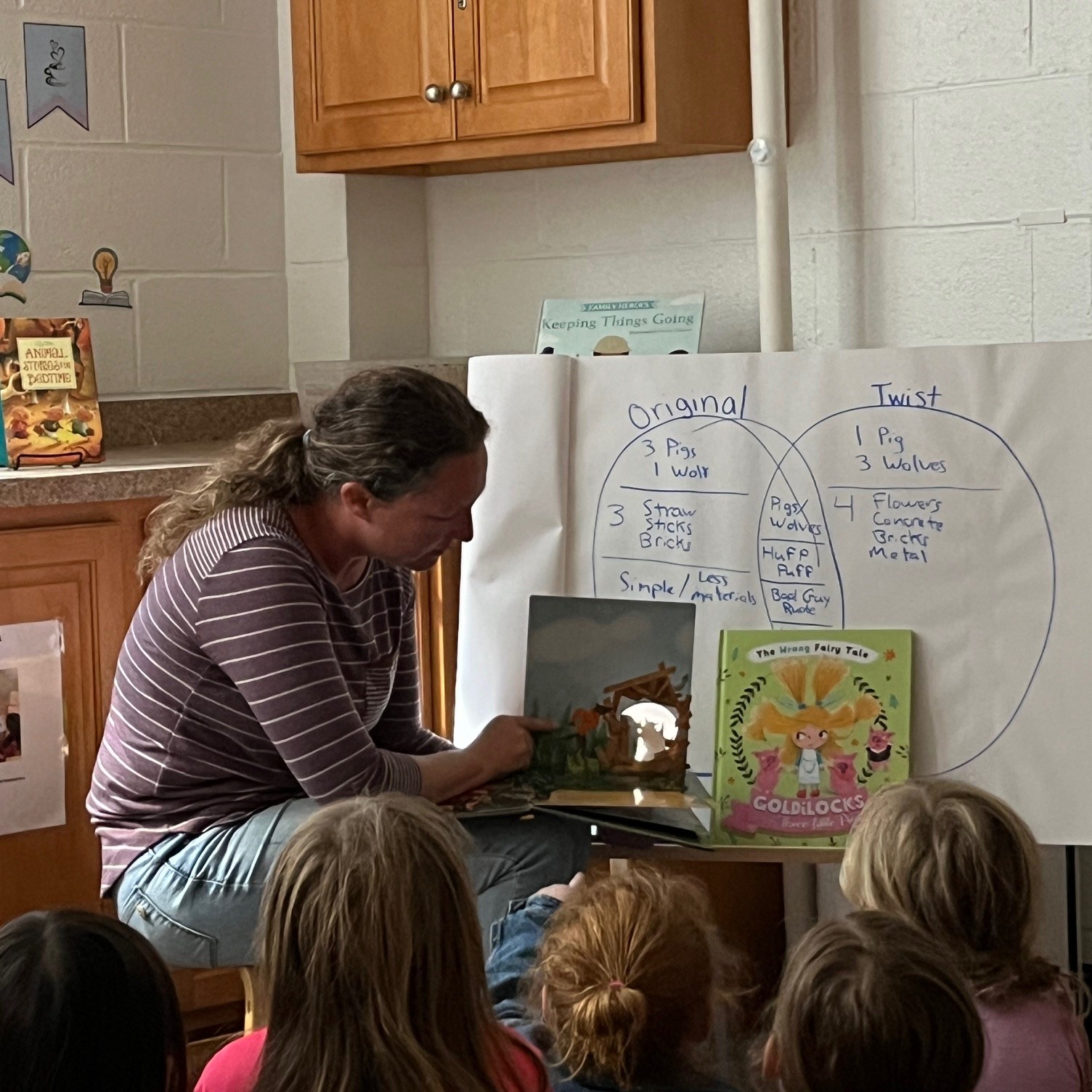
Last week Spark had the chance to explore the simple and magical world of The Three Little Pigs, not once, not twice, but through six different versions. Discussions were sparked about perspective, fairness, the author’s choice of words, hidden clues the illustrators left for the reader and so much more. We dove into new vocabulary and made our learning visible through charts, reenactments and STEM challenges. 

The amount of focus, energy and thrill that went into churning their own butter was a sight to behold! And as learners went on their first excursion to Parkhurst Park, you better believe that nothing tasted sweeter than freshly churned butter on a delicious piece of bread!

Build the Team: Collaboration in Sports 

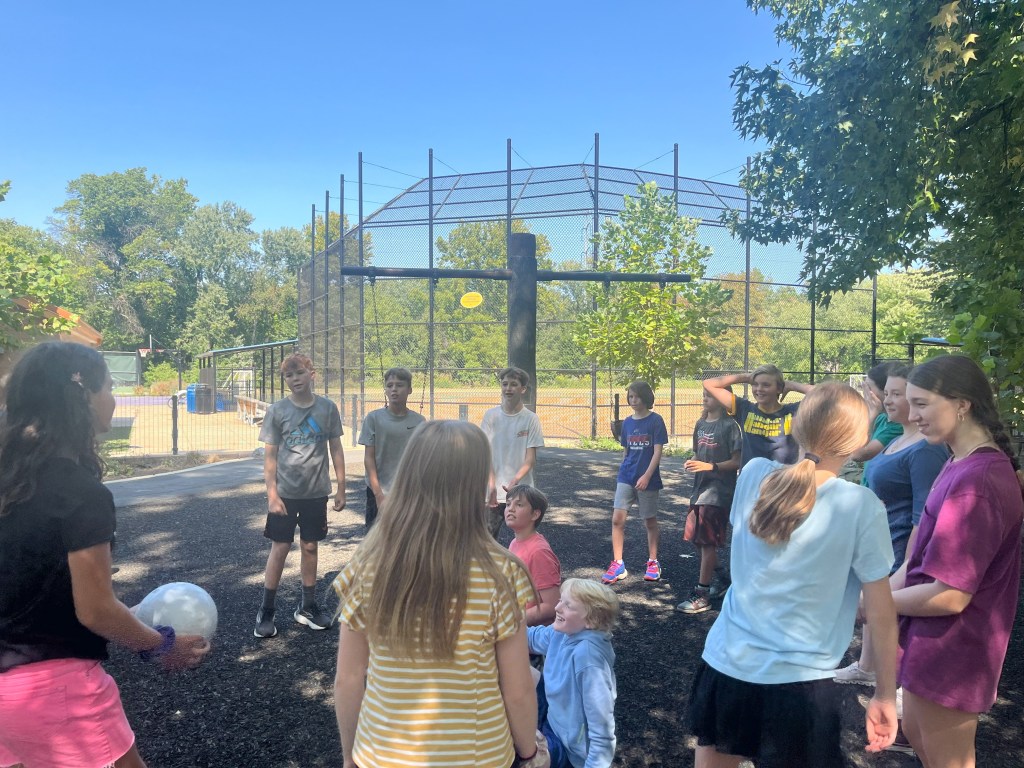
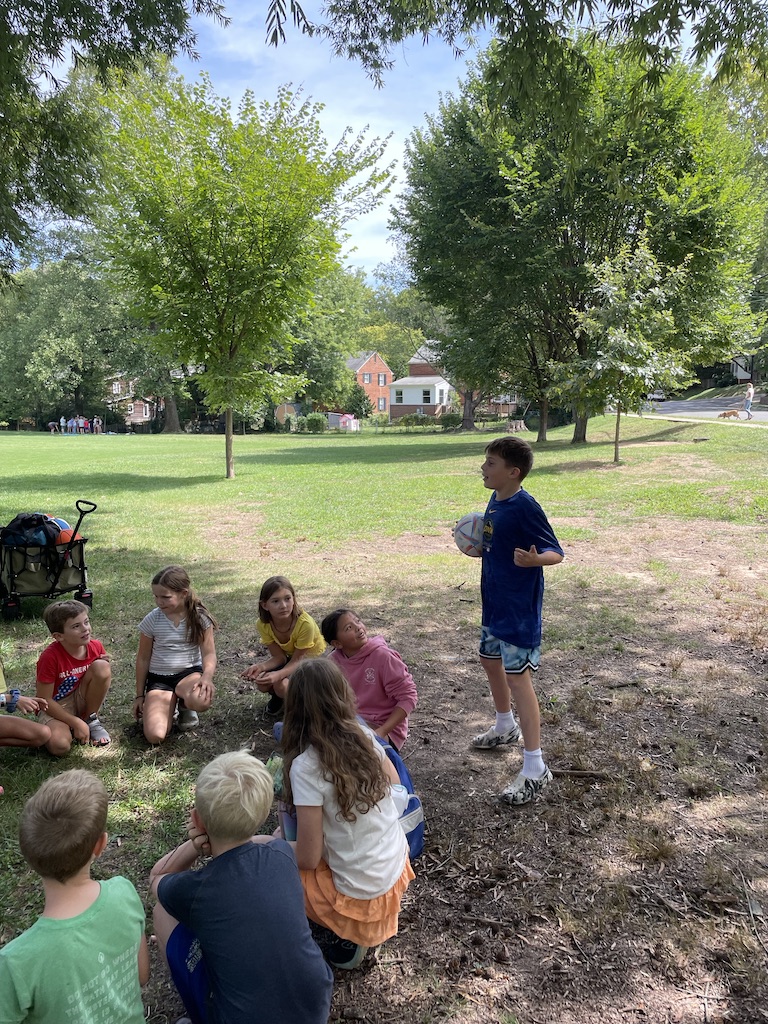
Discovery’s year is off to a thrilling start as we embark on a quest, slightly larger in scale, with 39 learners. In the past, and surely the upcoming weeks, many will raise their hands to ask questions embedded in curiosity, add on to systems that have been tried and proven, and fully lean into new experiences. Both returning and new learners have been fully dedicated to helping one another navigate the various parts of the day, scope the digital landscape of headrush, and tenaciously tackle the turf with gymnastics moves during outdoor play. Most inspiring is their ability to consistently collaborate. Just last Friday the entire studio participated in a whole studio soccer game. Similar to the intricacies of studio life, the soccer game displayed an effort of grit and determination to meet the goal (to score of course!).

Who would be goalie? How can we split up across the field to provide the best coverage for each team? Which learners could be counted on to encourage fellow learners in the tougher moments of the game with good sportsmanship? Of course everyone wanted to win, but our shared studio goal was collaboration. This was on display through moments of opposing team squeals, penalty kicks, and water breaks.

Some learners jumped up without hesitation at the idea of a whole studio World Cup game. While the others who were totally new to the experience took a second to contemplate the idea. Would it be challenging? Will I score? How can I help? On goalie duty, there was Liam for team one, and Fiona S. for team two. All other learners were playing and making themselves useful by passing the ball back and forth across the soccer field in order to score.

A zealous returning learner at TVS, described the park day for Discovery studio as a prime time experience where his leadership skills were crucial. Not only does this dedication to helping others happen on the soccer field, but also off the field! When asked what it meant to be a leader, he said “It feels good. It makes me happy, because it’s really fun. A lot of people listen to the oldest learners, because they believe them.” Here at TVS older learners get the opportunity to share their triumphs and failures with newer learners in the hope that they can gain understanding on what methods have been tried and can work. Other times experiences of oldest learners may influence newer learners to forge a pathway anew.

In soccer, forwards are the goal-makers! This returning learner’s goal setting helped greatly with getting the team to score. When asked what motivated his teams, he said “we had to lock in! That just means to focus hard, and never back down.” This is the perfect example of collaboration and how it transcends school and sports. In the end he also said, “I always try to be positive, let’s just say everyone’s negative and you’re down by a goal in soccer- you probably won’t win. But even if you have a few members that are positive you will have a better chance of scoring. It gives you motivation!” In affirming others, he was able to lead his team to an impressive comeback! One can’t help but think to themselves, Messi who?  

Another returning learner who is compassionate, brings a “can do” attitude to all aspects of our daily schedule, including the World cup game. In the studio you can often find her showing other learners how to submit work, or how to achieve mastery on Khan. As a midfielder in the game, she was frequently inspiring her teammates to remain brave and resilient. When asked about how she motivates others, she said, “It depends on what they’re doing, if it’s a unit test and they fail I’d say it’s okay. I’ve failed like six times on a unit test. I know it’s hard to not get it right, but keep going and never give up.” In fact, her good nature is what kicked the game into high gear, and allowed some of the newer discovery learners to give 100% to closing the score gap.

Mixed aged classroom settings such as this one, makes way for consistent partnership. When asked about her influence in the studio the returning learner said, ” It feels great because last year I asked all of the older learners for help. Now all of the younger learners ask me for help! It feels good to be helpful to younger learners in the studio.” Research has shown learning from a peer is far more enjoyable than more traditional learning styles. In all, the returning learner and her team were set out on having fun while putting on great sportsmanship! She said, “”I feel like we worked well on the team. In the first few minutes– it was challenging. Lots of players never played soccer before, but they got it in the end. I held my role and we each had rows. When I played goalie, I told people to attack the ball! Even though we lost, we had fun!” Just like in sports, teamwork is what fuels almost all of what we do here at TVS! 

Our first session in Discovery is Build the Team, where over the course of seven weeks, learners hone in on collaboration and communication styles in order to create a system that promotes agency. Skills that have been honed in on in the previous weeks laid the foundation for a successful and enjoyable game. This memorable moment for the Discovery studio was also teachable in areas of both strength and improvement. Collaborating can sometimes feel daunting, as if it’ll be life’s most challenging task to navigate. However, together we have kicked off a wonderful start to the school year with our team!

Commitment in Action: Building Community with Our Studio Contract

Here at The Village School, we are a community. In our mixed-age learning environment, awe-inspiring moments are happening all the time. I have witnessed our oldest learners inviting our youngest learners to play games. I have witnessed learners cheering each other on when they reach their goals. I have witnessed budding friendships transform into deep loyalties, and individuals with a common cause uniting to take action and create positive change. All of this is beautiful. These are the moments we love to hear about—guides and families alike. Still, our TVS community is composed of more than just these moments.

In addition to these more straightforward instances, I have seen learners navigate truly challenging conflicts with one another and even with themselves. I have seen learners wrestle with change and experience frustration and anger when they fail. I have listened to stories of personal hardship and seen learners pull inward when they are hurt. Already, learners are grappling with their identities and the roles they play in our ever-changing world. Why am I sharing this? Can’t we go back to talking about the harmonious games played between the oldest and youngest learners?

I’m sharing this because conflict, failure, hardship, and struggle are a huge part of why TVS is a true community. We don’t shy away from the difficult—in fact, we run toward it. In learning how to work through conflict, learner relationships, empathy, and self-advocacy grow stronger. By understanding that failure is normal and essential for growth, learners persevere and cheer each other on in the process of becoming. In sharing their stories and contemplating their roles, learners discover what they are passionate about and what they can do to make change. Every learner’s step and misstep, achievement and failure, is met with the promise of a community to support them both when they fall and when they soar.

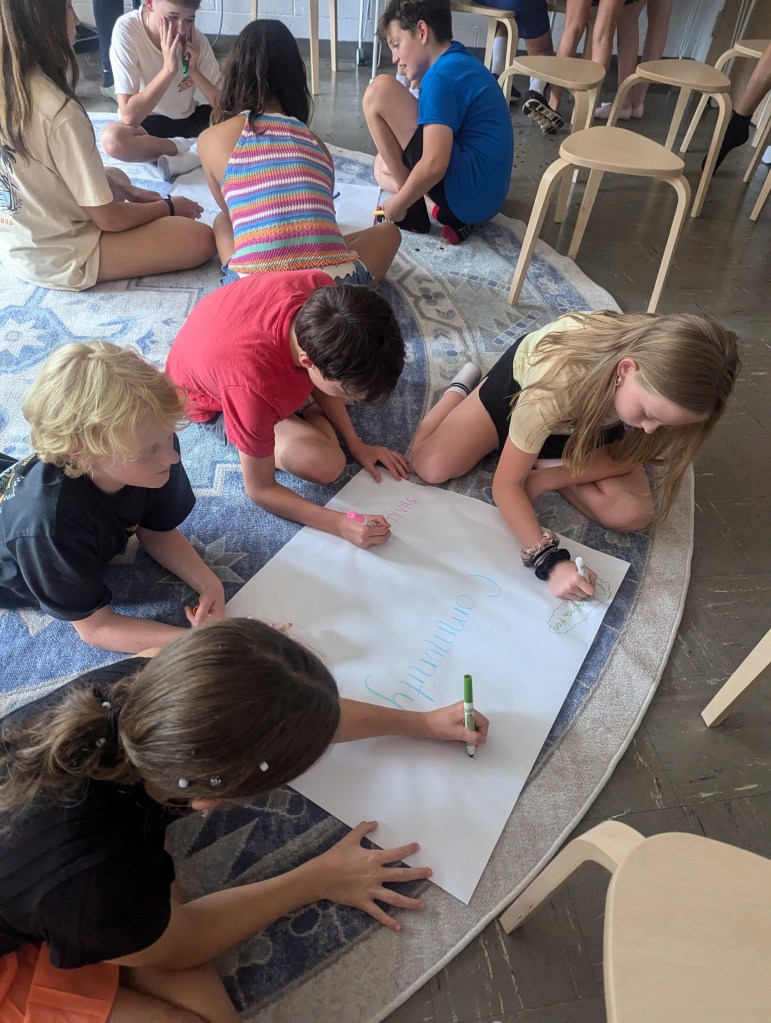
During the first session of each school year, every studio creates a studio contract. The studio contract is a learner-created document that outlines the agreements each learner promises to uphold. Adventure learners were tasked with this challenge during the first week of the session. They began building the contract by making their thinking visible with the Making Meaning Thinking Routine. First, learners were separated into small groups, and each group received a piece of chart paper with one of the following words: community, learner, or trailblazer. Next, every learner wrote a word they associated with the main word on their chart paper. Then, each learner chose another learner’s word and expanded on it by writing a phrase. Learners drew lines connecting their words and ideas. Based on their collective input, they created the following contract:

  1. Keep the studio clean.
  2. Take responsibility for my education.
  3. Treat everyone the way they want to be treated.
  4. Be respectful to others, their boundaries, ideas, and things—and NO body shaming.
  5. Be accountable for yourself and others.
  6. Always try your best and produce your best work.
  7. Be kind and patient with others.
  8. Have a growth mindset.
  9. Stop means stop, and no means no.
  10. Come to school ready and prepared.

This document reflects what our TVS learners want for our community—a community that celebrates, supports, learns, and holds itself to a high standard. It is also aspirational—we understand it may not always be followed, and when it isn’t, that’s when learning and growth occur. What more is there to say? Only this: building this kind of community is both a challenge and a constant effort. It takes trust, perseverance, time, care, and a whole lot of hope. Based on my experience with the TVS learners so far, it is well worth it.