“We have spent a lot of time on this topic. Are we ready to vote or should we table for the next meeting?”
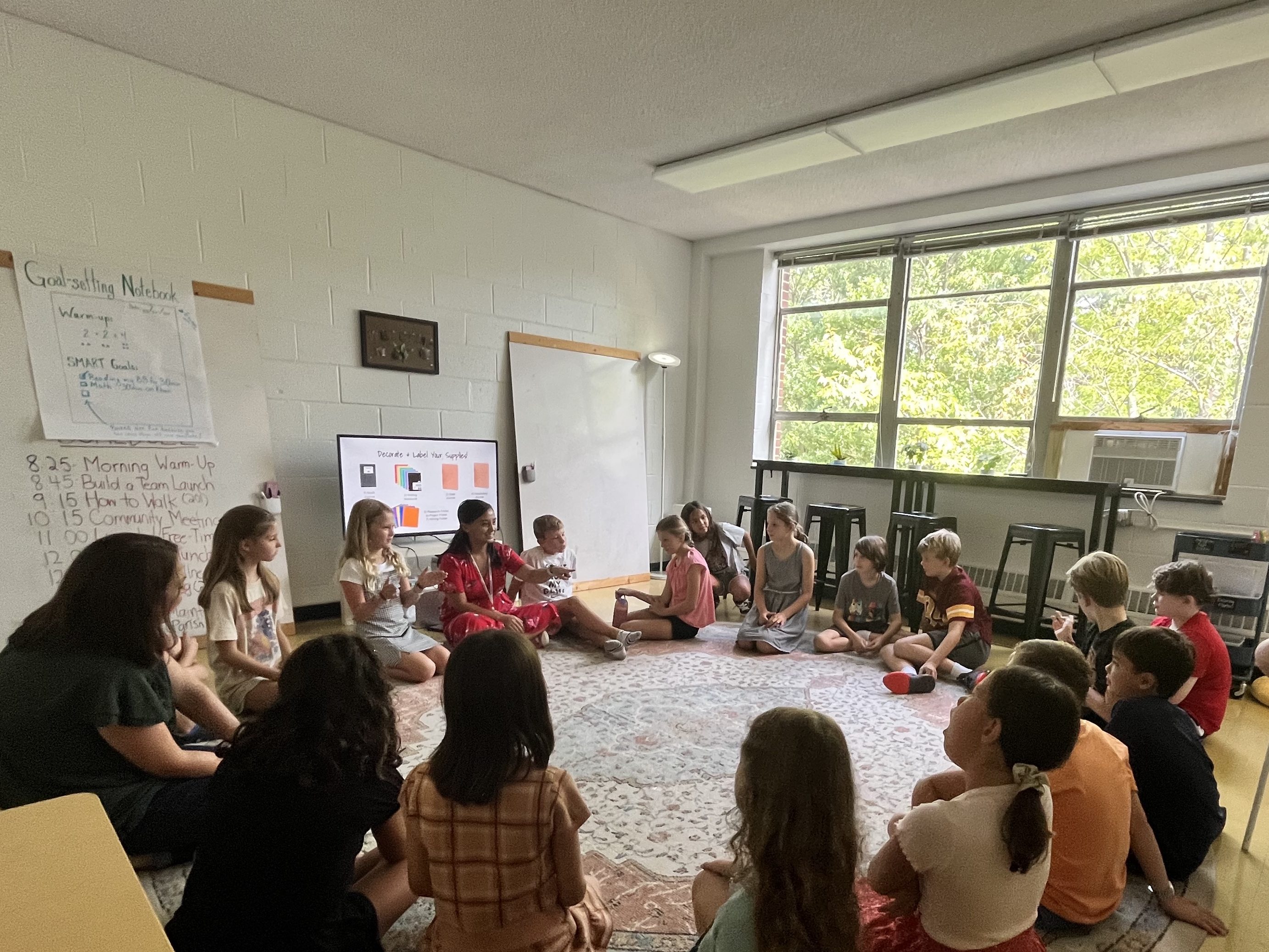
A reasonable request made by someone clearly intent on respecting others’ time and staying true to an agenda, delivered in the thoughtful tone of a leader. This is something one would expect to hear in a corporate leadership meeting or in the halls of our democracy. In actuality, this came from a 32-person community meeting composed of seven to eleven year old learners and led by two peers.
This first session of the year, Discovery Studio has been singularly focused on one goal, to build the team. To that end guides have facilitated opportunities for the learners to get to know their space, peers, and expectations for self-directed learning. As a new Guide at The Village School, I’ve similarly been discovering what to expect. Before the year started, I read blog posts and heard stories of the difference between TVS learners and students I may have had before. I was particularly enchanted by the tales of studios where every learner is a guide in their own right, sharing wisdom with peers and taking an active role in the creation of their community. How mystifying to see for myself the truth of these tales.
There is a special kind of joy as an educator in being in partnership with your learners and at times feeling redundant. More than once when I have noticed a learner who may need support and thought to offer aid, another learner has beat me there. When I move to alert learners to the time and direct them to what is next on a schedule a learner is doing the very same thing before the words leave my mouth. Moments when I look around a community meeting, consider encouraging the learners leading the discussion to bring everyone’s attention back together, and one of them does it instead with the grace of a seasoned executive. All I can think is, that’s The Village School difference.
As the first two weeks of school come to a close, Spark learners are becoming more comfortable in their new studio environment. Learners have joined together from different educational spaces and have brought their jovial personalities in to make Spark Studio a welcoming place. Friendships are being made each day through circle, morning work, and project time as they embody the profile of a learner.
During the first session, learners are learning to learn. They absorb lots of valuable information to help their community thrive in a meaningful way. Boundaries are created and modeled by learners to promote positive interactions as connections grow. Learners have introductions or presentations on practical life activities which prepare them for everyday life, sensorial materials that explore the senses, math, and reading.
An immense amount of effort and dedication is seen from younger learners as they learn to do a plethora of things. We see it shining through at their every effort as they explore the materials during morning work. The excitement in their voices when their eyes laser in on a material that they’re curious about and want to engage with is a joy to watch. Older learners are taking the initiative to show them the ropes and younger learners eagerly look for their return when help is needed.
Learning to live together seems to come naturally. The respect and compassion learners give each other is unmatched. Speaking in a nice way and communicating their thoughts to each other results in positive outcomes. If you’re wondering if the profile of a learner helps to cultivate friendships, our observations will probably say so. What will Spark Studio do in a few sessions? Will they lead and surprise their community? Will they come up with new ideas to help their studio thrive? We can’t wait to see!
Last spring the middle schoolers were late coming inside from their typical 45 minute afternoon free play. One or two learners straggling in after the majority of the group was not rare, but on this afternoon the entire group was late. It was one of those early spring days where the sky was extra blue and the sun was warm enough to remind you that summer was just around the corner. I figured it was the too-good-to-be-true weather that was to blame, so it wasn’t until the following day when we all headed outside to lunch that I realized what had stolen their attention: the sandbox.
The middle schoolers had created an intricate world of sand tunnels in the 10 x 10 sandbox on the playground. Instead of eating lunch first and then playing, which was our normal routine, lunch boxes were flung to the fence, and everyone picked up right where they left off, playing in the sand.
I stood there for a moment taking in the sight of these middle schoolers kneeling, laying, and sitting on the edge of the sandbox engrossed in imaginative play. I found one of the abandoned Adirondack chairs, usually never found empty, sat down, ate my lunch, and took in the scene. For over an hour I listened to the sixth, seventh, and eighth graders use their imaginations, work together, laugh, and reach a state of flow that caused them to find joy and forget time. I also chose to forget time – the freedom to follow the child is exactly what being a Guide at The Village School is all about. I found joy in the (rare compared to their peers) opportunity that these young people had to play in a literal sandbox, and felt gratitude that this type of experience is not a rare at our school.
Over the next several weeks the sandbox play continued. Each day the learners would return to their previous day’s creation and start anew. The younger learners would admire their work from a distance, somehow realizing the special synergy that was happening between the older learners and not wanting to disrupt it, they actually went out of their way to protect their creations. Another guide started recording other learner’s reactions to the new situation in the sandbox each day.
“Beautiful!”
“Awesome!”
“This is so cool!”
“What will they do next?”
“Ants, the ants could live in it!”
“No, don’t step on it, you’re breaking it!”
“I wonder how they made this!”
“Wow!”
I couldn’t help but think of how different this experience might have played out (pun intended) at a more conventional school. Elementary school learners in most Virginia schools are allowed 30 minutes of recess, many times split into two fifteen minute sessions, and the fifteen-minute middle school break that was recently reinstated doesn’t include a playground or a sandbox. I acknowledge that play can and should transcend the literal playground – but the typical experience reflects how and when we value play..
At TVS, playful learning is a goal of ours each day, not just for our youngest learners, but for all of us – including our guides. As a guide team we spent the summer studying the research-based pedagogical approach, playful learning. Harvard researchers write extensively about the importance of taking a playful stance – suggesting that playful learning happens anytime a learner is
Leading their own learning
Exploring the unknown, and
Finding joy
The researchers go on to claim that “playful learning in school occurs when students want to be doing the same as what their teachers want them to be doing” which can happen beyond the playground, and the sandbox.
Last spring, around the same time that our middle schoolers immersed themselves in the literal sandbox, our guide team hosted a professional learning event at our school. Participants from a diverse range of schools and contexts showed up to network, tour our space, and consider our learning design. To close out the event, we asked the attendees to gather in a circle and share their takeaways from their time learning about our school. As a team, we were interested to see what stood out about our space. One participant shared something that has stuck with me ever since:
“I’m inspired by the room for ambivalence in every space. It feels like a wonderful invitation to not have someone tell you who or how you should show up each day.”
I’m curious if this comment was inspired by the sustainability park models that were mid-creation in several studios. There were uncapped glue sticks, markers, tangled yarn, torn construction paper scraps, cardboard box fragments, and random pieces of recycled materials strewn around the room. Little did she know that her comment captured the heart of a pedagogy of play and our school’s mission.
The middle schoolers sandbox story serves as a powerful reminder of our mission here at TVS. In The Design of Childhood, Alexandra Yang writes, “Sand is a material that lends itself to sharing, making, and remaking…..the player has to create her own intrinsic fun.” This is our mission each day and each year at TVS. We set out this year and every year, to create a space where young people have agency over their own learning and the freedom to create their own experience, remaking it as many times as they want.
Yang also wonders, “Maybe sandbox games are the playground adults don’t realize they still need.” This year we invite you to join us in the sandbox – come share, make, remake, forget time, and find joy with us!
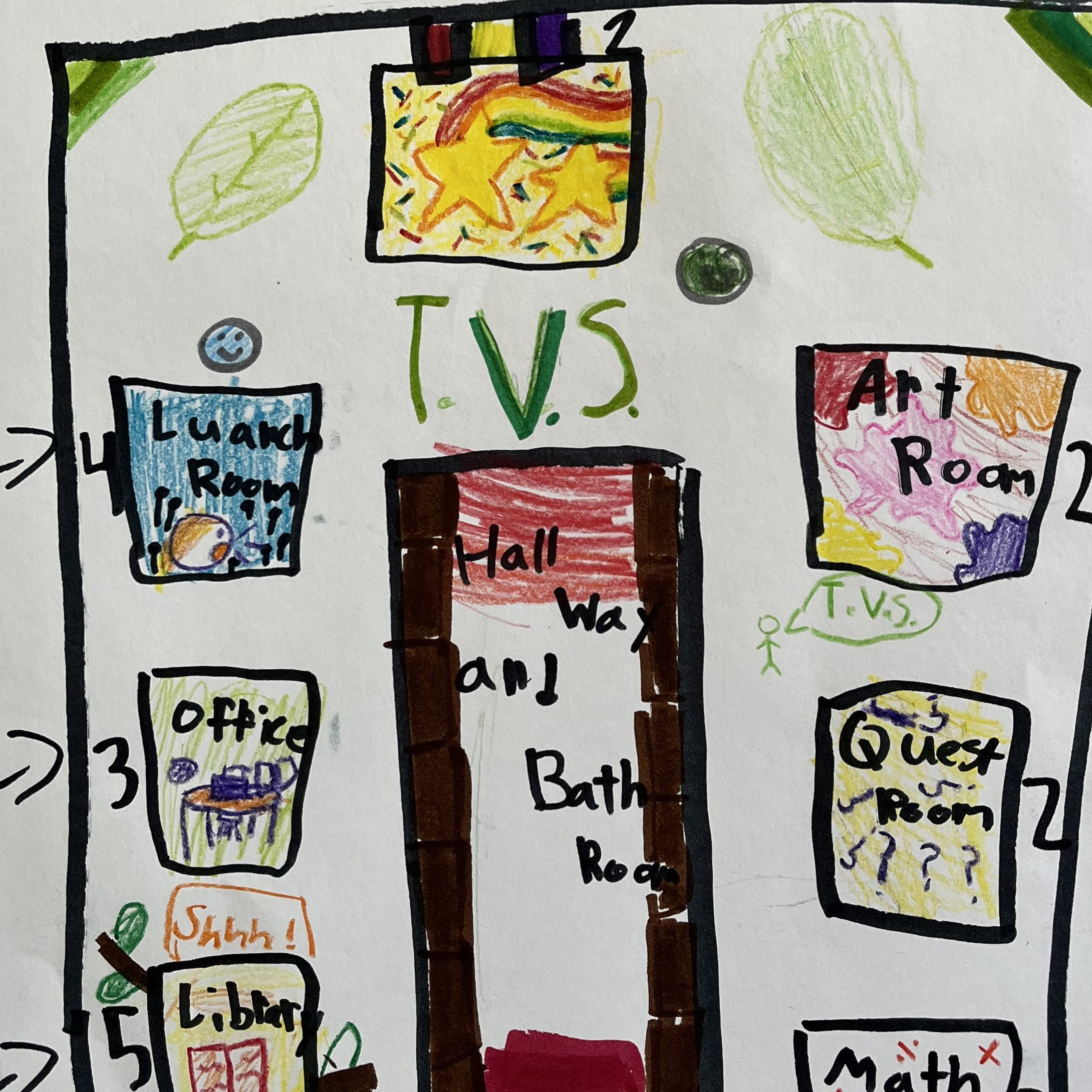
Welcome to Spark Studio! Spark learners will dive into the first session individually and as a community as they learn to live together in their new environment. They will focus on building their independence and collaborative relationships through grace and courtesy lessons. Each week, learners will gain an awareness of how their personal actions affect the studio and learn how to make respectful and kind choices that they outline in our studio contract. They will model and practice routines in the studio, as well as explore materials in the practical life, math, sensorial, cultural, writing, and reading areas. Through hands-on learning activities in their new project space (formerly the movement room), they will further explore what it means to be a community. They’ll work with a wide variety of materials to create self-portraits and harness their collective creativity to build a large-scale model of The Village School!
Discovery Studio
For our first session of the year, Discovery learners will be entirely focused on building our studio community. To do this learners will be immersed in activities and tasks aimed at developing an understanding of their space, others, and themselves. To get to know their space, learners will first be responsible for establishing common expectations by collaborating on a studio contract, maintenance procedure, and general routines. While learners will have many opportunities to build relationships with every member of the Discovery Studio, they will become an expert on one fellow trailblazer by designing a “Portrait” of that learner. Our learners will also engage in a descriptive writing memoir project to reflect on their own strengths and recognize themselves as trailblazers as well.
Adventure Studio
Welcome to the Adventure Studio! This session is all about building studio community and culture. For the Build the Team Project, learners will explore and identify the unique gifts they bring to their community and dive deep into what it means to be part of a team. Learners will have the opportunity to stretch their individual abilities and collaboration skills as they focus on a different Build the Team challenge each week. These challenges will include establishing a studio contract, constructing a badge plan, creating a music video, planning a field trip, and building a symbol that represents their character growth throughout session one. Each challenge will encourage learners to consider what makes a trailblazer and a community of trailblazers.
For Communications, learners will examine their own values, beliefs, and passions. What is important to me? What life lessons have I learned, and what have they taught me? Learners will work through each step of the writing process, practice giving and receiving feedback, and share recordings of their essays during Exhibition. Reflecting on their beliefs and values will aid learners in identifying the characteristics of the team they want to build, and ultimately, the kind of world they want to live in.
Health & Wellness
“By acknowledging our children’s emotions, we are helping them learn skills for soothing themselves, skills that will serve them well for a lifetime.” – John Gottman, PhD.
Emotions and feelings… What are they? How do they feel? And how do we handle them? These are some of the questions we will be exploring together during session 1 of Health and Wellness. We will explore the emotions of others, what they look like, and how we know how someone else feels. We will also explore how these emotions feel for us. How do we know we feel angry, sad, happy, joyful, lonely, or surprised? What signals are our bodies sending us? Once we recognize the different emotions we feel, we will better be able to understand how to cope with uncomfortable emotions. The learners will be introduced to mindfulness practices and tools for how to identify emotions. We will also play fun team building games at the park and work towards building a peaceful community together!
I’ve definitely romanticized those long boring summer months of my childhood: lazy mornings spent on the back porch, living in my pajamas well after lunch, hours spent at the neighborhood pool, and captured fireflies staring back at me through glass mason jars as I slept. Now that I think about it, maybe I’m not romanticizing at all; it does sound pretty magical. I grew up in the 80s, and my mom was a teacher who had the summers off – and she took those summers seriously. They were full of art classes for her and museum trips to Washington, D.C. for us, and a few camps here or there, but she was thoughtful to keep just the right amount of time for us to get lost in our own boredom. I remember those long days of “boredom” vividly. Once a few neighborhood kids and I built a huge fort out of the ridiculously large cardboard boxes that we collected from a recently purchased Nordictrack. The fort took us days to create, and we played in it for at least a week. We painted it, ate lunch in it, hid snacks in it, and created a whole new cardboard universe. There is only one explanation for how we crossed over the threshold into that cardboard world: we were bored.
Who knew how intuitive my mom was, ensuring boredom and play were a part of our summer experience. She knew if she ignored our “I’m booooarrrrds” enough, something inside us would unlock and over that threshold we would go. (In college I wrote an essay titled, My Mom Was Right – so I should have known.) Regardless of her educator instincts, neuroscientists confirm her narrative; research continues to emerge claiming the important role boredom plays in maintaining our mental health – a topic we are all concerned about these days.
We take that magical kind of free, unstructured play seriously here at TVS, too. Playful learning is a signature part of our learning design. Learners from ages 4-14 have an average of 2 hours of unstructured free play every day of the week, a stark contrast to the typical recess allotment. This summer our Guide Team is reading Project Zero’s latest research on the subject in a book called, Pedagogy of Play, which will inspire and equip us to infuse even more of a playful approach across studios.
At the risk of sounding trite (and old), I’m not sure kids these days experience the same type of “boring” summers. In the culture of overscheduling, overcommitting, and overextending, do kids even have the chance to feel bored and lean into that boredom and play? Acknowledging that a summer full of pricey camps is a privilege and not an option for many families, finding playful moments is still very much a possibility. Researchers who have spent their life’s work studying this topic remind us that playful moments can happen anywhere, anytime.
As the parent of an 8 and 10 year old, I have to remind myself of the benefits of playtime, especially when my email inbox explodes with summer camp registrations in January each year. (Those emails usually haunt me until Spring Break.) Dare I say it, boredom and free play is actually my number one summer priority for my kids.
Owen, a middle school learner, spent six weeks researching the role of play and writing a speech advocating for just this kind of experience for all kids. His speech is titled: Play is not a Privilege, It’s a Right, and we wholeheartedly agree. Read an excerpt of Owen’s speech and see if you aren’t inspired to allow yourself a little bit more time to get bored and play.
Play is not a Privilege, It’s a Right.
by Owen Quinn
As a kid do you remember getting home from school, throwing your bag on the ground, and then running down the street to play with your friends? You then quickly ran back because you forgot to do your chores. You finish up and bolt down the road. Your other friends are already there and maybe they’re doing something inside, or you played tag on the lawn. This is called free play, and it is very important.
And the truth is, most kids these days, in places like Northern Virginia, won’t experience a lot of free play. Kids are overscheduled, with sports, tutoring, and so on. And beyond that, these extracurricular activities are very intense to the point that for many kids, the spirit of the game is lost. Coaches and parents trade fun for winning.
I’ll tell you why this topic matters to me. I love free play. I always have, though there have been times in my life when I didn’t have time to free play. Here is the story. Two years ago I wanted to try lacrosse because I thought it would be fun, and it was! But coaches kept telling me I was behind, all because I started late, as a 10-year-old! I apparently had to have been playing since I was 3.
Almost all of the kids on my team were on a travel team as well, and I thought this was the answer. So I signed up for travel lacrosse. And I’ll admit, I got better, but the tournaments were so intense, they weren’t fun. And this was when I realized, I didn’t have to play travel. If my heart isn’t in it, what am I doing here?
I do not play travel lacrosse anymore, but I still love to play recreational lacrosse. I don’t have anything against travel sports, I just know that it wasn’t for me, and I believe there are other kids like me, who feel pressured.
I have more time now for things like going to the woods to build forts, skateboarding, and doing projects such as building a business. I love all of these things because I feel I have a lot of freedom within them, and it feels a little like free play. Don’t get me wrong, I think it is very important to play at least one team sport, but something that is even more important, and is lacking in kids’ lives, is free play.
Schools also need more free time so kids can play. The average school recess time in America is 25 minutes per day. Studies show that kids should have longer free time, the average being 1 hour a day. Kids that have short recess do not have enough time to get all their energy out and they come inside still in hyper mode. So some schools never even let the kids outside in the first place. This still doesn’t work. Exercising is part of not only your physical health but also your mental health.
I know that kids like me need to move their bodies a lot. I don’t know about other kids, but I require exercise to feel happy. After moving my body I feel reset, and I feel much happier. Kids that have at least an hour of recess are proven to perform better in school. People might believe that as you get older, you need less time to run and jump around, but that’s not true. All kids deserve the chance to move their bodies.
All kids also need to take risks. Risks are very important, especially for the adolescent mind. Risks help kids create a sense of independence as they become young adults, they allow kids to see what they can do and see what their limits are. And good risk-taking in adolescents is proven to make kids happier. And now you may ask, what is the difference between good risk-taking and bad risking taking? Research shows that kids that do not have a good outlet for risk-taking may take risks in unsafe ways, such as drugs, fighting, self-harm, or breaking the law, all of which are proven to give kids anxiety and depression later in life.
A good risk gives you a healthy dopamine rush. Some examples of good risks are rock climbing, mountain biking, martial arts, skateboarding, and parkour. Or if you’re not into athletics, you can take risks by joining some kind of social club, or within academics, entering a spelling bee is a risk.
Not all of these are factors of free play, but a lot of games or activities in free play will allow the healthy risk of these kinds. Free play allows kids to take risks without breaking someone’s trust.
Free play also builds social skills. My generation is full of kids that lack social skills, but why? I believe this has to do with a lack of free play. Free play without any structure, will lead to small arguments and conflicts between children, which is completely natural, and good for children. They may argue about what game to play, where to play, over the rules, or just conflicts about completely silly and random things. Kids usually end up with reasonable solutions. If kids never learn how to resolve these conflicts on their own, when they go into the real world, how will they know what to do?
Lenore Skenazy, author of the book Free-Range Kids says, “We want our children to have a childhood that’s magical and enriched, but I’ll bet that your best childhood memories involve something you were thrilled to do by yourself. These are childhood’s magic words: ‘I did it myself!’”.
So, now you know. You know that schools need more free play in their schedule, kids need free play to take risks, and kids need free play to build social skills. Kids need to play. Play brings out who you are. Growing brains are meant to play, and they are meant to play a lot.
This week we wrapped up our fifth year as a school community. Per TVS tradition, we marked the calendar with end-of-session studio celebrations in which families, guides, and learners gather to reflect on our year together.
By this point of the year, there is an intimacy that wasn’t there in the Fall. Traveling down the road of a school year together, we’ve developed new friendships, connections, and understandings made possible by the many experiences we’ve shared this year. That blank slate of a school year before us has been filled. What was once unknown is known- each of us familiar with the design, systems, and people that make up our very special “village”.
In a micro-school like ours, every person is intimately known and valued. In addition to our small size, our learning design honors the individual as the center of all learning. Our systems and processes ensure that our guide team knows each learner on a personal level and invites our families to join us in seeing and celebrating the special traits of each young person as they grow and learn.
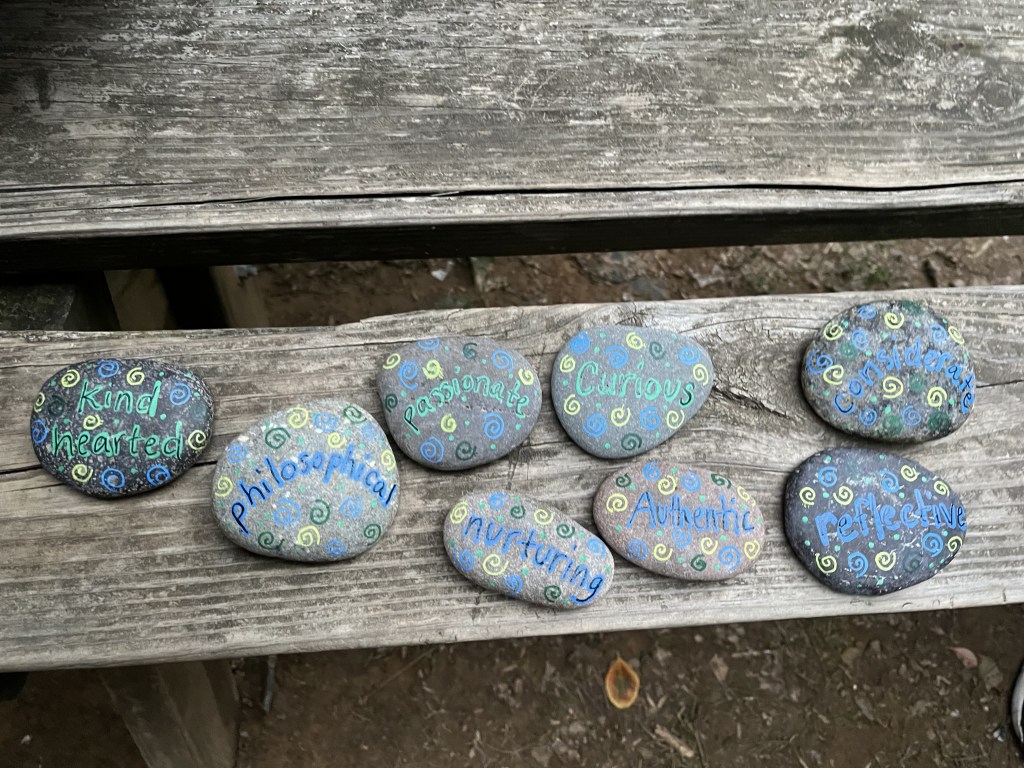
At our end-of-session celebrations this week, each learner was presented with a special character “rock”, displaying a single word that represents a character trait that the learner has exemplified this school year. Words like “Authentic, Curious, Perceptive, and Brave” are imprinted on individual rocks and presented to each learner by their guides in the company of their peers and family members.
In addition to the presentation of the character rocks, many learners give speeches, reflecting on their own personal growth in character and beyond. Not surprising, the unique anecdotes, stories, and advice in their speeches often illustrate the very character trait they find written on their own personal rocks.
A learner who is recognized for being innovative, states:
“I learned how to use other people’s advice and import it into my doing.”
A learner given the trait “courage”, gives advice to new learners and says:
“Be yourself and everything will work out!”
From a learner described as “perceptive”, we hear:
“There are still times when I will let my desire to do things perfectly slow me down. But since I know this about myself, I ask for help, move forward, and create something I’m proud of- not something that’s perfect.”
A learner who is celebrated for their confidence exclaims:
“One of my favorite quotes is If you can dream it, you can do it. This quote by Walt Disney reminds me that I can do anything I put my mind to and so can you!”
Yes, in a school such as ours, we have the great honor of seeing, knowing, and celebrating each and every learner on their journey of becoming. And yet, as we celebrate their unique character traits at this particular moment in time, we acknowledge that it is in fact a journey. This moment, while worthy of celebrating is also fleeting- tomorrow our learners will surprise us in new and unexpected ways by transforming into something yet unknown. Grow, learn, change, repeat, repeat, repeat. It’s what childhood and adolescence were designed for.
Perhaps our great task as guides and parents is to embrace a practice of “unknowing”, seeing them each day with curious, fresh eyes- knowing that they will carry only pieces of these traits with them into tomorrow.
As we end our fifth year as a school community, I am celebrating our own unique journey of becoming at TVS with gratitude, awe, and openness to all that awaits- knowing that we carry so many beautiful pieces of who we are today into the next great adventure of tomorrow.
During our last session of the year, we want to take some time to reflect on where we have been, how things have changed, and all that we have learned. In Discovery Studio, learners are challenged to write a speech to share at Exhibition with their family and peers reflecting on their journey over the past year. How was the start of their journey different from the end of their journey?
While brainstorming some learners shared:
“The beginning was confusing, now I am more sure”
“I am reading more now”
“More focused”
“I was shy at the start, now I am more outgoing”
“It took 2 weeks to make friends”
“I’ve grown to realize what I can work on, my strengths and weaknesses”
“Now we are more united, more of a community”
They also took some time to think about who they are becoming as whole people. When asked what characteristics they have you grown in, learners responded:
“Perseverance”
“Creativity”
“Being brave”
“Determination”
“Curiosity”
Reflection helps us understand our experiences. When we reflect, we can determine what we want to keep doing because it was rewarding or because of how it made us feel and what we, or future learners, might do differently next time. It helps learners self-assess and is vital for growth.
When asked what was one lesson they learned from the year, learners shared:
“Focus = progress and success, which leads to mastery”
“Trying new things, it leads to good things”
“Learn to fail”
As learners transition into the next year, what might they tell others to equip them with tools for success? How can they help someone with what they have learned? If being distracted was an obstacle for them and they felt very frustrated by it, it might be for others as well and how they overcame it can be shared with other learners.
Learners will think about the legacy they want to leave behind. They have the opportunity to inspire their community with stories of any mistakes they learned from and by expressing gratitude for those that helped them along the way.
At the end of Session 7, learners will introduce themselves, describe obstacles they faced, tell a story, describe something they have overcome, and share quotes and advice. We can’t wait to hear what they have to share!
The word is out on learner-centered education and we couldn’t be more excited about the number of educators who are passionate about our mission here at TVS. After reviewing over 150 guide applications, 40 phone interviews, and 15 in-person (and learner-led) interviews, we are thrilled to welcome five new Guides to complete our team and help us welcome new families to our community for the 2023-2024 school year!
At the same time, some of our current team members will be taking on new roles. It is our hope and belief that these positions will strengthen our learning design, our community, and our ability to deliver on our mission.
New Team Members
Aaryn Drapiza- Lead Adventure Studio Guide
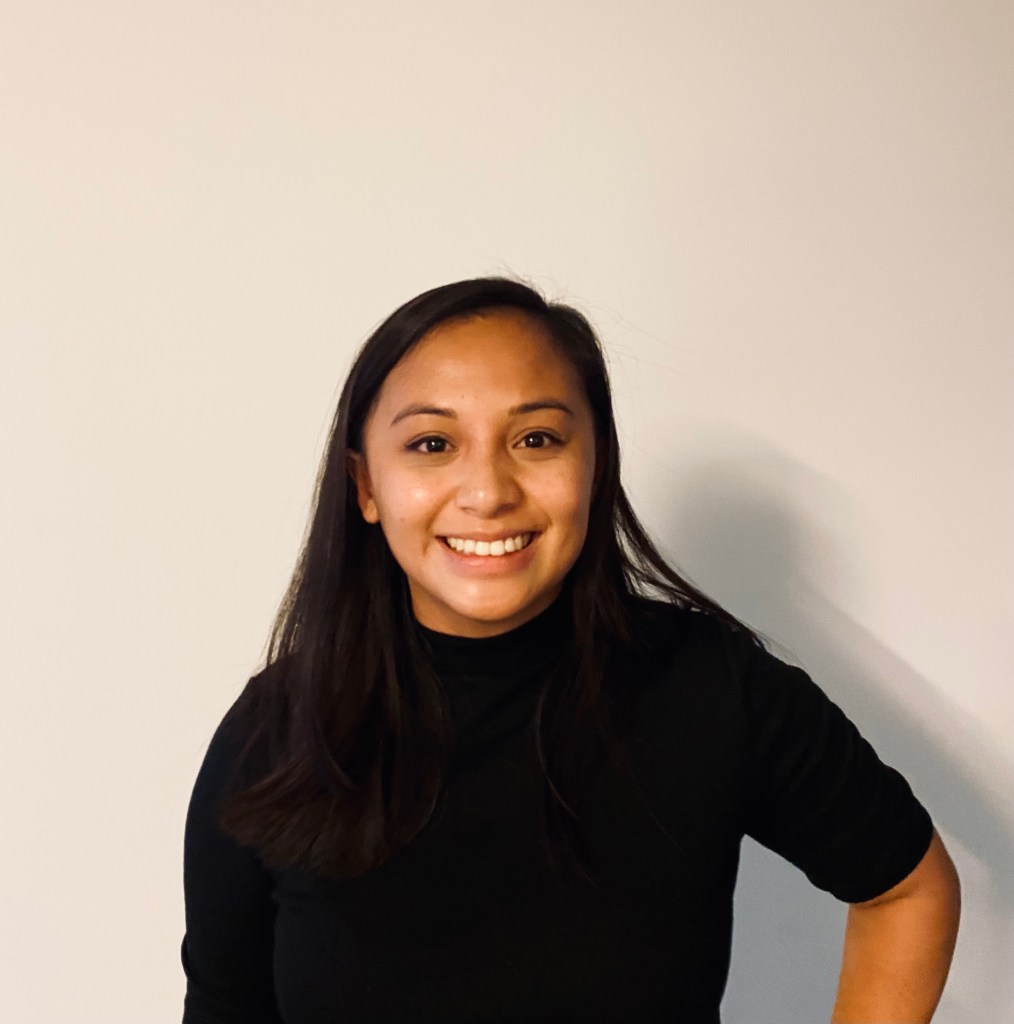
Aaryn is a lifelong learner and deeply passionate about inspiring others to follow and nurture their natural curiosities. She discovered her love of guiding learners while working with children of all ages as a swim teacher, teacher’s aide, camp gymnastics instructor, and nanny. After graduating with a degree in Humanities, a discipline that challenged her to think critically and never stop asking questions, Aaryn pursued a path in education so she could continue inspiring, equipping, and connecting young people on their journeys. Aaryn has worked as an Elementary Guide and Lead Middle School Guide and is excited to further her education experience at The Village School. She also has her Upper Elementary Diploma from the North American Montessori Center. In her free time, Aaryn enjoys listening to audiobooks, singing along to musicals, running, and exploring DC.
Madelyn Brewer- Lead Discovery Studio Guide
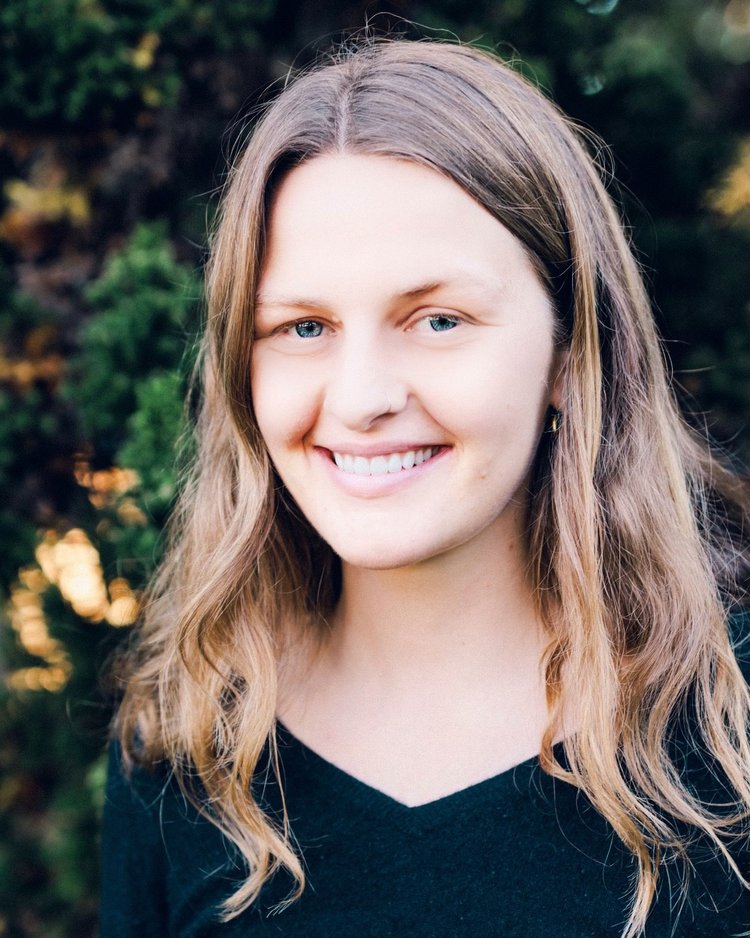
Whether it is discovering what makes something float or memorizing the lyrics to the latest Disney hit, Madelyn aims to guide learners with the same boundless enthusiasm and curiosity that they embody every day. Madelyn received her Bachelors in Philosophy from Connecticut College in New London, CT. However, it was her volunteer time and work outside of school that inspired her to pursue education. Since beginning her career, Madelyn has taught at a country day school, a project-based micro-school, and a parochial school. Madelyn is eager to join a school community where she can prioritize what she considers essential for young people to thrive–a multifaceted approach that nurtures curiosity, confidence, and independence. It was only natural that she found her way to The Village School!
Cara Borja- Lead Discovery Studio Guide
Cara has a strong passion for the fields of science and education. She received two undergraduate degrees in biology and psychology from the University of Maryland, Baltimore County, and a master’s degree in neuroscience from Brown University. During her studies, she actively pursued teaching opportunities and obtained professional teaching certification in middle school science. Her professional work experience includes being a researcher at the National Institutes of Health, working for non-profit communities in Washington, D.C., and being an educator in multiple areas in the DMV.
She loves building connections with young people, enhancing their knowledge and curiosity about the world, and having the opportunity to make a positive influence on their lives. She is thrilled to be continuing her journey at The Village School!
Lauren Coyle- Lead Spark Studio Guide
The first “classroom” Lauren experienced was the grapefruit groves her family cultivated for generations, where she dug in the dirt and helped care for trees with her dad. There, she learned that education is more than desks and tests; education is experience, learning with your hands, and cooperating with others to grow something new. Lauren loves witnessing each child’s unique sense of wonder about the world and welcomes the chance to be curious with them as they learn.
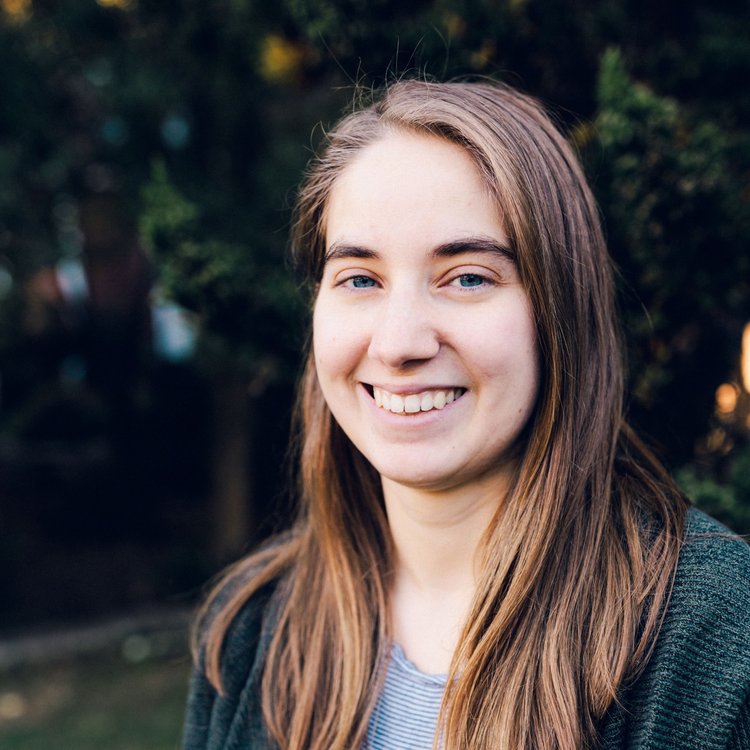
Lauren has a B.A. in psychology from The College of William and Mary and a doctoral degree in clinical psychology from George Washington University. Alongside coursework in child development, Lauren interned at two different schools in D.C. She completed her residency at a community mental health center in Fairfax and then continued there as a full-time clinician, conducting individual and group therapy sessions for patients of all ages. After taking some time off to raise three toddlers, Lauren grew passionate about combining her background in psychology with early childhood education and five years ago returned to the workforce as a lead teacher at a Reggio-Emilia-inspired preschool. She is excited to join The Village School Guide team and aid in cultivating young learners’ natural ability to follow their interests and learn in community with others.
Lauryn Elliot- Visiting Guide
Born and raised in Northern Virginia, Lauryn is a native of the area and has always strived to give back to her community in any way that she can. Lauryn is a member of Delta Sigma Theta Sorority, Inc. and crossed at James Madison University where she earned her B.A. degree in Justice studies with a minor in Political Science and pre-Law. Lauryn is currently pursuing an M.S. in Political Science at Liberty University and has hopes to earn her doctorate degree. Lauryn has always had the enthusiasm, determination, and passion for being a guiding hand for the younger generations and has witnessed firsthand how different pedagogical approaches can improve a child’s education. Lauryn is excited to join a community of life-long learners at The Village School and support the mission of empowering young people to become architects of their own learning!
New Roles
Hannah Runyon- Program Designer and Camp Director
Hannah graduated from Colorado College with a degree in Geology and Environmental Issues. She is passionate about inspiring curiosity and critical thinking in connection with natural world and has worked with children of all ages as an environmental educator, mentor, camp counselor, nanny, and wilderness trip leader. Hannah grew up in the Adirondack Mountains of Upstate New York and attended non-traditional schools as a child. In her free time, she likes to run, make clothing on her sewing machine, bake, and make pottery.
Hannah has spent the last two years at The Village School as an Apprentice Guide and Discovery Lead Guide. She is excited to be stepping into the role of Program Designer and Camp Director for the 2023-2024 school year, which will allow her to utilize her passions and talents for learner-centered curriculum design and outdoor education. Although Hannah will miss guiding learners each day in the studios, she is excited for the opportunity to design and lead camps at TVS throughout the school year- and as always, to continue learning!
Rebecca Blake- Assistant Guide and Extended Day Coordinator
Rebecca grew up in Northern Virginia exploring nature trails and historic sites in the area. She received a BBA in Computer Information Systems from James Madison University and worked for a technology company before moving into education. Creativity and play foster a love of learning she is passionate about sharing. She spent a year teaching a nature class, helping students explore the woods, cultivating youth leadership, and teaching technical outdoor skills in a mixed-aged learning environment. Rebecca believes learner-centered education is crucial for keeping learners engaged and responsible for their own education, acknowledging individuals’ unique interests and strengths. She loves to see a learner excited to learn more about a new topic or feel pride in understanding a tricky concept. She endeavors to empower learners to think creatively, use empathy, and solve tough problems. In her free time, Rebecca enjoys reading and hiking.
Rebecca has spent the last year at The Village School as a Visiting Guide and Assistant Guide. She is excited to continue on as an Assistant Guide with the goal of supporting our Wellness and Spark programs as well as taking on the additional role of coordinating and overseeing TVS’s Extended Day program for the 2023-2024 school year.
Join us in celebrating our new guides and new roles to complete our team for the 2023-2024 school year!
In the last session of the school year, Spark learners are embarking on a four-week journey filled with potions, a variety of substances, and lots of water. This week, learners began this experience with an introduction to science and the precautions to take when participating in experiments. Learners learned that it is extremely important to wear safety goggles and gloves, to walk slowly as they gather materials, and how to keep each other safe as experiments bubble and fizz to no end.
Learners demonstrated their safety knowledge daily before engaging with substances and solutions. When the result wasn’t their expected outcome, they continued to explore different solids and liquids. Oh, the excitement on their faces when one group of learners potions started to overflow and purple water engulfed the wooden table.
Research has shown that there is a definite relationship between science experiments and learners. Science and its many experiments provide learners with opportunities for learning about life, Earth, and the universe. Observations, making predictions, drawing conclusions, and solving problems gives learners a first-hand understanding of how science works! Building upon these skills will be long-life, unleash creativity, and shape their ability to be open to others ideas.
As we dive deeper into science these final weeks of school, learners will engage in fun, hands-on activities that will further their interest. Working as a team to make discoveries collaboratively and putting their lives as scientists into action. After all, science is wonderful!
Guest Contributors: Hazel Hales & Charlotte Myers, Adventure Studio Learners
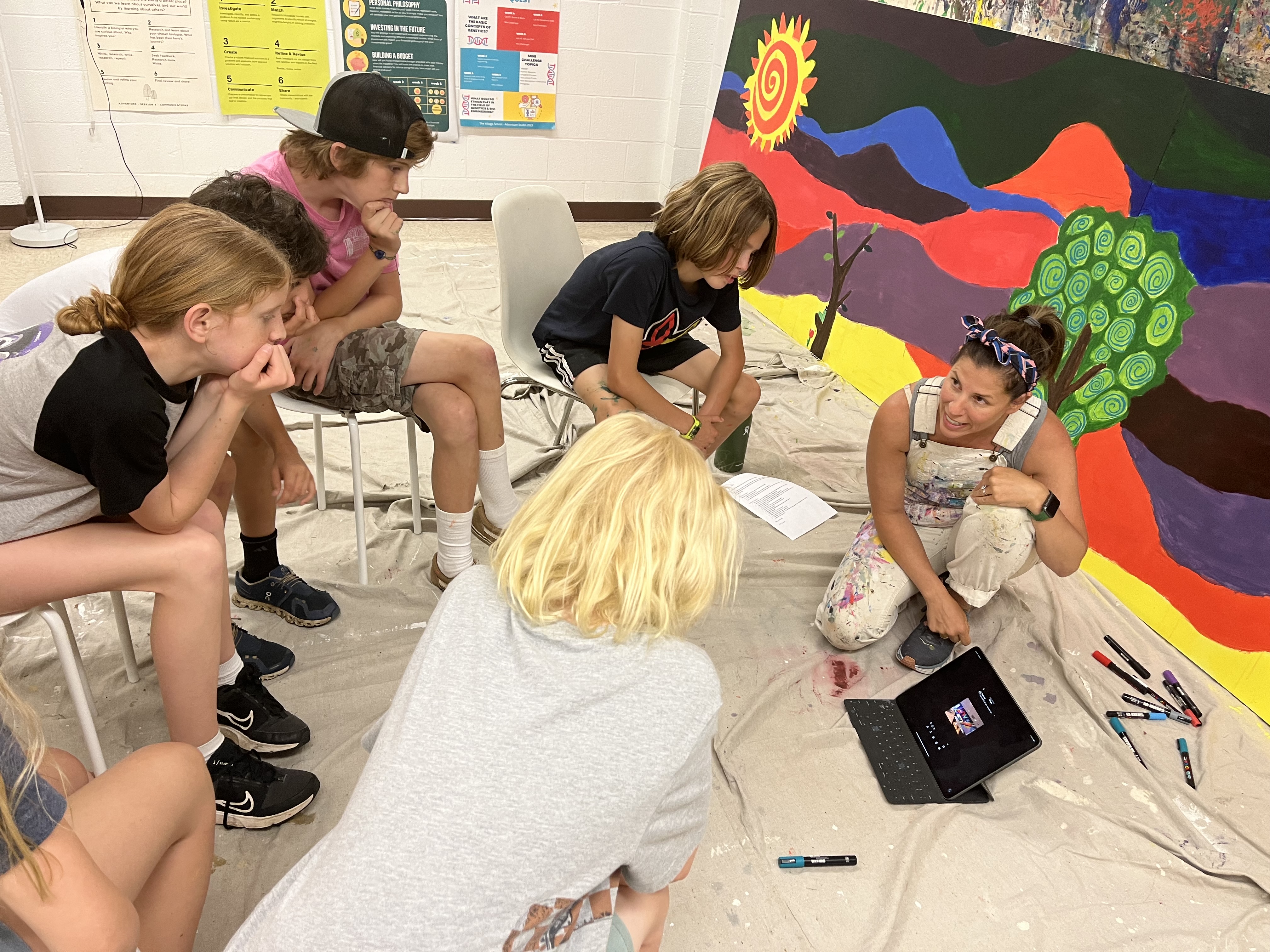
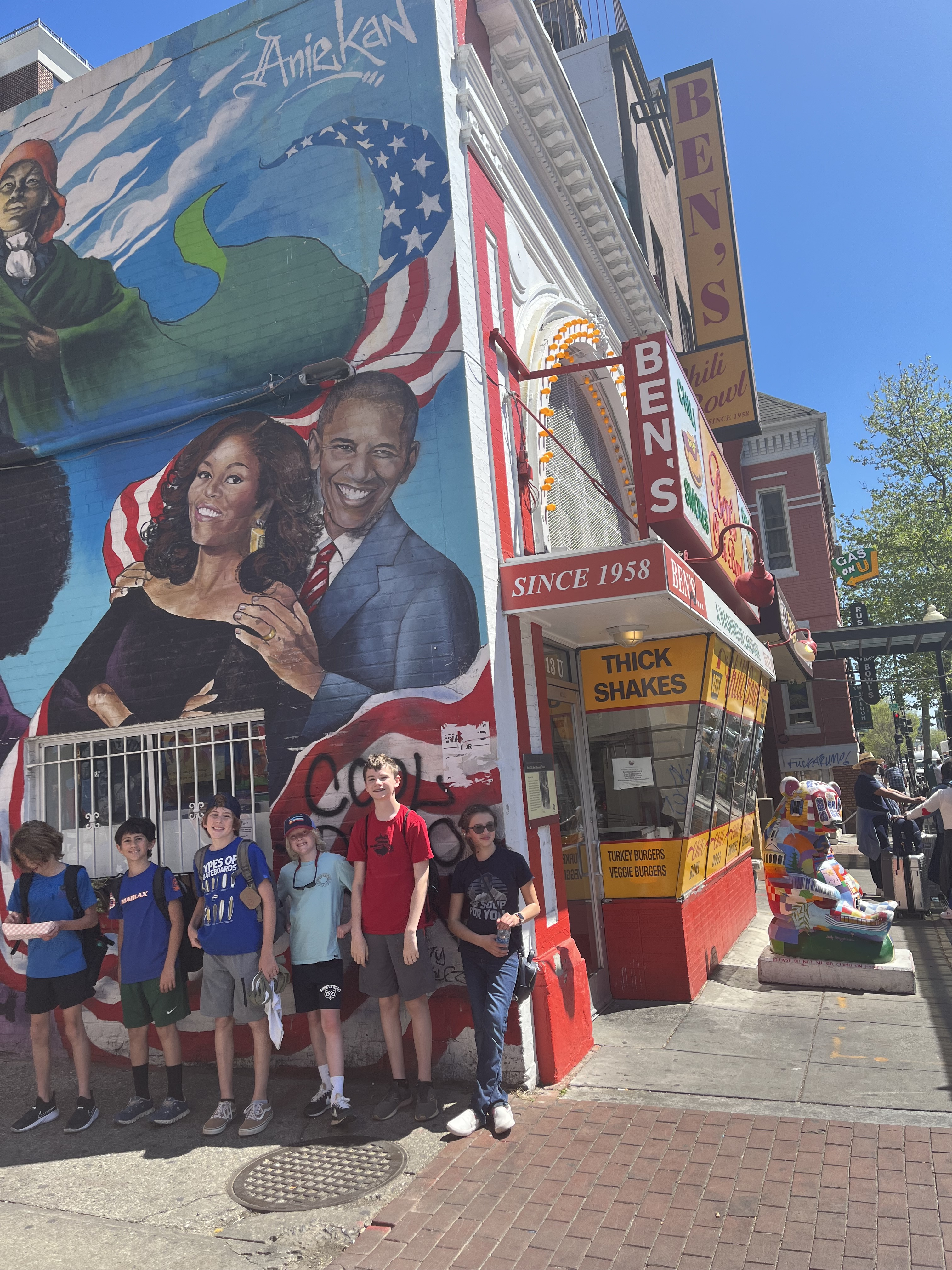
Adventure Studio was challenged to design and create a mural for the Session 6 Quest, based on the murals in Washington, DC. Although we faced challenges and obstacles, our mural exceeded expectations and we are proud to share it with the TVS community!
To start the Mural process, we took a field trip to DC, where we went on a Mural Tour. Studying these murals inspired a list of things that every mural has
vibrant colors
relatable to the location of the mural neighborhood/community
really big
represents something beyond – symbolic
We used this rubric, as well as input from the community, to create our designs. We split into three groups, each coming up with an individual design, and then combined them into the final design.
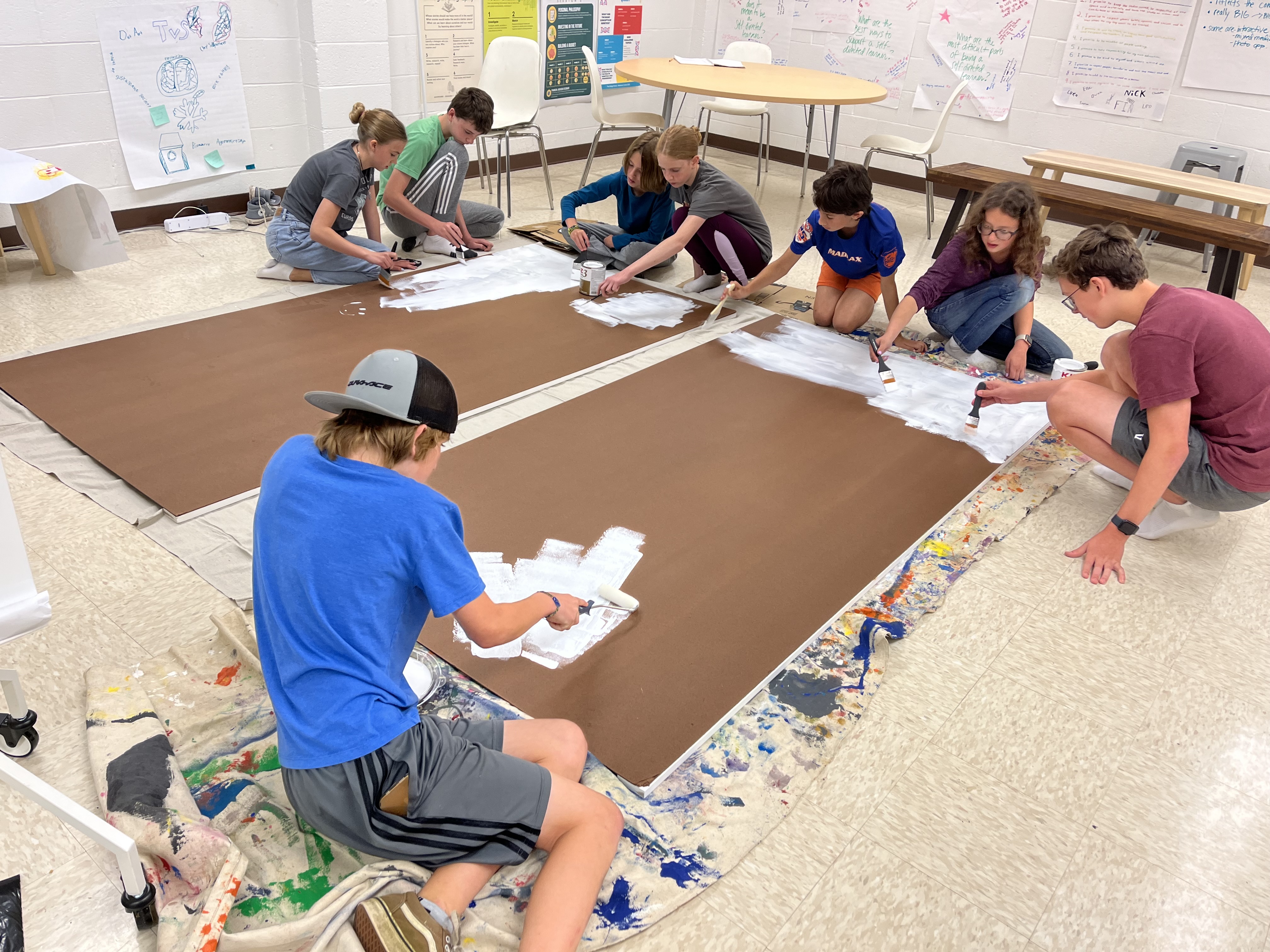
To start the painting process, we primed our masonite boards with two coats of primer (hoping to not get it on our clothes!), making it weather proof . And after two days of priming, we were ready to sketch!
Although mumbles of, “I have no artistic ability ” kept flying around, we were thankfully able to use a projector, projecting the image onto the boards and then trace the lines. This gave us a template to sketch it on the boards and would keep it proportionate. After finishing, we painted the entire thing with the first coat, and kept it up with the second and third coats, until week seven, when we finished and signed it.
This mural represents the journey of the learners and trailblazers, when they come to the Village School. There are many symbolic representations in our mural, and each message applies to our school.
The trees represent the growth of the learners as they move through the different studios, from Spark to Adventure. The caterpillar on the spark tree eventually turning into a butterfly on the Adventure tree serves the same purpose, representing growth. Next to the trees, there are symbols, a rose next to the spark tree represents a new beginning, the start of the hero’s journey. The apple represents discovery, since the apple that fell on Newton’s head led him to discovering gravity. The compass represents adventure, because of it being a necessary traveling tool, leading adventurers to their final goal, and destination. And the spirals on the sun and trees represent the journey, a cycle of accepting a call, embracing challenge, and learning important lessons.
Ms. Carrie, our Artist in Residence, was an essential part of this project. She provided us with materials and gave us guidance as we chose colors, size, placements, and how to fix mistakes, so shout out to her!
Before this Quest, a lot of us thought that we couldn’t draw very well, and that we were bad at painting. But, we’ve all grown in our understanding of art, artistic abilities, and ability to work together, and we made something that we’re all proud of.















 villageschoolnova.blog