Learning to Learn Math

I’ve never considered myself a “math” person until I became a high school English teacher and realized that there was no such thing as a “math person” just like there was no such thing as an “English person”. Throughout the ten years of my career that I spent as an English teacher, I made a point to share my appreciation for math with all of my students, many who were shocked that a person who loved books could also love numbers. Friends who were math educators and well-known educational researchers also helped me shake this misconception – and so did the statistics classes that I took during my doctoral studies.

So where did I get this idea? I know for certain that it originated early on as a result of the messages I received in school. To be a math person at school you had to be good at math, and to be good at math you must learn fast and solve problems even faster. In fifth grade, my math teacher would pass out our tests in order – best to worst score. Each week I would cringe with scarlet cheeks as she placed the last test in her stack on my desk, face-down, of course. If I had only had the chance to take my time, learn at my own pace, and most importantly, build confidence in my ability to learn to learn math – maybe I would have been a math, not an English teacher. 

The irony of the traditional math teaching approach is that math in the real world is meant to be slow – not fast. In a typical math class, the lessons are planned and scheduled before the school year begins leaving no time to plan responsively to the emerging needs of learners. Memorization is prioritized over conceptual understanding, and efficiency is prioritized over divergence. This type of learning is shortsighted, and as a result, turns many young people – myself included – away from understanding and appreciation for math. 

One of the most frequent questions we get about our learning design is often in the form of a complaint about math and they go something like this… “But, don’t you need a teacher to learn math?” “My kid really doesn’t like learning math this way.” “Learning math that way doesn’t work for my kid.” 

As a parent myself, I can relate to these sentiments – learning math is difficult and stretches a different part of the brain. I can also empathize with how difficult it can be to watch your child struggle to learn something, and how fear can creep in when I begin comparing my own children to their friends who attend different schools with a more traditional approach. When I slow down and think about the purposeful and research-based design of the math curriculum at TVS, my fears subside and I feel grateful for the opportunity my own kids have to learn how to learn math and develop confidence in their mathematical ability. 

The goal of the math curriculum at TVS is much different than the typical or traditional math classroom. In fact, we would posit that the two are designed for completely different end results. The goal of our math curriculum at TVS is to build each individual learner’s capacity for learning how to learn math- or even, more broadly, how to solve problems, so when they encounter math challenges or difficult problems in their future schools,  jobs, and life, they will have the ability to approach such challenges with confidence.  

Most parents, educators, and learners can get on board with our ultimate goal of building the confidence and capacity to solve difficult problems. It’s the process that makes us uncomfortable. 

For a learner, this process involves making mistakes, getting stuck, languishing a bit, feeling frustrated, avoiding asking for help, making more mistakes, complaining, figuring out what they need to learn, figuring out what tools they need, asking for help, finding momentum, making progress, feeling successful, making mistakes, getting stuck, (repeat, repeat, repeat!) Over time, the process of learning something new and challenging becomes far less intimidating, and learners draw on their previous experience to know what to do next.

Take an example of one of our oldest learners- a learner who has used Khan Academy to master arithmetic and pre-algebra, and is now halfway through Algebra I.  Recently, this learner was making mistakes as he worked through the practice problems on Khan Academy. He was stuck. Feeling frustrated, he started avoiding math. Enter the languishing period. Noticing this, his guides and parents checked in with him. He responded by complaining about how difficult the problems were and how Algebra was a “different kind of hard” than he’d ever faced in math. He said he wasn’t sure what he needed to learn it but “Khan wasn’t helping”. Enter the complaining phase. Curious about his approach, a guide sat next to him as he worked through a problem. When he got stuck, she suggested going back to the video and modeled taking notes. Once back at the practice exercise, the learner referenced her notes as he solved the problem. Instead of the reassuring “ding” that indicated he got it right, his selected answer showed red and a “not quite” message. Before clicking “start over”, he clicked on the hints to see how they solved it. He looked back at the notes and discovered what he had done wrong. He solved the next four problems successfully and moved on to the next lesson. This time, he took out his notebook to take notes.  At home, he confirmed with his parents that it is his goal to complete Algebra I this year. He made a weekly goal to stay on track and uses time outside of school to meet his goal if needed. Enter the finding momentum phase. 

At TVS, we are deeply familiar with this process of learning how to learn math. The experience we share here is commonplace; the learner described is not alone in his process of learning to learn math. Mastery-based learning is hard and frequently uncomfortable and gratifying and confidence-building. All of this is by design. While our learners aren’t exempt from getting stuck, avoiding work, or complaining as they learn how to solve difficult problems, through our learning design they adopt a core belief that they are capable of learning hard things. They might need more practice, more support, or more tools, as they explore and master new concepts, but thankfully all of these are within reach. 

As a result, I am certain that although some of our learners definitely enjoy math more than others, all of them would scoff at the idea that there is such thing as a “math” person. For this, I am so grateful.
Karma is a TVS Apprenticeship: A Community Partner Testimonial 

The Village School Apprenticeship is one of our most compelling signature learning experiences. The TVS Apprenticeship is our spin on the more conventional internship, typically offered to seniors in high school, if offered at all. At TVS we believe young people are capable of so much more than the world gives them credit for, so we naturally invite our middle schoolers, age 11-14 to step off campus and step into the “real world” to learn from experts in fields of their interests. The apprenticeship experience is a cornerstone of our school, as it draws on all three pillars of our learning design and puts our mission of empowering young people to discover their passions and share them with the world in action. 

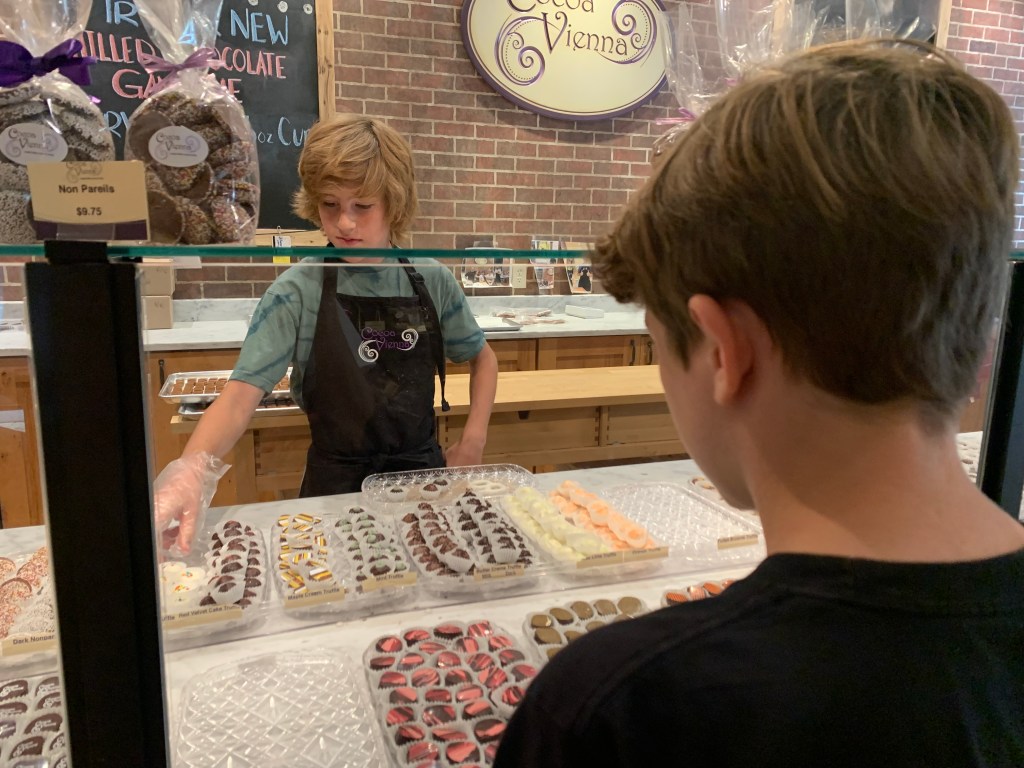
Over the past three years our middle schoolers have secured internships at the local farmers market, a costume design firm, a national accounting firm, a podcast recording company, the National Park Service, a local chocolatier, and the United States Senate. 

There are now dozens of brave adults who have welcomed TVS middle schoolers into their place of business – and it seems to us like it was a risk they are all glad they took. 

Below is the reflection of the CEO of a digital marketing firm who hosted a sixth grader for a 40 hour apprenticeship. We’re curious after reading their testimony about what you might say if a TVS learner reaches out to secure an apprenticeship with you…

We were excited at the prospect of hosting an apprentice from The Village School. While we weren’t sure exactly what to expect from such a young learner, we soon discovered that the apprentice we were working with was more mature than several college interns (and many adults) we’ve worked with in the past. We also found that it quickly became an overwhelmingly positive experience for our team. 

The apprentice brought a great level of maturity and enthusiasm, as well as a fresh perspective. Their being brand new to the industry was a great eye opener, and helped us check our assumptions about things we sometimes consider “common knowledge” in our industry. Throughout the process they helped shape and create valuable insights and ideas to improve our process, and share our knowledge to make the process more accessible to both clients and employees new to the industry. 

Supporting a young learner is not just an investment in their future – for us it was both an investment in our community, as well as a way for us each to pay forward the various training, education, and life lessons that had been shared with us when we were a similar age. I was also surprised to see what a positive impact the apprenticeship had, especially on the parents, aunts, and uncles in the team, who were thrilled to invite a learner and show them the ropes with the same intention, respect, and excitement as they would their own children, nieces, and nephews.

I highly recommend participating in The Village School’s apprenticeship program. It’s an incredibly rewarding program that benefits everyone involved – your business, your team members, your customers, the learner, The Village School, and society at large. And if that doesn’t sell you on it, consider the karma. Maybe participating in the apprenticeship program today gives lady luck the push she needs for a new customer or client to give your company a shot tomorrow.

SparkHouse’s Learner-Centered Paradigm

SparkHouse is a conference where schools from all over the country come together in Washington, D.C. to discuss ways to popularize learner-centered education. We talk about our schools to discover the similarities and differences of each school and make our learner-centered school better. We learned what learner-centered education means to us and how we can make it more accessible to everyone.

“A new future of learning is emerging–one that celebrates the wonder, creativity, and endless imagination in every child.”

Education Reimagined

Alexa: I am extremely grateful I got picked to go to SparkHouse. It was an amazing experience that I will never forget. Everyone felt genuinely excited to learn and excited to be there.

One of my most important takeaways from SparkHouse is how I want to improve myself. It made me want to become a better person. It inspired me to be more kind and think about what I am saying and how it will affect others. SparkHouse inspired me to give myself more room to grow and trust myself. 

Another important takeaway I had was that we have the power to change things. SparkHouse is an organization formed on the notion of change and I believe that it can make the world a better place. This inspired me to make a change in the world too.

I realized how important education is, and some people aren’t getting a good one. A lot of kids aren’t thriving in their learning community and SparkHouse could change that.

Overall, SparkHouse was a transformative experience.

Kate: I am so glad I went to SparkHouse because it was an incredible experience I will take with me for the rest of my life. 

At SparkHouse, I learned that to be a leader, you have to act like a leader to show younger people what a true leader is, not just tell them, and the same goes for learning. To get younger people to want to know, you have to excite yourself because kids have a habit of copying what you do. 

SparkHouse was a meaningful experience because everyone treated me like the human I am. A lot of times, adults will treat kids like they don’t know anything when, in reality, a lot of times, we know just the same amount as adults. 

What I want everyone to know about SparkHouse is that there is hope for everyone. Everyone has the ability to do anything, but they might not be in the right environment. That’s why learner-centered schools are so important; everyone can find the right environment to learn. Sometimes, learner-centered schools are not suitable for some people, and that’s okay, but in many cases, they are the correct answer. That’s why it is so essential to get the word out there that there is another answer. 

A lot of times, kids grow up thinking that they are stupid and dumb when, in reality, it is the adults in their life that are telling them that and the tests that they are not good at. But learner-centered schools don’t have that mindset because they help kids learn that everyone learns at a different pace and that is okay.

Luke: SparkHouse was a transformational experience for me because it showed me there is no one way to do learner-centered. Learner centered can be taking responsibility for your own learning to following your passions and goals. At SparkHouse we talked about the similarities and differences within our schools and found that learner directed means learning the way you personally are meant to learn. Learner directed is not just taking responsibility over your own learning or following your gifts and passions, what learner centered means is learning the way that your brain learns the best. The biggest takeaway I had was seeing how many cool things every learner was doing when they had the environment and resources to thrive.

Owen: This was not my first Education Reimagined event, but I feel so much more knowledgeable after participating in this event, and it has been the most influential Ed Reimagined event that I have participated in yet. I am so grateful that I was invited to this incredible event, and I am grateful to all the other environments out there for helping me learn more about learner-centered education.

At the 2023 SparkHouse conference, I learned so much about other schools, and learned even more about myself and my own environment. I learned how much I want my environment to be full of curiosity and excitement to learn. I wanted to try and spread that contagious feeling through my school. I think that this trip was extremely necessary for my school, and we all went back home feeling inspired to make some changes to our environment.

This conference made me curious about education and made me put a lot of thought into what I want my high school experience to be. It is really scary to think about high school because I don’t know exactly where I will go. There are no learner-centered high schools where I live. As I thought about it, I realized that, wherever I go, I think that learner-centeredness will come with me, because I will always do cool projects and I will always have a unique sense of agency in my education, thanks to my elementary and middle school experience.

At this SparkHouse, the most interesting part was making the videos. At SparkHouse, we split into groups and pulled different topics out of a hat. Each topic was oriented around learner-centered education. My group’s topic was employers on learner-centered education. We made a video full of cool scenes with an interesting storyline. This was the most hands-on thing that we did, and I enjoyed how we could relay our opinions and beliefs through creativity.

I really am grateful for being able to be part of this community and inspired by all the really good things Education Reimagined is doing to raise awareness of what learner-centered education really is. Hopefully, one day, everybody will know about learner-centered education. Every kid deserves this education.

Aaryn: I am truly grateful for SparkHouse and honored to have connected with the incredible young people and educators there. I was moved, challenged, encouraged, and inspired by this learner-centered community at what felt like every moment. I can’t wait to see how this dedicated and capable group of learners will continue to ignite learner-centered education!

Exploring the Five Character Traits of Learning to Live Together

“We believe that the kind of person our learners become is far more important than how much they know. By viewing each of our learners as trustworthy, capable, and kind we know we are making a profound difference in their self-worth and who they become.”

The Village School

This session, Adventure learners are exploring the five Learning to Live Together character traits outlined in the TVS Profile of a Learner: accountability, compassion, servant leadership, collaboration, and respect.

Accountability

“By rising above and consciously holding ourselves accountable, we will be able to overcome what was holding us back and achieve things that we never thought possible.”

Janyssa Berrios

Learners dove into Session 2 with Janyssa Berrios’s Tedx Talk on accountability. After reflecting on Berrios’s ending challenge (see above quote), learners were invited to share any tools and strategies that they could use to hold themselves accountable during Session 2. One learner said, “I need to break big tasks down into small tasks. That will help me reach my goals.” Another learner stated, “I want to make daily goals and have a list of things I need to do.” To utilize these strategies and provide the space for each learner to make progress at their own pace, learners have been writing at least two goals of their own on a shared whiteboard in the studio each day. For example, one learner might plan to do forty-five minutes of math and thirty minutes of reading, while another learner may choose to write a Deep Badge Book review and complete research for Civilizations. 

At TVS, learners have a lot of freedom and responsibility. One of their biggest responsibilities is taking ownership of their learning and putting their best effort into their work and community.

Compassion

“We don’t get harmony when everybody sings the same note. Only notes that are different can harmonize. The same is true with people.”

Steve Goodier

During the second week of Session 2, learners explored compassion as a way to help each other overcome obstacles. Naturally, this deep dive began with a story–a story about a snail and a caterpillar. In the story, a snail and a caterpillar are going to a garden party and face an unexpected challenge along their path–a wooden door. The snail’s shell is too big to fit under the door so she asks the caterpillar if they can go another way. At first, the caterpillar has a hard time understanding the snail’s request because he has never personally experienced that challenge. After talking things through with the snail and doing his best to see the situation from the snail’s perspective, the caterpillar and snail work together to find a different way to the party. 

At the end of the story, learners were asked the following question:

Which of the following is the most important for seeing another perspective so we can help each other overcome obstacles?

  1. Focused listening
  2. Reminding yourself that everyone faces different challenges in different ways
  3. Asking thoughtful questions with sincerity
  4. Something else?

Though there were individuals in each camp, the majority of learners chose option B. Learners then discussed the benefits of tapping into compassion, shared several concrete examples of approaching situations with understanding, and explored how compassion can build a team.

Servant Leadership

Leaders eat last.

Simon Sink

At the beginning of the year, Adventure learners watched a talk given by leadership expert Simon Sinek on how to build trusting teams. In the talk, Simon challenges the audience by asking, “How do we create an environment in which our people can work at their natural best?” and stating, “Leadership is not about being in charge, it’s about taking care of those in your charge.” Simon’s question and statement served as two touch points for the learners while building the team last session. Now, two months later, learners have been challenged by Sinek’s words once again.

Sinek discusses servant leadership in his account of how he developed the title for his book Leaders Eat Last. Sinek proposes that the phrase ‘leaders eat last’ is very literal and that leadership itself is servant leadership. When asked what the phrase ‘leaders eat last’ looks like in day-to-day life, one learner responded, “Servant leadership looks like making sure everyone is taken care of.” A second learner added, “Leaders eat last looks like checking on someone when they’re having a bad day.” A third learner shared, “It’s helping people when they need it.” 

Collaboration & Respect

Learners will wrap up their deep dive into the Learning to Live Together character traits by exploring collaboration next week and closing out the session with respect.

Learning to Live Together

At TVS, learners learn how to live together. The environment is often messy and the community is constantly changing. As each trailblazer ascends their mountain, they’re equipped with the tools they need along their path and, more importantly, choose who they are as they climb.

A Team of Trailblazers

“If you want to go fast, go alone. If you want to go far, go together.”

African Proverb

The first session of the year is all about building community, creating culture, and finding a rhythm. In contrast to a more traditional middle school where only one day or week might be reserved for community building, in the Adventure Studio, learners focus on the Build the Team Project and spend an entire six weeks completing challenges that intentionally build community. With every challenge, the adventurers learn more about their roles and responsibilities as members of a community, and dig deeper into what it means to be a trailblazer. One of the first team-building challenges learners faced was the Frostbite challenge. For the challenge, learners were divided into small groups and given the following scenario:

“Imagine this: You and your crew embark on a new adventure and decide to climb Mt. Elbrus, the highest peak in Russia. Though you thought this would be one of the best trips of your life, your arctic adventure turns into an arctic expedition gone wrong. As a storm approaches, your group leader gets frostbite and can no longer move. To make matters even worse, the UV rays reflecting off of the ice and snow cause the rest of your group to develop snow blindness and they can no longer see. As the storm draws nearer and nearer, your mission is to work together to build a shelter that will survive arctic wind and snow. Your leader will verbally guide you as you build your shelter. Good luck!”

As soon as the 30-minute timer began counting down, the pressure was on! Some learners patiently attempted to identify their mystery objects, some started throwing things together as quickly as they could, and others waited for instructions from their leader. Newspaper was ripped, paper cups went flying, bits of plastic were hastily flung over leaning structures, and tape was furiously wrapped around anything and everything. When the timer hit zero, learners presented their shelters to the whole studio and then reflected on the process of building a shelter together. Learners identified the mindsets and skills that are necessary for building a team, as well as the challenges that naturally come with having so many different perspectives. One learner shared, “When one of us did something wrong, our leader would correct us and no one got frustrated. We just took a deep breath and tried again, this time listening to all of the instructions given to us.” Another learner stated, “It surprised me that my team was actually able to build a structure that may be able to survive a big storm/blizzard.” A third learner shared, “I was surprised that everyone had their own idea!”

Here at TVS, learners are trailblazers. Trailblazers are empowered to take risks, overcome obstacles, make choices, be leaders, and claim ownership of their journeys. Since the Frostbite challenge, learners have used their unique talents and gifts as trailblazers to come together and craft a studio contract, build badge plans, create a music video, and plan a field trip. That’s not all. These trailblazers have also stretched their critical thinking skills by engaging in challenging discussions, changed and improved studio systems, practiced holding each other accountable to their studio promises, and gained confidence in advocating for themselves and others.

Here, learners have the special opportunity to craft the environment and culture they want to be part of. In just a few weeks, learners have taken several steps towards not only becoming independent individuals, but also becoming a strong, capable, and resilient community; a community that strives to be a team of individuals who choose to show up and be present, learn from failure, and lift each other up. 

Here, learners unite to be a team that trusts, a team that leads, a team of trailblazers. 

Self-Directed Music?

Does your child love music? Probably. But how can there be a self-directed music class? This is a question I’ve asked myself since joining the Village School. My college degree is in music education, but I don’t think a single class of my Bachelor’s degree talked about how a learner-led music classroom could function.

Let’s take a look at traditional modes of music education: band, choir, orchestra, and general music classes. All of these have either a conductor/director or a music teacher who leads the class. The musicians follow directions and sing or play their instruments in accordance with prescribed methods. While there can be moments of self-direction, as a whole, the model is very teacher-centric.

So far, my approach to teaching music at the Village School has been one of experimentation. I’ve never seen a learner-led music class. I’ve done lots of research, and only one book even exists on the topic, written in the past three years, and originally in Finnish (luckily I found an English translation). So what have the learners done?

Spark learners during freeze dance!

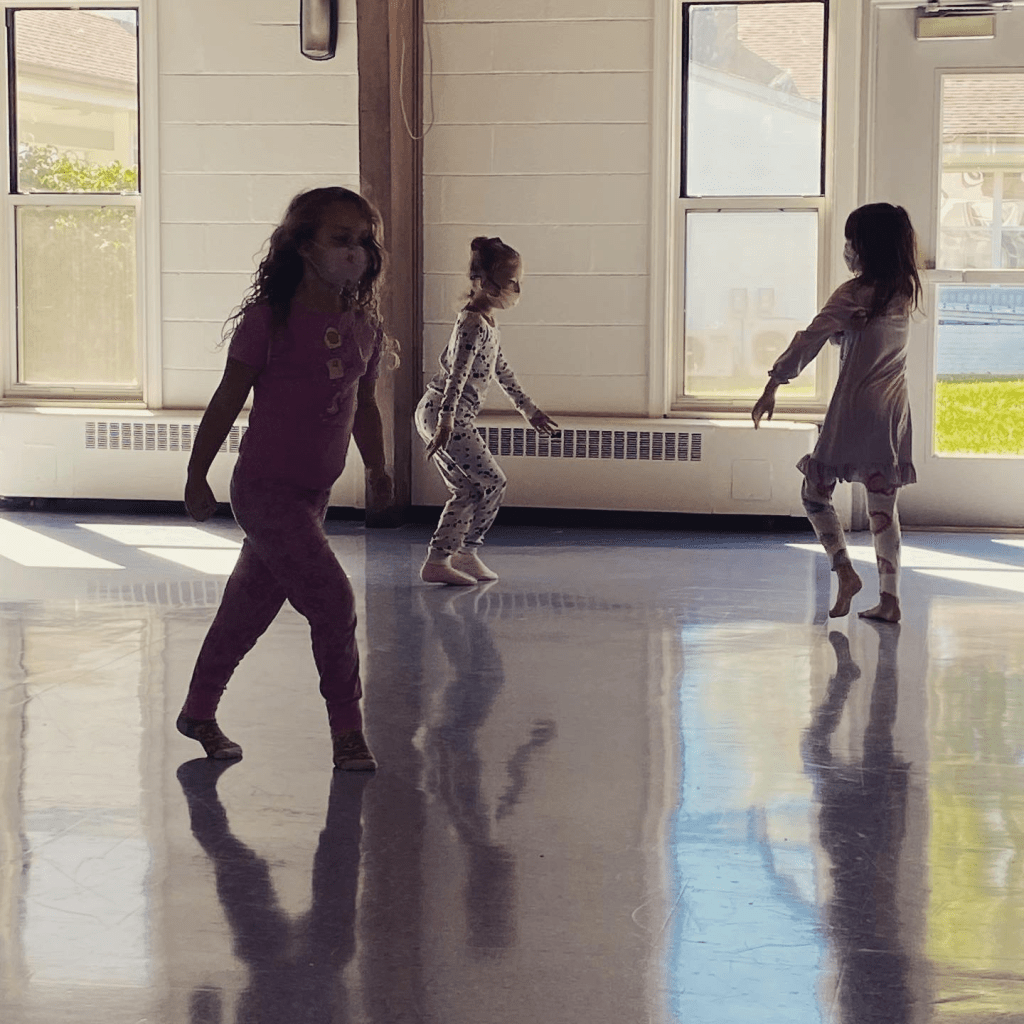
The Spark studio learners have music twice a week, and we have a few main activities. One of the learners’ favorite activities is “Draw What You Hear.” I’ll play a piece of music that’s around 5 minutes long, and the learners have a blank piece of paper and crayons. Their only direction is to draw what they hear. They’ve drawn along to a Copland ballet, to Latin jazz, and to a Trinidadian steelband. Oftentimes, the learners get to explore with instruments as well. They’ve written songs together and played lots of games with their drums, castanets, shakers, xylophones, and a myriad of other instruments. We always end with freeze dance, where the learners get to dance however they want to a song, but they have to freeze whenever the music stops! Our first session was all music from North America, and this session, all of our music is from Asia. Each session, the music will all be from a new continent!

Discovery and Adventure studios have music together on Fridays. This is where I’ve been most hands off. Their goal in session one was to write a song. I provided a few online resources that they could use if they wanted, and wrote a very general framework for how most songs are written. With that, some formed groups, others went at it alone, and across three or four music classes, I got to watch people experiment at the piano, create beats online, bring in instruments from home and form bands, and write some exquisite lyrics, all without my help or direction.

Adventure learners dressing up and bringing in instruments

At the Village School, we want to do music differently. We want learners to explore and discover their musical interests and to harness their creative power. So far, I’ve seen lots of creative power, lots of discovery, and lots of exploration. As the year goes on, who knows what they’ll come up with?