Learning Occurs at the Point of Challenge

At the heart of all passionate educators is a deep desire to see young people succeed. As an educator (and a parent), I can relate. Watching a student’s eyes light up after a newly found realization is a dopamine hit like no other. It’s probably why I can remember most of the 150 high school students who I had the pleasure of getting to know during my first year of teaching almost 20 years ago. Like so many first year teachers, I spent all of my time considering new ways to support them in their success. Despite the changes the field has endured since my early years, one thing hasn’t changed: the heart of educators. They show up each day because they care so deeply – which is exactly why it is so difficult for them to see their students’ “fail.” 

This desire to help is the Achilles heel of all educators because learning occurs at the point of challenge. I know this to be true from my life experience, but also because Ron Ritchhart said so. Ritchhart and his research at Project Zero, Harvard Graduate School of Education’s Research Group, has been a lightpost for me (and so many others) over my entire career. I was recently at a conference where Ritchhart was a featured speaker and he shared more about how learning and challenge go hand in hand. I couldn’t help but think about how his research focused on teachers and students applied to parents and their children and our TVS belief that failure is essential to learning. 

Ritchhart shares that despite the fact that we can all acknowledge that in order to learn we must face challenges, make mistakes, and even fail, we do all that we can to prevent our students from experiencing those things. I think many parents (myself included) fall into the same trap. Ritchhart offered not one, but eight reasons why we avoid the challenge zone with our students. As you read through the list, replace the word teacher with parent and the word student with child, and notice how many you can identify in your own practice as a parent: 

  1. Teachers don’t see the benefit from learning from mistakes and we aren’t rewarded for them. 
  2. Teachers want all our students to be successful…all of the time.
  3. Teachers fear student frustration. 
  4. Failure of any kind is seen as a negative reflection on us as teachers. 
  5. Teachers are used to procedural explanations and giving good explanations to reduce grappling and increase efficiency. 
  6. The benefits of direct instruction have been oversold. 
  7. Mistakes and challenges feel inefficient and messy. 
  8. Teachers are outcome driven, looking for correctness above all else, so we value products over process. 

If you’re like me, you were nodding your head at just about everyone on that list. Don’t feel too humbled, yet – learning occurs at the point of challenge, remember? All of these resonated with me as I listened through the lens of an educator- but two really stuck out to me when I considered the list through the lens of a parent. 

Number 3: Teachers have a low tolerance for student frustration. I am way more comfortable with other children’s frustrations than the frustrations of my own – mostly because I don’t have the time or patience. (I really hope you’re nodding your head here, and I’m not revealing a deficiency in my parenting because you’ll read more about that in a few paragraphs). Lisa Damour offers a reason for this low tolerance. She claims that being the parent of a tween or teen requires one to be an “emotional garbage can,” there to collect all of the feelings of your child as they learn to deal with, react to, and process their feelings. Lately, I find this to be one of the most challenging aspects of parenthood (specifically when rushing out the door in the morning, or after a long week at work). 

Educational research indicates that educators share this low tolerance for struggle and frustration and often define their role as someone whose job it is to remove discomfort from students. The issue, as Ritchhart points out, is that when teachers remove the challenge (emotional or academic) learned helplessness and low self-esteem ensue. The reality is, that if deep learning is what we are after, discomfort is a prerequisite. Teachers (like parents) need to learn to deal.

Number 4: Failure of any kind is seen as a direct reflection of me as a parent. Is it not? This reminds me of one of our recent parent book club picks, Never Enough, where the author references the immense amount of pressure parents (especially affluent parents) put on their children to be the best at whatever they attempt – all because our children’s success are a direct reflection of us and our ability and competencies as parents. Dr. Becky would call this co-dependence and Krissy Posatek would call this enmeshment, and they both would agree that this is unhealthy and severely misguided. 

Educational researchers also suggest this to be misguided. In fact, several studies have shown that explaining too much or even providing too clear directions can actually be detrimental to learning. Bjork’s research on this topic posits a strong connection between “grappling” and deep learning. In a world that prioritizes ease and convenience, what we actually need to learn is to grapple more, because ease and convenience do not, in fact, improve human performance – or learning. 

Despite our propensity to avoid challenges for both ourselves as parents and for our children, there are some things Ritchhart suggests we do to encourage and support what we are all after: deep and meaningful learning experiences. Most encouraging to me as a TVS parent and guide is that according to the experts, the best way to lean into challenges is to ensure that the decision making power is in the hands of the learner. 

At The Village School our learners are always chasing their “challenge zone” whether it’s a new badge book they are reading or a new math skill they are learning. Guides across all of our studios often lead discussions focused on the challenge zone and learners are well versed in how to identify what is challenging to them, what’s too easy, and what feels too difficult. Our school and studio culture values challenge and failure despite how uncomfortable it might make the adults, because we know the powerful learning that always results. 

What we (the adults) must focus on is building up our tolerance for challenges, recognizing the powerful impact it will have on our kids. Ritchhart suggests that an indicator of an educator’s effectiveness should not be how many students in the classroom are “succeeding” but rather how many learners are encountering a struggle, because this is an indicator that deep learning is happening. As a parent, I’m going to work on my tolerance for this. The next time one of my kids is grappling with what to pack for lunch or how to divide fractions I’m going to do my best to resist the urge to remove the challenge and instead lean in (while hiding from them in the bathroom).  
Building the Root System

Recently, I had the privilege of visiting a local preschool to deliver a workshop to parents about the importance of play. As I shared a vulnerable story about my own child and her journey to rediscover herself through play, it occurred to me how often this is the story of our learners at The Village School and how rare and unique our little school truly is. 

In a previous blog post, We Choose Dirt, I shared about how unstructured play is an essential component to our learning design. This uninterrupted free play experience allows our learners to explore their imaginations, take risks, deeply engage with their peers, and as Jonathan Haidt shares in The Anxious Generation, allows them to grow their root system – their ability to deal with the unpredictable challenges that life inevitably will bring their way. He refers to these challenges as “the wind” that pushes the trees, enabling them to build a strong root system.

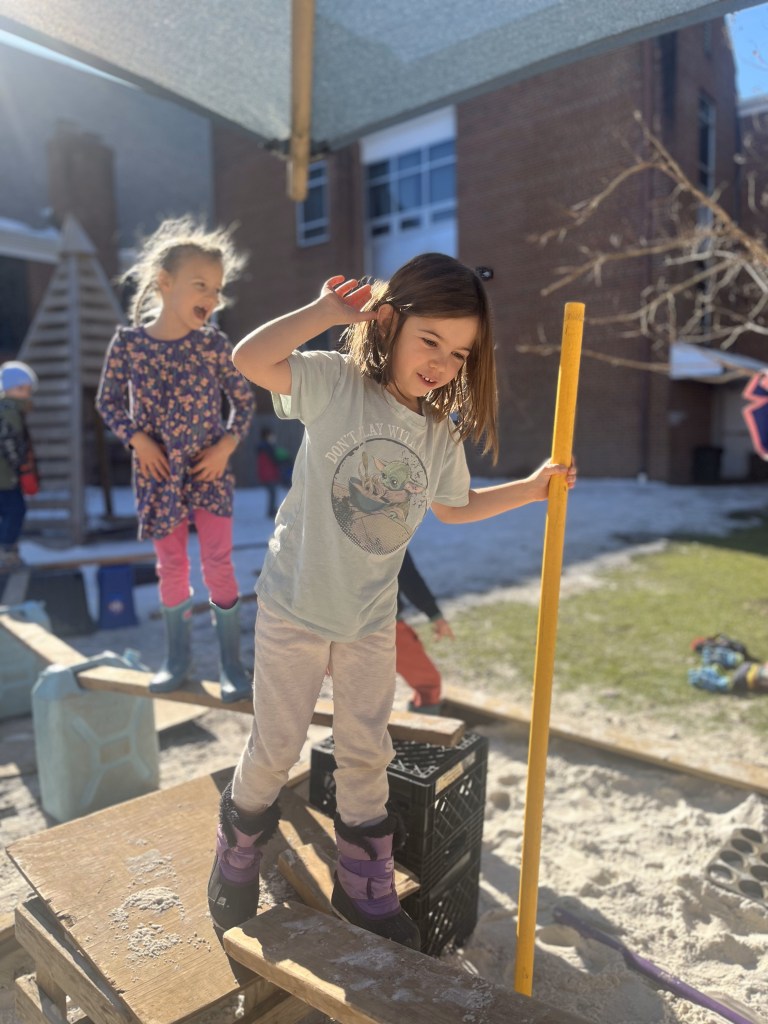
In Spark Studio, I have seen this root system being built during outdoor play in the recent fascination with obstacle courses. Each day, the learners have worked together to create taller towers, more challenging road blocks, and much bigger gaps to jump from section to section. The other guides and I often catch ourselves holding our breath as we watch the learners try out their next challenge. After they make a big jump, the learners chant “YES!” and “I did it!” The guides and I all find ourselves finally exhaling and chanting quietly “the wind, the wind, the wind”. It is hard to watch our children do things that may seem “dangerous” or “risky” but in these moments, it is important that we remind ourselves of safe risk and the self-confidence that can be built when we let go and let them grow their roots. 

In Discovery Studio, I have observed their growth through a different lens. In Health and Wellness, we have been exploring conflict resolution. This has been a popular topic in the past because we often engage in role play, playing out what conflict looks like and analyzing how fictional characters could stand up for themselves, find a compromise, and make amends. The real work for Discovery learners comes out in play, once they leave the safety of fictional characters, and spend the next 2 hours engaged in unstructured play. 

As I wander the park, observing learners with their peers, conflict inevitably arises. I’ll hear something like “you always do this!” or “you never let me play!” As an adult and a highly empathetic human, these words tug at my heart. My instincts are to jump in and remove any hurt that could possibly take place. It is in these moments that I have to remind myself that if we rescue our learners from any conflict that could be hurtful, they will never grow their root system for dealing with conflict later in life. As the adult and guide, I walk alongside them, listen and support our learners with navigating conflict with their peers. As a guide, my  role is to take a step back and support, allowing our learners to use their language to work through conflict. We cannot rescue them from the hurt but we can give our learners the tools to handle the hurt. We cannot give our learners self-confidence and resilience but we can curate an environment where these life-long essential skills can flourish. 

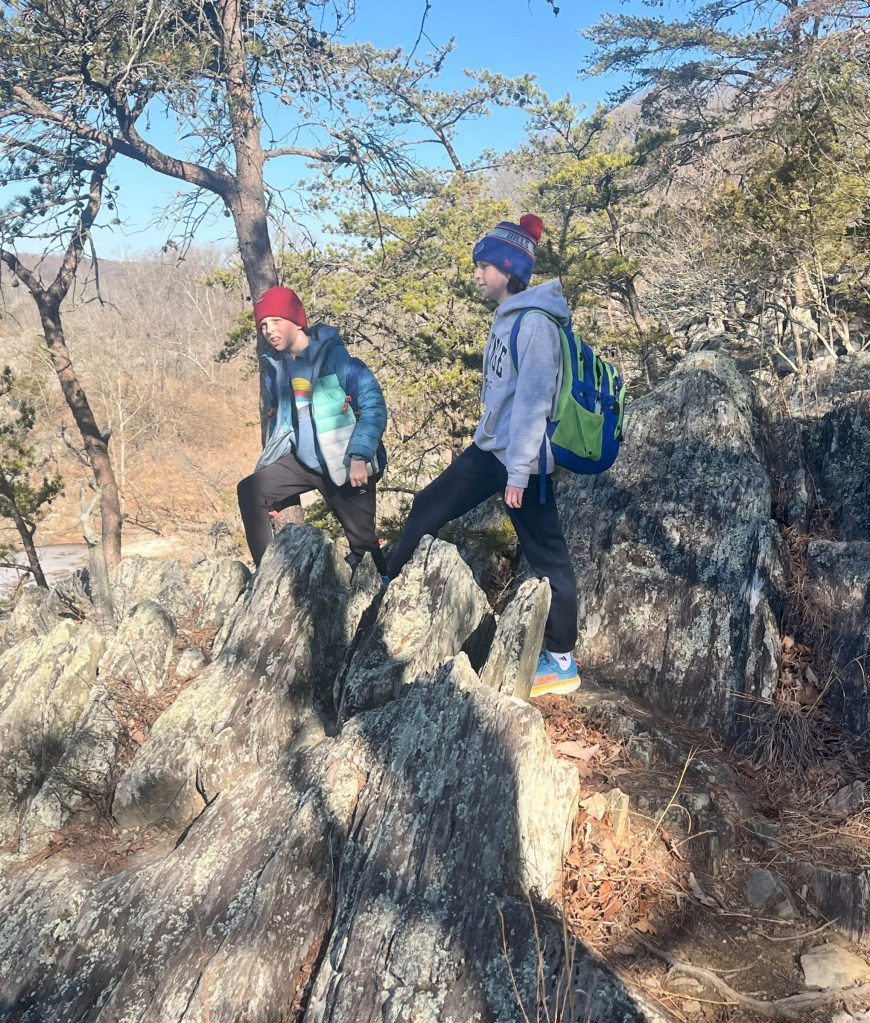
Adventure Studio brings a whole different level of uncomfortability in building a strong root system. As a guide, I find my role constantly challenged as the studio ebbs and flows through challenging life experiences. Recently, we all embarked on the Billy Goat trail. The guides and I scoured the internet looking for whether the trail would be safe after the ice and snow leftover from our most recent winter storm. When we couldn’t find a solid answer, we all found ourselves thinking – we can do this, they can do this, we will all be together and it will be okay! As we started our hike, it was indeed one big ice sheet. We all found ourselves looking at each other, knowing what each of us was thinking – can we really do this? We all took it one step at a time. There were many falls, slips, and  catches from fellow peers. At one point, myself and another learner even found ourselves off the path, stuck between two big boulders. Three learners immediately came to our rescue and guided us down. They beamed for the rest of the journey, chanting to the rest of the group “We just saved Ms. Bridget!”

Later on in the hike, we had to work together to climb up to the top of a rocky slope. The phrases, “you can do it!”, “you’ve got this!”, “I’ve got you”, and “I won’t let you fall” were countless. Every single learner and guide helped each other to reach our destination. Many of the learners were scared but when we all reached the top together, the looks of pride and accomplishment were heartwarming. 

The next time your learner takes a risk and you find yourself holding your breath, breathe out and chant to yourself “the wind, the wind, the wind” and know that you are supporting your learner with building a strong root system that will support them with whatever life brings their way.

Taking Responsibility for Your Own Education

Have you ever had the feeling of awe while watching your child? Not pride or fulfillment or joy, but awe. Dashner Keltner describes awe as the feeling you get in the presence of something vast that changes your understanding of the world as you know it, like looking up at a sky full of stars or a first glimpse of the Grand Canyon. 

As a parent at The Village School for the past five years I’ve felt a lot of emotions: frustration, worry, pride, gratitude – and I’ve learned to lean into all of them. Each emotion is a vital part of parenthood, and  especially important during the parenting of a self-directed learner. I’ve also had the privilege of experiencing awe based on the learning experiences that my own children and others have as learners at TVS. These moments occur in all the expected spaces like the end of year Character Rock Ceremony, or the middle school I have a dream speeches, but my favorite experience of awe are the experiences that sneak up on you when you’re least expecting and create the kind of awe Kelter summons and changes the way you see the world. 

One of those moments happened just a few weeks ago when my 9 year old daughter tearfully shared a fear that she would never be able to memorize multiplication facts. Thankfully, I had some patience left in my tank from the day. I gave her a hug, affirmed her feelings, and asked if she had any ideas for how to overcome this worthy challenge. After a little back and forth, I showed her a strategy other TVS learners have used – a menu of online courses including some on multiplication. After several minutes of doing her own research, she called me over to show me a three night class that started that night. Fifteen minutes later she was live on a zoom class with a teacher and seven other 9 year olds. 

For the next three nights my husband, her sister, and I sat in the other room eavesdropping and meeting each other’s knowing gaze each time we witnessed her participation. The learner who was in tears afraid of the multiplication challenge was zoned in, engaged, raising her hand, participating on a zoom class (something she had never experienced before), getting questions right, getting questions wrong, asking for explanations and clarifications, and even completing “homework” in the traditional sense. Each night the class was just over an hour and she was locked in the entire time. 

Towards the end of the third and final class the three of us eavesdroppers looked at each other in awe. The determination to take responsibility for her own education and her belief in herself that she could do it was a moment of full of wonder for us – it didn’t matter if she learned any multiplication, what mattered was her ability to set a goal, follow through, and face a fear.

Taking responsibility for your own education is a throughline of The Village School experience. At the beginning of each year learners in all studios sign a contract that lists the promises they make to themselves and each other with the goal of creating and maintaining a healthy community. A line on each contract reads: I promise to take responsibility for my own education

Most parents share that this feels like a huge relief, and I agree. On the surface, I’m relieved to have one less thing to add to my never-ending to-do list, or maybe I’m just excited to add something to my list that I can immediately check off (if you know, you know). Short-term relief to my mental load as a parent is always a win, but when I think more about what the promise my kids and the other learners at The Village School make to themselves, I’m more curious than relieved. The recent experience of my 9 year old demanding to take an online class to help her with math is a tangible example – but my curiosity persists. How do other parents recognize it happening? What does it mean to other families – and what does it mean to the learners? Really, I’m mostly curious about what the young people themselves think about this promise. Forget what it means to me and the other adults, but what does taking responsibility for their own education mean to them? So, I did the obvious, and I asked them. 

Here are some of their responses: 

It means to be helpful and use kind words. age 7

To always make sure that you’re working hard. – age 10

It means to hold yourself accountable and look out for others, too. – age 9

Be ready to learn and keep track of your goals. – age 7

Finding a place to focus and find flow. – age 8

We take responsibility for our own education because we get to choose what we are working on and it’s up to us to not get distracted or distract others.  age 10 

I get to choose what I want to do and take my own time to finish it. – age 11

As expected, the learners’ were able to articulate their experience better than me. I posed the same question to our team of guides: What does it look like when a learner is taking responsibility for their own education in your studio? The discussion that followed was rich with examples of young people, but one story really stuck with me. 

A guide shared that during a routine guide meeting with a sixth grader, she noticed that despite completing a unit on Khan academy several weeks prior, the learner had yet to begin the next unit. Curious about why this might be the case, the guide inquired. The learner gave a knowing sigh and shared “Ah, yes. I haven’t moved on to the next unit because even though I mastered the percentage unit on Khan, I don’t feel like I have a deep enough understanding of percentages and how they work. I don’t want to move on until I understand it better. I think percentages are important in life and I want to really get it right.” The guide asked if the learner had any ideas about how to gain the deeper understanding she so desired. The learner shared a thoughtful plan that involved more practice and promised to follow up in a few weeks – once she felt more confident in her ability and understanding. Can you think of a time in your sixth grade life that you had this perspective on your school work? If you’re like me the answer is a definite nope. Never, ever. This is what taking responsibility for your own education looks like. 

As a parent (and a guide) taking responsibility for your own education means more than the relief of one less adult responsibility. The promise represents a manifestation of the value and trust that I have in my own kids. It communicates that they don’t need me to accomplish their goals – they can set goals and reach them on their own. Of course I’m here to cheer them on, support them, and guide them, but ultimately, it’s their responsibility. At The Village School taking responsibility for your own education is not just a concept, it’s a daily practice that when reflected upon can change one’s view of the world and activate a sense of awe. 

Session 4 Sneak Peek

Spark Studio

In this session, Spark learners will discover how Science, Technology, Engineering, and Math can be used to invent new things to solve real world problems. Learners will explore their wonders about inventions, such as “how does flying work?”. Learners will read and learn about historical figures in STEM and how they solved problems. They will get hands-on experience through science experiments and projects. By the end of session 4, learners will become an inventor themselves!

Discovery Studio

In this session’s Project, Discovery learners will explore how nature’s clever solutions can inspire new ideas to solve everyday problems. From buildings to technology, learners will discover how designs in nature have led to creative inventions around the world. They will also have the opportunity to dive into storytelling by creating their own podcasts, sharing their ideas and using their voice in a powerful way! 

Ever wondered what goes into making a podcast? In this session’s Writer’s Workshop, learners will dive into the essentials of podcasting, exploring different podcast formats and discovering what makes a podcast truly engaging. From there, they  will select a topic, conduct interviews, write compelling scripts, and perfect their editing skills to produce their very own episodes. The best part? They’ll get to share finished podcasts with our TVS community who’s eager to listen! Let’s get ready to hit “record”!

Adventure Studio

This session for Project, learners will design cities for tomorrow with working electric grids. Working in teams, they’ll explore electrical circuits, energy transformation, and sustainability. From simple circuits to complex grids, they’ll combine creativity and science to tackle big questions about innovation, functionality, and environmental responsibility in city design.  

Learners will also step into the world of science fiction by crafting their own original stories. Through discussions, text analysis, and peer feedback, they’ll explore what makes the genre unique and bring their ideas to life! This Communications challenge culminates in the sharing of their imaginative creations with the community.

Health & Wellness

The overarching theme for session 4 will be “Building Bridges”. All learners will be expanding upon conflict resolution strategies that we utilize everyday. Our Spark learners will be exploring what it means to have an argument with a friend, what it feels like, and how we can handle hurting our friend’s feelings. In Discovery, we will explore what it means to be a bridge builder. The learners will practice perspective taking, how they can benefit from different points of view, and how to repair relationships after conflict. In Adventure Studio, we will analyze our mindsets around conflict. Conflict can be an opportunity for change, growth, and transformation. The learners will analyze how they handle conflict and areas where they want to grow.

Session 3 Sneak Peek

Spark Studio

In this session, learners will explore different cultures. They will imagine themselves in another country and learn about different languages and traditions (foods, drinks, clothing, and how things are made). They will also discuss how those differences and similarities play a part in our everyday lives. Learners will have the opportunity to engage in hands-on materials in each area of the studio that reflect our theme.  Spark will conclude the session with an international celebration for Exhibition that features handcrafted drinks and treats. 

Photo by Porapak Apichodilok on Pexels.com

Discovery Studio

Discovery will be deepening their understanding of identity, culture, and self-expression through mask making in this session’s Project.  Learners will make connections between their own crafted masks to traditions across the globe. Learners will take away that masks can symbolize protection,  or enhance, or disguise appearance in some cases such as battle, theater, film, and more. By the end of the session, learners will be able to write an artist statement that conveys the deeper meaning behind their art.

Writer’s Workshop: Every hero’s journey encompasses a narrative that outlines the experiences that encompass their lives. This session, learners have the opportunity to write an autobiography that includes background information, their triumphs, and climactic events. Through sharing beautiful and unique anecdotes about themselves, learners will become authors in their own right, championing them to share their stories with the world.

Photo by Artem Podrez on Pexels.com

Adventure Studio

Project: Get ready to dive into the thrilling world of physics! During this session, Adventure will team up to unravel the secrets of acceleration, force, momentum, and energy. With hands-on experiments and a secret mystery project, they’ll channel their inner scientists and embrace the excitement of the scientific method through trial and error to create innovative prototypes. Our experimentation culminates in a high-energy Exhibition, where learners will showcase their finished product in action. 

Communications: This session learners will explore the transformative power of gratitude and discover how expressing their gratitude can enhance their well-being. Using the pastiche technique, they’ll focus on expressing their appreciation rather than simply reflecting on it. At the end of the session, learners will share their thoughtfully composed letters with their recipients, deepening their relationships and experiencing the joy and fulfillment that comes from meaningful expression.

Photo by Pixabay on Pexels.com

Health & Wellness

“Nutrition is a critical part of health and development. Good nutrition means your body gets all the nutrients, vitamins, and minerals it needs to work its best… Healthy eating promotes stable energy, strong bones and teeth, improved mental health, healthy weight, and prevention of chronic diseases.” – American Academy of Pediatrics

Spark Studio: It’s back – Be Your Own Food Critic! Spark learners will try different fruits and vegetables and learn about how they  impact our bodies in amazing ways. 
Discovery & Adventure Studio: Learners will be reflecting on healthy nutrition habits, dental care, and sleep habits. We will also have a chance to try fruits and vegetables that can have positive benefits to our dental health and aid in getting a good night’s sleep.

Photo by John Finkelstein on Pexels.com

Learning to Learn: Middle School Civilizations

Middle school Civilizations, or “Civ” as the learners call it, is one of The Village School’s signature learning experiences. The curriculum is a rich task built with intention and backed with research. Learners are asked to engage with most of the topics and character traits listed in our school Profile of a Learner as well as meet each strand of Project Zero’s Understanding Map, a research based framework for designing powerful learning experiences.

Twice a week learners are presented with a Civ Challenge that is composed of three parts: research, writing to learn, and socratic discussion. Each challenge is centered around a list of approximately 10 socratic questions, with a focus on what is known as the “big question”. The big question is about a specific time or person in history. Learners are challenged to come up with their own answer to the big question based on their own research. Each Civ Challenge is accompanied by a bank of sources that may include primary sources, images, graphs, videos, and articles that are relevant to the big question.  Additionally, each challenge weaves in current events that connect to the historical topic. There are current articles, news clips, and primary sources that highlight these connections. 

Learners are challenged to do at least 30 minutes of research using the sources provided, and take notes on the information they are gathering. After their research is complete, they begin writing to learn. Writing to learn is different from the purpose of most academic writing, and research shows that the older a learner gets, the less opportunities they have to write to learn in school. Writing to learn is to help learners process their thinking and determine their own ideas and thoughts – or as one researcher explains, “Writing to learn is learning to think.” This is exactly the purpose of the writing task in Civ. 

Learners must submit their written response by the deadline in order to participate in the final aspect of the challenge, a peer-led socratic discussion. Learners arrange themselves in a circle, nominate a discussion leader, review the discussion guidelines and begin. The conversation starts with sharing responses to the big question, followed by the discussion leader’s guidance through the rest of the questions.

This session’s CIV, “The People Who Made America” included ten challenges focused on one or two individuals who helped shape the country. One of the challenges focused on Mary Tape, a desegregation activist who fought for Chinese-Americans’ access to public education. Here is an excerpt from the challenge followed by the “big question” followed by a snapshot of some of the learner responses and discussion:

Mary Tape was a Chinese immigrant living in San Francisco in the 1890s. She became an important figure in the fight against racial discrimination in education. After her daughter was denied entry to a public school because of her Chinese descent, Tape took a bold stand against the schools. She wrote letters and took legal action that led to a landmark court case. 

Was Mary Tape a hero for her family and other Asian Americans or a failure?  Should heroes be defined by personal victories or by the ability to inspire and effect larger change? 

“I don’t think you have to succeed to be a hero.” 

I think she was a hero to her family and to the people that she inspired. I think you can fail and still be a hero in some people’s eyes.” 

“I disagree – I think she was a failure because she did actually fail at what she was trying to do. I think what she did was heroic, but it doesn’t make her heroic.”

“I actually completely agree with Charlotte because I think calling her a failure is a bit of a stretch. I also agree with something Jude said that being a hero or a failure depends on the standard. I think for Mary Tape the standard was heroic – she was fighting a similar fight as MLK, because she was fighting against racial discrimination. MLK is one of the most influential heroes in the world.”

“I agree with Charlotte. It’s hard to categorize someone as a complete hero or a complete failure. I do think that she failed in her goals, but she certainly didn’t fail in being her. She was a success in that she brought the injustice to light and made people aware of it. Generally I think she was a hero because she did more good than bad. 

I wouldn’t describe her as a failure. She stood up for her family and that’s heroic to me. 

“Wait -can someone explain what she did with the school?”

“She went to the Supreme Court and advocated for her children to be accepted into the local public school, but the Supreme Court l,et everyone know that segregation was still okay, so they had to make a different school for her children. 

“All last year in Health and Wellness we talked about what makes someone a hero, and I remember talking about how a hero is someone who positively influences others, and she did that.” 

“Along the way to your goal, you’re always going to have failure. Just like us in our journey at TVS, we’re going to fail sometimes.”

“I agree with Amira. I think she was a hero because even though she encountered failure she still did something incredible. Her argument made it all the way to the Supreme Court which is a big deal. Even though it didn’t turn out how she wanted, she brought awareness to this important issue. I definitely think she was a hero.”

“Hey, can you read the second part of the question again? I noticed no one is answering that part.”

“I think if someone is a hero their actions need to affect more than just themselves. You can be a good person, but that’s not the same as being a hero. I don’t think that your reach has to be huge. You could do something to benefit your school or your neighborhood and that can be heroic.”

“I think that heroism should be defined as the ability to inspire others. Inspiring others is good leadership. If you’re being a leader, you’re being a hero – and if you’re being heroic, you’re inspiring others to be heroic.”

I think it matters what your intention is. Her intention was to make a positive impact and in that sense she succeeded.

Below is one of the learner’s written responses: 

A hero is a person who is admired or idealized for courage, outstanding achievements, or noble qualities. And by that definition, Mary Tape was a hero. She might have failed to get her child into public school, but she inspired others, not just to follow the law but to do what is morally right. 

When Mary Tape sued the school and the case went to the Supreme Court, the case was not just for her daughter but for all Asian Americans. She might have failed to get her daughter into an American school, but she put action in the movement and took a step toward equal rights. 

You can’t be a failure if you inspire millions. You can still be a hero if your goal fails. Failure is a part of learning, and failure is a part of changing the world. Martin Luther King Jr. was arrested multiple times, and he may have failed at that moment, but he is still considered a hero. Mary Tape is the same—someone who, in the immediate future, may have failed but, in the long term, succeeded. 

Learners go through this entirely self-led process twice a week. They learn to read critically, write thoughtfully with evidence to support their ideas, consider other perspectives, connect history to current events, and to their own experiences, And, most importantly they are trusted to engage in this process as independent learners, writers, and thinkers. This learning task is something most high school students wouldn’t be trusted to attempt. In a traditional, highly competitive high school environment there isn’t room or time for learners to struggle or fail.  Like so much of the learning design at TVS, we choose to trust over control. Civ requires the adults in the room to really lean into our Constructivist approach to learning and our belief that young people can be trusted to learn from their own experience. 

As expected, the learners capture the heart of Civ best, as one learner put it: “…Civ is definitely the most challenging part of being in Adventure, but it’s also the most fun.” And, of course we agree: the more epic the challenge, the sweeter the victory. 

The Power of a Learner Centered Community 

In a learner-centered school, every day presents moments of discovery, growth, and connection. Watching Discovery Studio in action these past two sessions, I’ve seen firsthand the responsibility, care, empathy, and strong sense of community that we foster here at The Village School.

An example of this happened recently during our afternoon project time. I was helping a learner who had hit their head and needed an ice pack. As we were transitioning from project time to our debrief—where we come together to reflect on how our project time went—I found myself worried about how the launch room might manage without a guide there to lead the discussion. But when I got to my launch room, I saw the magic of our model working.

The older learners, who had seen an opportunity to step up, had already circled up the rest of the launch room and were leading our group in the debrief discussion. Without being asked, they had circled up in our launch room, and began asking thoughtful questions about our project, how it could be better, and how they could support each other through the challenges they are facing as a group. 

While this is just one story of leadership, it reflects the heart of our model. As a guide, I have had the opportunity to watch this happen every day in our community. What I have noticed is that, in a mixed-age, learner-centered environment, there is a continuous cycle of nurturing and being nurtured. Older learners step into leadership roles, guiding their studio mates and creating space for younger learners to contribute. This act of leadership not only supports the younger learners but also inspires them to take on leadership themselves as they grow. Learners here understand that they are not just individuals in a studio but active, contributing members of a community where they support and uplift one another. They recognize that each of them plays a significant role in the learning journey—not only for themselves but for everyone around them. This allows for them all to appreciate their unique strengths, recognize the challenges they face, and know that they can offer help and support, regardless of their  age. 

What stands out to me the most is how this shared responsibility extends beyond academics. It creates a culture of kindness, resilience, empathy, compassion, and independence, where the act of leading and being led continuously nurtures growth in both directions. 

In moments like these, I am reminded that a learner-centered community does more than teach—it transforms. It empowers learners to take ownership of their growth, to support one another, and to recognize the value of their unique contributions. Through leadership, empathy, and shared responsibility, each learner develops a deep sense of belonging and purpose. This environment fosters not only academic growth but the kind of character and resilience that will carry them far beyond the classroom. As guides, we are privileged to witness how these learners inspire one another every day, creating a cycle of care and leadership that continually strengthens our community. And it’s in these moments—when learners step up to lead, when they nurture each other’s growth—that we see the true power of a learner-centered model in action. It is a place where each individual’s success is tied to the success of the community as a whole.

Learning to Learn Math in Spark

If you have school-aged children, you might have noticed that learning math today looks nothing like it did when you were in school. Unlike the approach we experienced as students and the approach that still persists in many conventional schools, The Village School learning design prioritizes deep understanding over rapid rote memorization. Our goal with math (and other subjects!) is that learners are equipped with a sense of math efficacy that comes from learning to learn instead of simply learning. Spark Studio Guides have designed a math curriculum that nurtures a growth mindset creating space for young learners to feel capable and excited as they deepen their numerical fluency. 

Learning at TVS in Spark Studio and beyond is based on mastery and not bound by age or time. Similar to the literacy curriculum in Spark, the Spark math curriculum is highly-structured, multi-sensory, and research-based. The Spark Math Map is a visual representation of the most important mathematical skills that Spark learners work to master, and are foundational for any young learner in providing them with both the understandings they need for our elementary math curriculum and equipping them to learn how to learn math as they encounter it in their daily lives.

You can probably remember seeing a toddler determined to hold the right number of fingers up to show their age demonstrating their earliest counting skills. Hands and toes serve as everyone’s first math manipulatives. After fingers and toes comes blocks, and in Spark Studio we introduce an engaging collection of Montessori math manipulatives. The intentionally designed manipulatives allow our youngest learners to learn math through natural play – a pedagogy we lean heavily on here at TVS.  

One of the most memorable math manipulatives in Spark is called the long bead chain. Visit any Montessori classroom and you’ll see the beautiful wooden display case of carefully hanging colorful chains of beads. These color-coded beads are used to master several basic mathematical fluency skills including linear counting, skip counting, multiplying, and squaring and cubing. By physically holding and counting the beads, learners are able to internalize the idea of quantity and pattern recognition, two foundational math concepts necessary for developing math fluency. As learners string together bead chains of various lengths, they visually and kinesthetically experience mathematical progression. This process fosters independence and encourages learners to approach math as a logical, engaging journey rather than just memorization.

The bead chain is just one example of how the math curriculum in Spark Studio is both playful and purposeful. In addition to the available manipulatives, Spark learners often engage in math games that promote numerical reasoning and thinking. The benefit of multi-age learning really shines through when learners are engaged in math-based games: older learners are able to model and articulate their thinking about math in a way that inspires and influences younger learners more than any adult could ever achieve. 

However, most central to our math curriculum in Spark Studio is the development of a growth mindset. We know from research and our experience at TVS that a learners’ belief in themselves when it comes to learning math is the most powerful lever in shaping their experience and success. We also know that young people – especially our own children – will internalize and model the attitudes that are modeled for them. Do you talk about math fondly – or do you proclaim yourself “not a math person”? Expressing confidence about your own mathematical abilities will help your learner (and maybe even yourself!) realize that learning math is all about attitude, effort, and practice. Even when things get tricky – just take one bead at a time!

Session 2 Sneak Peek

Spark Studio

Photo by Sara Free on Pexels.com

It’s fall y’all! Learners will get to explore how food gets to their table by reading about and discussing all things harvesting. From learning about plant life cycles to understanding how food fuels their bodies, learners will try new foods, challenge their math skills using pumpkins, read and write about fall activities, and perhaps even learn to make their own lunch! During project time, learners will work in new groups, practicing team building skills while exploring interests and brainstorming project ideas. Amidst all this, Spark will take a trip up into the Washington Monument after the first sessions’ rich exploration of the structure. See you in session 2!

Discovery & Adventure Studio

Photo by cottonbro studio on Pexels.com

It’s Election Season! Learners in Discovery and Adventure Studios will engage in a deep dive into the Democratic Process exploring the different ways they can share their voice, inspire positive change, and participate in the democratic process before they are old enough to vote! The Project and Writer’s Workshop and Communications challenge will create opportunities for learners to explore the three branches of government and their function, analyze the UN Rights of the Child, investigate the legislative research process, examine how art can be used in activism, and develop their persuasive letter writing techniques. At the end of this session learners will journey to Capitol Hill to deliver one pagers to Congressional Staffers and send a persuasive letter to a politician both advocating for a policy issue advocating for children’s rights.

Health & Wellness

Photo by POI * on Pexels.com

“Beauty begins the moment you decide to be yourself.” – Coco Chanel

Throughout session 1, we focused on belonging. Session 2 will be focused on “becoming”. The learners will take an introspective look at who they are through a values game, reflections on goals, abilities, and dreams.  We will visualize the parts of ourselves that make up who they are. Then, we will take a “vibe check”, asking ourselves about the energy we put into the world and what energy we hope we are expressing to others. At the end of the session we will take a look at the story of our lives so far and make predictions about what is to come. 

At TVS Learning is Real, Not Artificial

If you’ve read something recently about how AI is going to transform education as we know it, you’re not alone. If you’re like me, you ignored the click bait for a few months, overwhelmed by the thought of trying to deeply understand yet another seemingly “unprecedented” story of our times. Then, if you’re also like me, after several months of playing ostrich, you decided to finally click and begin the process of understanding just how AI was going to change your life. 

After reading article after article, watching an Oprah special, scrolling my LinkedIn feed for fodder, and even reading a book, I have my own hot take on AI in education – that starts with rejecting the premise. Yes, AI has the potential to radically change education as most of us know it. However, if AI has the power to drastically change education, this says more about the current state of education than the power of AI. Despite the rapid advancement of technology over the past 100 years, schools as we know it still look the same: rows of desks, rote memorization, quizzes, tests, and compliance valued over creativity. The important question to consider isn’t how AI will transform schools, but how we should be rethinking the very concept of school itself.

At The Village School, AI is embedded in our learning design because it is a new and useful tool. As new technology emerges, part of our learning model is to learn to learn about them. AI is not fundamentally changing our TVS learning design because we are focused on the act of learning, skill development, and character education – we aren’t in the business of checking boxes. If we were a school that cared more about what our learners know – then for sure, AI would radically change our approach. The good news is that we’re not. One of our school community’s core beliefs is that we care more about who a learner becomes than what they know. We also believe that young people can be trusted to learn from their own experiences. 

While many schools are frantically searching for ways to keep AI out of their classrooms, this session we put AI into the hands of our middle schoolers. Their deep dive into the world of AI included: creating their own chatbots, considering how using AI aligns with their core values, and determining how AI should or should not be used for their learning. The lessons were inspired by resources from Common Sense Media, WISSIT, and our own team of educators.

Middle schoolers spent time understanding what AI is, how it’s trained, who’s behind the scenes, how AI is or isn’t biased, how AI algorithms can get to know you (really well!), and most importantly, how AI should or should not be used, if at all, in school. They even debated the question: Is AI the future of education – or not? 

This session’s focus on AI won’t be the last time learners at The Village School use, consider, and question AI. As a school, we will continue to explore the possibilities and limits of AI and any other relevant technology that emerges during this “unprecedented” time. And, rather than hiding from it in fear of change, we will continue to intentionally run towards it with curiosity, embracing the unknown and transforming it into opportunities for growth. 

I’m glad I finally decided to get my head out of the sand, learn as much as I could, and make my own decision about AI and the future of education. I learned a lot, had some fascinating conversations with other educators, with learners, and with a few AI chatbots themselves. (One even helped me fine tune the title of this piece – thanks, Khanmigo!) Most importantly, my deep dive reinforced my belief in the learning model at The Village School. Even AI can’t disrupt the power of project-based, character-driven, authentic learning experiences. 

Photo by Junior Teixeira on Pexels.com