Connecting with Compassion

As a guide who recently graduated college and moved states away from my family, I’ve been grappling with some personal challenges, which made last week particularly tough. 

However, amidst those difficult times, I also experienced an overwhelming amount of love and support when I came into work each day, not just from my fellow guides, but from every learner in the Adventure studio. 

On Monday, some of my coworkers noticed I was upset and surprised me with lunch and snacks, bringing me to tears. The learners noticed that I wasn’t myself, and offered support: “Are you okay?”, “What happened?”, and “What can I do to help you?” Feeling the overwhelming love and support, I went home that day thinking, “Wow, I can feel the support of the community” and “I am so extremely grateful to be a part of the culture we are building.”

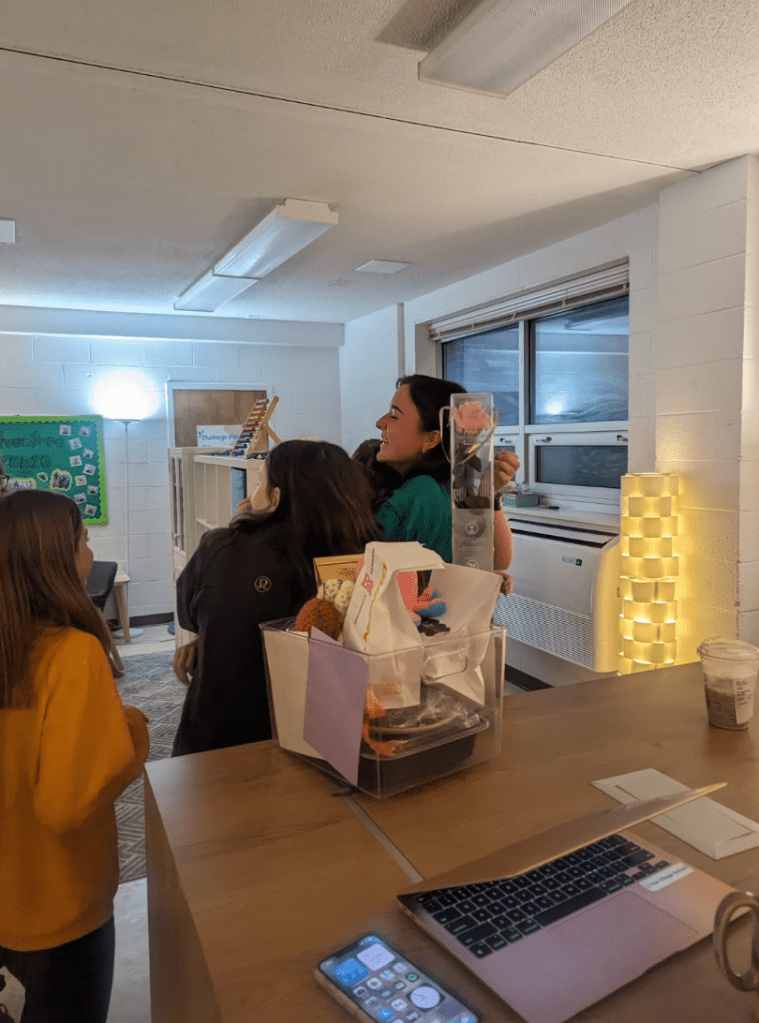
The next morning a group of Adventure learners approached me with another form of support – a bin full of goodies, from homemade cookies and brownies to a stuffed animal they made. Included was a card that read “I just want you to know we are here for you. Whether you need to talk to someone, you need someone to make you laugh, we are here!” 

At that moment, I thought to myself, “I can see the model working. I can really see how this school differs from every school I have been to and any place that I had worked before this.” I was blown away by the compassion and empathy the learners had.
When I shared this story with my friends and family, they responded “your middle schoolers did what??” followed by, “Oh Gosh, that would’ve never happened at the schools I went to.”

These are not the only stories of empathy at The Village School, but just one of many. 

I’ve also witnessed this sense of belonging and support many times since the beginning of the year. Recently the middle schoolers went on a three day camping trip. After a long day of hiking in the rain, the girls settled into their tent and realized that one of the learners’ sleeping bag was completely soaked through, and she was freezing. Without a thought, another learner rearranged their own set-up to make more room and dry space. What strikes me as so special about this moment and the other moments like it, is that the learners do the next right thing without asking for help, assistance, or guidance. They do the next right thing because it’s the right thing to do and they really do care about each other. 

These stories of empathy also include moments during work periods when learners notice a friend struggling to meet their goals. Just this week, a learner completed their pre-algebra badge and the entire studio erupted in cheers, acknowledging all the hard work that had led him to that point. This is evidence of a culture of care and collaboration, which is in contrast to the culture of competition that is the status quo in many schools.  

At The Village School we care about who the learners are, rather than what they know and these stories are just some examples of how a culture of belonging and support are enacted in our studios every day.  We lift eachother up when we are down. We help each other through the lows, and cheer for each other through the high. 

Our learners have the opportunity to cultivate close relationships with their guides and peers. Unlike traditional schools, where students frequently switch classes, here they work closely with guides across subjects. As guides, we strive to understand each learner individually, including their progress, passions, goals, needs, strengths, and learning style. This understanding extends beyond academics, allowing us to nurture a community that is empathetic, loving, and kind. We genuinely care about each learner, demonstrating to them that they belong and are valued in our community.

Learning to Learn Math

I’ve never considered myself a “math” person until I became a high school English teacher and realized that there was no such thing as a “math person” just like there was no such thing as an “English person”. Throughout the ten years of my career that I spent as an English teacher, I made a point to share my appreciation for math with all of my students, many who were shocked that a person who loved books could also love numbers. Friends who were math educators and well-known educational researchers also helped me shake this misconception – and so did the statistics classes that I took during my doctoral studies.

So where did I get this idea? I know for certain that it originated early on as a result of the messages I received in school. To be a math person at school you had to be good at math, and to be good at math you must learn fast and solve problems even faster. In fifth grade, my math teacher would pass out our tests in order – best to worst score. Each week I would cringe with scarlet cheeks as she placed the last test in her stack on my desk, face-down, of course. If I had only had the chance to take my time, learn at my own pace, and most importantly, build confidence in my ability to learn to learn math – maybe I would have been a math, not an English teacher. 

The irony of the traditional math teaching approach is that math in the real world is meant to be slow – not fast. In a typical math class, the lessons are planned and scheduled before the school year begins leaving no time to plan responsively to the emerging needs of learners. Memorization is prioritized over conceptual understanding, and efficiency is prioritized over divergence. This type of learning is shortsighted, and as a result, turns many young people – myself included – away from understanding and appreciation for math. 

One of the most frequent questions we get about our learning design is often in the form of a complaint about math and they go something like this… “But, don’t you need a teacher to learn math?” “My kid really doesn’t like learning math this way.” “Learning math that way doesn’t work for my kid.” 

As a parent myself, I can relate to these sentiments – learning math is difficult and stretches a different part of the brain. I can also empathize with how difficult it can be to watch your child struggle to learn something, and how fear can creep in when I begin comparing my own children to their friends who attend different schools with a more traditional approach. When I slow down and think about the purposeful and research-based design of the math curriculum at TVS, my fears subside and I feel grateful for the opportunity my own kids have to learn how to learn math and develop confidence in their mathematical ability. 

The goal of the math curriculum at TVS is much different than the typical or traditional math classroom. In fact, we would posit that the two are designed for completely different end results. The goal of our math curriculum at TVS is to build each individual learner’s capacity for learning how to learn math- or even, more broadly, how to solve problems, so when they encounter math challenges or difficult problems in their future schools,  jobs, and life, they will have the ability to approach such challenges with confidence.  

Most parents, educators, and learners can get on board with our ultimate goal of building the confidence and capacity to solve difficult problems. It’s the process that makes us uncomfortable. 

For a learner, this process involves making mistakes, getting stuck, languishing a bit, feeling frustrated, avoiding asking for help, making more mistakes, complaining, figuring out what they need to learn, figuring out what tools they need, asking for help, finding momentum, making progress, feeling successful, making mistakes, getting stuck, (repeat, repeat, repeat!) Over time, the process of learning something new and challenging becomes far less intimidating, and learners draw on their previous experience to know what to do next.

Take an example of one of our oldest learners- a learner who has used Khan Academy to master arithmetic and pre-algebra, and is now halfway through Algebra I.  Recently, this learner was making mistakes as he worked through the practice problems on Khan Academy. He was stuck. Feeling frustrated, he started avoiding math. Enter the languishing period. Noticing this, his guides and parents checked in with him. He responded by complaining about how difficult the problems were and how Algebra was a “different kind of hard” than he’d ever faced in math. He said he wasn’t sure what he needed to learn it but “Khan wasn’t helping”. Enter the complaining phase. Curious about his approach, a guide sat next to him as he worked through a problem. When he got stuck, she suggested going back to the video and modeled taking notes. Once back at the practice exercise, the learner referenced her notes as he solved the problem. Instead of the reassuring “ding” that indicated he got it right, his selected answer showed red and a “not quite” message. Before clicking “start over”, he clicked on the hints to see how they solved it. He looked back at the notes and discovered what he had done wrong. He solved the next four problems successfully and moved on to the next lesson. This time, he took out his notebook to take notes.  At home, he confirmed with his parents that it is his goal to complete Algebra I this year. He made a weekly goal to stay on track and uses time outside of school to meet his goal if needed. Enter the finding momentum phase. 

At TVS, we are deeply familiar with this process of learning how to learn math. The experience we share here is commonplace; the learner described is not alone in his process of learning to learn math. Mastery-based learning is hard and frequently uncomfortable and gratifying and confidence-building. All of this is by design. While our learners aren’t exempt from getting stuck, avoiding work, or complaining as they learn how to solve difficult problems, through our learning design they adopt a core belief that they are capable of learning hard things. They might need more practice, more support, or more tools, as they explore and master new concepts, but thankfully all of these are within reach. 

As a result, I am certain that although some of our learners definitely enjoy math more than others, all of them would scoff at the idea that there is such thing as a “math” person. For this, I am so grateful.