We Teach Ourselves How to Fish

Just this week I was reminded about a moment of failure that I endured as a TVS guide. Three years ago I was brand new to the TVS team, leading the middle school studio – which then was made up of mostly sixth graders. As an educator I had spent the past fifteen years working with high school students; this was a new challenge for me, and I was ready for it. 

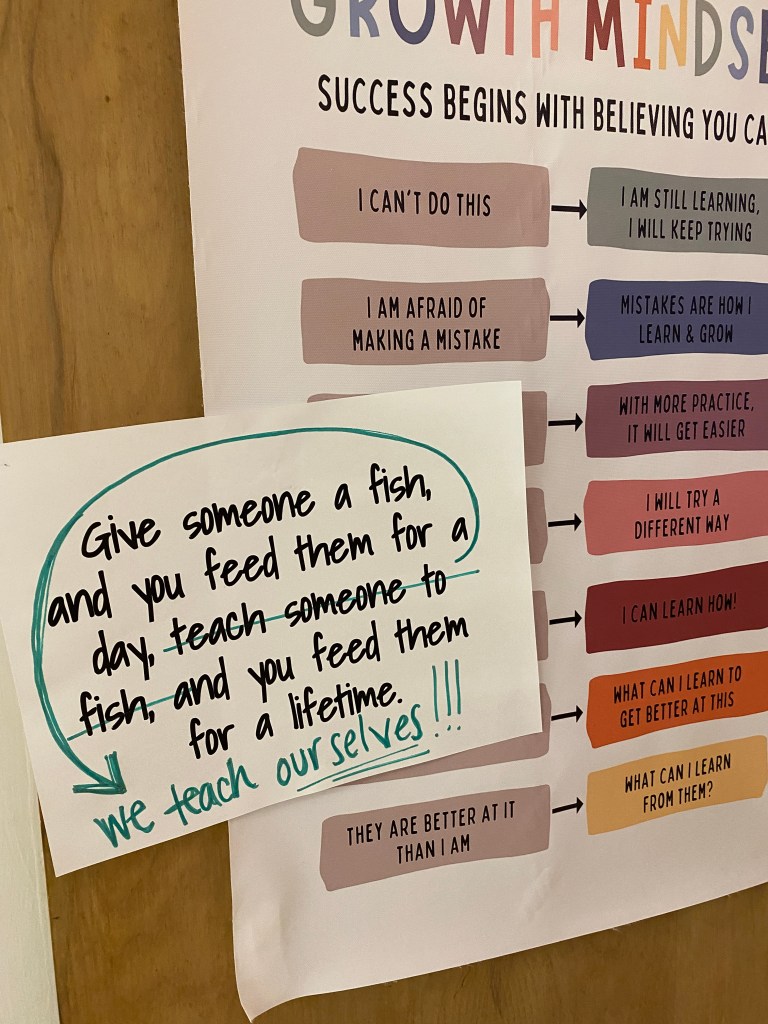
The moment occurred during the first few weeks of the school year when I prepared a launch (a mini-lesson) focused on the proverb: 

Give someone a fish and feed them for a day, teach someone to fish and you feed them for a lifetime. 

The quote was displayed in a carefully chosen font on the large television screen and the learners were carefully arranged in a circle, ready for discussion. I was prepared and excited for my carefully planned discussion. I read the quote, shared the first socratic question, and what happened next was not what I had planned. The learners read the widely-accepted, well-known adage and tore it apart with one single comment: 

Ms. Elizabeth, no one teaches us how to fish. We teach ourselves. This is The Village School, remember?

Talk about a mic drop moment. The lesson I had so carefully prepared for no longer applied. I remember thinking to myself: 

Who are these kids and what is happening? 

Are they really pushing back on an ancient proverb? 

Who do they think they are and how can I be more like them? 

I wasn’t sure if I was annoyed, impressed, or both. I’d like to say this was the first and last time the learners at The Village School found a loophole I didn’t see coming and took me on a journey I never anticipated, but this moment proved to be the first of many. 

This particular failed discussion of fish was buried in my memory until a few weeks ago when I was observing one of our 8th graders give their final presentation as a TVS learner. She was asked what one of her most memorable moments was and she looked straight at me and said: That discussion about fish. That was a good one. 
It took me a few minutes to retrieve the memory, and once found, the experience all came flooding back. Impressed by the fact that this three-years-ago conversation had stuck with her I realized its own significance to me and how so many of the discussions and experiences I have had over the past three years could be related back to the lesson this early conversation held: At TVS we teach ourselves to fish. 

I’m not even sure which lesson gleaned here is the most important. 

Is it that young people are just as or more wise than ancient wisdom?

Is it that young people are more capable of new analysis where adults see fixed understanding? 

Is it that young people are adept critical thinkers when given a chance to think for themselves? 

Or, is it that we actually have no idea what experiences might stay with a young person as a core memory that contributes to their understanding of themselves and their place in the world?

This particular learner referenced the fish discussion with a sense of pride. What was a moment of failure for me, was a source of empowerment for her, as she learned the power of questioning – or as she put it: I really love finding a loophole, and I’m good at it. 

I think what she really found is the power in her own voice, and isn’t that what we all want for all our children? 

Before this moment during her presentation, I had been sitting quietly and strategically in the corner of the room, trying my best to be a fly on the wall and simply take in the scene. I anticipate these end of year presentations with equal parts dread and joy. They are modeled after a Portfolio Defense, however at TVS the title “Character Defense” would be more accurate. We call them “Learning to Live Together” presentations, as learners must provide evidence of their growth in the character traits represented on our school’s Profile of a Learner. While other schools mark the end of the year with a summative test, we mark it with a celebration of character and growth. 

These presentations often hold emotional moments between young people and the people who care about and spend the most time with them: their teachers and parents. I cherish the opportunity to observe the connection between these groups and the bittersweet reminder of the fleeting nature of childhood and the power of the TVS agentic learning model. As an observer I watch the dynamic between the learner and her audience. 

I watched her mother’s face as she spoke about her growth in respect and accountability. 

I watched her guide’s faces as she spoke about her ability to collaborate with her peers.

I felt my own face soften as she spoke about compassion towards others and herself.

I watched her own face when she said “I really just like myself. I like who I am.” 

I watched her friend’s faces nodding in agreement, laughing quietly at a photograph in the presentation, or a reference to a joke only they understood.

I watched everyone in the room turn towards this young person with pride, a deep sense of respect, and reverence for their thoughts and ideas about their own learning experience. The magic of the Learning to Live Together presentation is that adults are asked to set aside their own judgements about how this young person had experienced school and life – and forced to lean in, listen and trust. 

One of the TVS values is that we trust young people to learn from their own experiences, and these presentations are just one example of how we live out that value. 

My favorite defense question to post to learners at the end of these presentations is to fill in the blank: I used to think…now I think about what they have learned about themselves as a result of their time at our school. Here are a few of their responses: 

I used to think I didn’t have the power to change the world, but now I know that I do. 

I used to think that I had to get everything perfect all the time and now I know that I don’t – even though I still want to. 

I used to think that I wasn’t a leader, but now I think that I am. 

I used to think I was the kind of person who didn’t care about school work, and now I think I am the kind of person who cares and I feel really good about it. 

What a gift to learn such powerful lessons about yourself at such a young age. If one thing’s for sure, learners at TVS will leave knowing more about themselves than their peers – and sometimes their parents. 

At the end of this school year, I was reminded that I used to think my role as a TVS guide was to teach young people how to fish – and now I think, my role is to cheer young people on as they teach themselves. 
Terrible First Drafts 

“Almost all good writing starts with terrible first drafts” is one of many insights into the art of writing from author Ann Lamott. As a C- high school English student,  former high school English teacher, and successful doctoral student, I’ve written and read my fair share of terrible first drafts. Because of these experiences I think I’ve earned the right to have my own insights about writing, how to teach it, and more importantly, how to create opportunities for young people to grow into confident writers. 

For those of you who know me, you’ve probably heard my story about being an avid reader, writer, and published poet, until September of my freshman year of high school when a teacher shared some pointed feedback in crisp red pen on an unfortunately terrible essay about Gilgamesh. After that moment I quit English, abandoned books, and stopped writing. Spoiler alert: I found my way back. (All that happened in between is a story for another time.) 

Since the trauma of the red pen I’ve grown into a (mostly) confident writer. I’ve also had the privilege of learning from all of the mistakes my students and I made together over my ten years in the English classroom and three years it took me to write my dissertation. The most valuable takeaway for me was the power of writing to learn over learning to write. 

One aspect of the Village School learning design that impressed me the most when my family first joined the school five years ago was the volume of writing to learn that was required. Teachers, and especially high school teachers, are cautious about the volume of writing assignments because the more writing, the more pages to grade with that infamous red pen. Most classrooms are places where writing is expected to be formulaic (easier to grade), perfect (easier to grade), and without individual voice (easier to grade). 

Writing to learn is different from learning to write, as the focus positions writing as a powerful tool for thinking, exploring ideas, and developing intellectual identity. Additionally, writing itself is one of the most significant acts a person can make in terms of deep learning. The primary goal at TVS is that we foster an environment where young people develop their writer’s voice and belief in their ability as a writer. We expect to see lots of mistakes in those terrible first drafts and even in some final submissions. We refrain from the red pen because we’re choosing to focus on long term growth over short term perfection.

The quickest way to squash a developing writers’ confidence is to take a red pen to a piece of writing to correct  lower order concerns like grammar or spelling mistakes. If you don’t believe this, my ninth grade self will tell you how it feels to have an adult point out all that is “wrong” with your paper and so will the research. The most impactful feedback anyone can provide to another writer is feedback on the ideas present in the writing, not the technical aspects. These are known as higher order concerns, and what college writing centers focus on and so do TVS guides. Feedback should cause thinking, not more work. 

I know this begs the question – and I know what some of you skeptics might be thinking. Trust me, my mother asks the same questions out loud (not in her head). “These kids need to learn capitalization!” “But, what about commas?” “Please, diagram some sentences!”I hear her, and I hear you. Parents often have the same questions and are skeptical about the type of feedback their learners receive on writing specifically – because they, like many adults, are looking through the lens of that infamous red pen. A missing period or misused comma are an easy correction that might seem harmless, however this type of feedback misses the mark, pun intended. Sometimes these questions emerge after we send home TVS elementary schoolers standardized test scores that show a deficit in these technical aspects of writing (that are a lot easier to ‘measure’ than creative ideas and a compelling thesis). However, those same test scores also report that by the time learners get to 8th grade, they’ve figured it out without any formal grammar instruction. (Please tell my mother!)

A writing to learn approach is not an abandonment of these conventions, it’s about a trust that these aspects of a piece of writing will become important to the learners over time. It’s a testament to the constructivist belief that The Village School is built upon, as well as our intentional design for deep, purpose driven learning. 

Recently a parent stopped me to share about their fifth graders’ middle school visit day experience. They specifically wanted to share with me how proud their child was about completing the Civilizations writing assignment – a rigorous task that most learners new to middle school find quite challenging. I smiled as they shared their critique of their learner’s essay. In their own words: “it was terrible.” I asked the next question about the parent’s response with my fingers crossed. And as they answered with a knowing smile and reported that through gritted teeth they told their learner how great it was. (High-five, TVS parent!) Terrible first drafts are exactly what we are going for, more often than not. 

So, the next time you show up to an Exhibition or are reviewing a young person’s writing, ask them questions about the ideas in their writing instead of the technical aspects like the format or the font (unless it’s Comic Sans.) And, fine, if you just can’t help yourself, we give you permission to correct just one (of the most likely many) grammar mistakes.  As long as you promise to remember: they are writing to learn. 

Session 6 Sneak Peek

Spark Studio

This session, Spark learners will explore the wonders of our environment. Learners will embark on a journey to uncover how things are made, explore nature, and discover what makes Earth so amazing.  They’ll take nature walks, engage in scavenger hunts, and witness how waste can be wonderful.  They’ll even learn about their carbon footprint and experiment with hands-on activities to understand how everyday choices impact us. In project, learners will reuse recyclable materials, turning objects into treasure as they create and design a forest.  By the end of the session, learners will have made a meaningful connection to the planet they call home.

Discovery Studio

Discovery is just days away from buzzing into an exciting new adventure—Entomology! This session, Discovery will be transforming into budding entomologists! In Project, learners will work in teams to classify different insects, diving into their unique characteristics, habitats, and behaviors. They’ll observe a real ant farm in action, watching these tiny engineers build and work together, and witness the magical transformation of caterpillars into butterflies! After studying the incredible world of insects, each team will design their very own “Super Insects,” combining the best traits from nature’s tiniest creatures. Get ready to creep, crawl, and flutter into a fascinating journey as Discovery embarks on an exploration of the insect world!

Adventure Studio

Welcome to Apprenticeship season, one of the most unique and memorable times at The Village School! This session for Communications, learners will focus on the following to prepare for their real-world Apprenticeships in Session 7:

  1. Discovering their values, strengths, and skills
  2. Dreaming up possibilities for their Apprenticeships 
  3. Identifying their networks
  4. Researching companies and organizations 
  5. Growing their professional communications skills  

Real learning is real fun! 

For Project this session, learners will dive into the bold worlds of Jean-Michel Basquiat and Banksy, exploring how these street artists use style and symbolism to share powerful messages. Inspired by their techniques, learners will investigate what makes their own school community special and collaboratively create a mural that tells their school’s story. This hands-on experience will blend art, identity, and community into one unforgettable masterpiece.

Health & Wellness

“Life is about change.

Sometimes it’s painful. 

Sometimes it’s beautiful. 

But most of the time, it’s both.”

Lana Lang

Session 6 is often full of excitement! We are getting close to the end of the school year. We are ready for warm weather, summer days, family time, turning off our alarm clocks, snow cones, swimming, camps, and so much more! Along with the excitement of summer, often comes another feeling… uncertainty. Many of our learners and families have gone through big life changes and transitions this year and there are many more to come… graduations, moves, finishing badge plans, and transitions to new studios. This session in Health & Wellness, we will be reflecting on life’s transitions, exploring how we cope, and how we can handle whatever life brings our way. 

Rubber Bands

This is a guest blog written by Jackson Rice, a Discovery Studio Learner at The Village School.

Hi, my name is Jackson, I am 11 years old. In this blog I will share a story that changed my life forever, and it might change yours. I am a fifth grader preparing for the transition to middle school. As I look at the values of The Village School, the most important character trait for me is that children can learn from their experiences and mistakes. The reason this stands out to me is because it means children can learn on their own accord and don’t always need someone patrolling over them and telling them they can’t learn that way, as a traditional school would.

The way a learner grows is by expanding their rubber band like a math rubber band or a history rubber band. The way you expand these rubber bands is by doing more of that thing. At The Village School you can work on anything at any time. Let’s say you are not the best at grammar, but you are good at math, you can decide if you want to work on math or grammar and not be forced to do something you already know. At The Village School, you have fantastic mentors and guides who not only teach you but also guide you in the right direction. I am going to share a story about when I had to stretch my rubber bands. 

Earlier this year I was not doing so well on my badge plan, and still had 30 badges left to do. I was nervous that I was not going to move up to sixth grade if things stayed like this. But with one guide meeting, where you meet with a guide and talk about how the year is going, I said I was nervous that I would not move up to middle school. The guide said not to worry, and if I took things one step at a time, I would get to the finish line: middle school. After that guide meeting, I started to look at my badge plan differently. I focused harder on my morning work. I started to work on stuff at home, and soon or not, I was almost done with my badge plan.

I crossed the finish line, and now I can start to work on my sixth-grade work early and get ahead so I won’t fall behind. There were a lot of lessons I learned from this experience, but the most important one was time management. You can do a lot more when you have a plan and know what you’re doing.

During the story I just shared, I stretched a small rubber band to make it bigger, in other words, I learned. Robert F. Kennedy once said “Only those who dare to fail greatly can ever achieve greatly.” This is one of my favorite quotes because it shows that mistakes are just another step to success and stretching your rubber bands is the only way to grow. When you are at The Village School, you will learn life lessons and skills that you would never learn at any other school but The Village School.

Session 5 Sneak Peek

Spark Studio

Have you ever had an idea for a business or product, but weren’t sure where to start? Spark has too! This session, learners will explore the ins and outs of starting a business. Learners will think about different businesses and products, both that were a success and failure. They will look at what qualities make a successful businessperson before designing their own business, writing out a plan to follow. 

In project time, learners will split into groups where they will decide on a product to sell, list out and purchase materials, and create their business and products. They will get real-world, hands-on experience with a budget to work out how much to charge for their products, how to give change, and even decide what to do with their earnings. 

To conclude the session, learners will become young entrepreneurs in action as they market their products to sell with their business logos and posters for exhibition. 

Discovery Studio

Project

Discovery is T-minus 2 days away from an exciting Launch…literally. This session, Discovery will be setting off as space explorers! In Project, learners will begin by discussing what an Astronaut’s daily life entails. Then, they will research the solar system to create a map and prepare their own trip to space! After exploring stars and constellations, they’ll finally  plan their own lift off by putting their rocket designs to the ultimate test! 5-4-3-2-1, get ready to reach for the stars as Discovery embarks into Astronomy!

Writer’s Workshop

Have you ever sat down and been transported to another world with a nail-biting, thrilling science fiction story? In this session’s Writer’s Workshop, learners will dive into the essentials of sci-fi storytelling, exploring key elements like world-building, futuristic technology, and compelling characters. From there, they will brainstorm imaginative concepts, develop engaging plots, and refine their writing through peer feedback and revision. The best part? They’ll get to share their original sci-fi stories with our fellow learner “editors”! Let’s get ready to write about the future!

Adventure Studio

Curious to know what it takes to design a roller coaster? In our upcoming Project, learners will step into the shoes of engineers, crafting their own marble coasters while diving into the physics of motion! Using everyday materials, they’ll experiment with potential and kinetic energy, acceleration, and Newton’s laws to create loops, drops, and turns that keep their “riders” on track—powered by gravity alone! Stay tuned to see how creativity meets science in this hands-on engineering challenge. 

For Communications this session, learners will step up as trailblazers, using their voices to ignite ideas and spark action in their communities. Through their 10-minute ‘I Have a Dream for My Community’ speeches, they’ll take bold stances, share stories, and propose real-world solutions—proving that leadership isn’t just about having a vision, but about having the courage to stand up and make it happen.Get ready for powerful ideas, courageous voices, and the first steps toward real change! 

Health & Wellness

Have you ever had a moment of embarrassment or feeling incredibly awkward after leaving a conversation and you just relive it over and over again? “Why did I say that?” “I wish I had done that differently!” We all have these moments! This session we will be exploring awkward moments and how to turn them into learning experiences. We will practice social skills such as how to enter and exit a conversation, how to read body language, how to read a room, and how to make a dreaded phone call! Let’s get ready to have some fun with feeling awkward!

Learning to Learn: Middle School Civilizations

Middle school Civilizations, or “Civ” as the learners call it, is one of The Village School’s signature learning experiences. The curriculum is a rich task built with intention and backed with research. Learners are asked to engage with most of the topics and character traits listed in our school Profile of a Learner as well as meet each strand of Project Zero’s Understanding Map, a research based framework for designing powerful learning experiences.

Twice a week learners are presented with a Civ Challenge that is composed of three parts: research, writing to learn, and socratic discussion. Each challenge is centered around a list of approximately 10 socratic questions, with a focus on what is known as the “big question”. The big question is about a specific time or person in history. Learners are challenged to come up with their own answer to the big question based on their own research. Each Civ Challenge is accompanied by a bank of sources that may include primary sources, images, graphs, videos, and articles that are relevant to the big question.  Additionally, each challenge weaves in current events that connect to the historical topic. There are current articles, news clips, and primary sources that highlight these connections. 

Learners are challenged to do at least 30 minutes of research using the sources provided, and take notes on the information they are gathering. After their research is complete, they begin writing to learn. Writing to learn is different from the purpose of most academic writing, and research shows that the older a learner gets, the less opportunities they have to write to learn in school. Writing to learn is to help learners process their thinking and determine their own ideas and thoughts – or as one researcher explains, “Writing to learn is learning to think.” This is exactly the purpose of the writing task in Civ. 

Learners must submit their written response by the deadline in order to participate in the final aspect of the challenge, a peer-led socratic discussion. Learners arrange themselves in a circle, nominate a discussion leader, review the discussion guidelines and begin. The conversation starts with sharing responses to the big question, followed by the discussion leader’s guidance through the rest of the questions.

This session’s CIV, “The People Who Made America” included ten challenges focused on one or two individuals who helped shape the country. One of the challenges focused on Mary Tape, a desegregation activist who fought for Chinese-Americans’ access to public education. Here is an excerpt from the challenge followed by the “big question” followed by a snapshot of some of the learner responses and discussion:

Mary Tape was a Chinese immigrant living in San Francisco in the 1890s. She became an important figure in the fight against racial discrimination in education. After her daughter was denied entry to a public school because of her Chinese descent, Tape took a bold stand against the schools. She wrote letters and took legal action that led to a landmark court case. 

Was Mary Tape a hero for her family and other Asian Americans or a failure?  Should heroes be defined by personal victories or by the ability to inspire and effect larger change? 

“I don’t think you have to succeed to be a hero.” 

I think she was a hero to her family and to the people that she inspired. I think you can fail and still be a hero in some people’s eyes.” 

“I disagree – I think she was a failure because she did actually fail at what she was trying to do. I think what she did was heroic, but it doesn’t make her heroic.”

“I actually completely agree with Charlotte because I think calling her a failure is a bit of a stretch. I also agree with something Jude said that being a hero or a failure depends on the standard. I think for Mary Tape the standard was heroic – she was fighting a similar fight as MLK, because she was fighting against racial discrimination. MLK is one of the most influential heroes in the world.”

“I agree with Charlotte. It’s hard to categorize someone as a complete hero or a complete failure. I do think that she failed in her goals, but she certainly didn’t fail in being her. She was a success in that she brought the injustice to light and made people aware of it. Generally I think she was a hero because she did more good than bad. 

I wouldn’t describe her as a failure. She stood up for her family and that’s heroic to me. 

“Wait -can someone explain what she did with the school?”

“She went to the Supreme Court and advocated for her children to be accepted into the local public school, but the Supreme Court l,et everyone know that segregation was still okay, so they had to make a different school for her children. 

“All last year in Health and Wellness we talked about what makes someone a hero, and I remember talking about how a hero is someone who positively influences others, and she did that.” 

“Along the way to your goal, you’re always going to have failure. Just like us in our journey at TVS, we’re going to fail sometimes.”

“I agree with Amira. I think she was a hero because even though she encountered failure she still did something incredible. Her argument made it all the way to the Supreme Court which is a big deal. Even though it didn’t turn out how she wanted, she brought awareness to this important issue. I definitely think she was a hero.”

“Hey, can you read the second part of the question again? I noticed no one is answering that part.”

“I think if someone is a hero their actions need to affect more than just themselves. You can be a good person, but that’s not the same as being a hero. I don’t think that your reach has to be huge. You could do something to benefit your school or your neighborhood and that can be heroic.”

“I think that heroism should be defined as the ability to inspire others. Inspiring others is good leadership. If you’re being a leader, you’re being a hero – and if you’re being heroic, you’re inspiring others to be heroic.”

I think it matters what your intention is. Her intention was to make a positive impact and in that sense she succeeded.

Below is one of the learner’s written responses: 

A hero is a person who is admired or idealized for courage, outstanding achievements, or noble qualities. And by that definition, Mary Tape was a hero. She might have failed to get her child into public school, but she inspired others, not just to follow the law but to do what is morally right. 

When Mary Tape sued the school and the case went to the Supreme Court, the case was not just for her daughter but for all Asian Americans. She might have failed to get her daughter into an American school, but she put action in the movement and took a step toward equal rights. 

You can’t be a failure if you inspire millions. You can still be a hero if your goal fails. Failure is a part of learning, and failure is a part of changing the world. Martin Luther King Jr. was arrested multiple times, and he may have failed at that moment, but he is still considered a hero. Mary Tape is the same—someone who, in the immediate future, may have failed but, in the long term, succeeded. 

Learners go through this entirely self-led process twice a week. They learn to read critically, write thoughtfully with evidence to support their ideas, consider other perspectives, connect history to current events, and to their own experiences, And, most importantly they are trusted to engage in this process as independent learners, writers, and thinkers. This learning task is something most high school students wouldn’t be trusted to attempt. In a traditional, highly competitive high school environment there isn’t room or time for learners to struggle or fail.  Like so much of the learning design at TVS, we choose to trust over control. Civ requires the adults in the room to really lean into our Constructivist approach to learning and our belief that young people can be trusted to learn from their own experience. 

As expected, the learners capture the heart of Civ best, as one learner put it: “…Civ is definitely the most challenging part of being in Adventure, but it’s also the most fun.” And, of course we agree: the more epic the challenge, the sweeter the victory. 

Session 2 Sneak Peek

Spark Studio

Photo by Sara Free on Pexels.com

It’s fall y’all! Learners will get to explore how food gets to their table by reading about and discussing all things harvesting. From learning about plant life cycles to understanding how food fuels their bodies, learners will try new foods, challenge their math skills using pumpkins, read and write about fall activities, and perhaps even learn to make their own lunch! During project time, learners will work in new groups, practicing team building skills while exploring interests and brainstorming project ideas. Amidst all this, Spark will take a trip up into the Washington Monument after the first sessions’ rich exploration of the structure. See you in session 2!

Discovery & Adventure Studio

Photo by cottonbro studio on Pexels.com

It’s Election Season! Learners in Discovery and Adventure Studios will engage in a deep dive into the Democratic Process exploring the different ways they can share their voice, inspire positive change, and participate in the democratic process before they are old enough to vote! The Project and Writer’s Workshop and Communications challenge will create opportunities for learners to explore the three branches of government and their function, analyze the UN Rights of the Child, investigate the legislative research process, examine how art can be used in activism, and develop their persuasive letter writing techniques. At the end of this session learners will journey to Capitol Hill to deliver one pagers to Congressional Staffers and send a persuasive letter to a politician both advocating for a policy issue advocating for children’s rights.

Health & Wellness

Photo by POI * on Pexels.com

“Beauty begins the moment you decide to be yourself.” – Coco Chanel

Throughout session 1, we focused on belonging. Session 2 will be focused on “becoming”. The learners will take an introspective look at who they are through a values game, reflections on goals, abilities, and dreams.  We will visualize the parts of ourselves that make up who they are. Then, we will take a “vibe check”, asking ourselves about the energy we put into the world and what energy we hope we are expressing to others. At the end of the session we will take a look at the story of our lives so far and make predictions about what is to come.