“Our mission is to give young people agency in their learning, helping them discover what they can uniquely contribute to the world.”
When my youngest son was four, he loved the act of throwing rocks into the water at the creek by our house. He would carefully select a stone and watch the impact as it hit the water’s surface. He loved seeing the ripples, watching them circle the rock’s point of entry and move outwards, creating small waves in the surrounding water. He could do this for hours.
At age 10, he could still do this for hours- though the task had changed from simply throwing rocks to skipping rocks.
Today, At age 12, he’s often found at the creek with a group of his neighborhood friends. There, they work together devising and implementing various ways to manipulate the flow of the water. Just last week, while walking the dog, I found them knee-deep in the water, moving stones and logs to create a dam and bridge from one side of the stream to the other.
It’s evident to me why he has always loved this so much. In the sacred space, he is in charge. He chooses the materials and how to use them. He selects the pace and when to take a break. He gets to see the immediate outcome of his actions. As he’s gotten older, he naturally chooses to increase the complexity of the task, seeking a greater challenge, and others to join him.
In the comings and goings of life, the prescriptive nature of childhood, and a largely adult-imposed agenda, my son is captivated by this space that allows him freedom and choice. He has agency over his experience.
When I think of this, it always reminds me that is truly what we all want, children and adults alike. We all want the opportunity to impact the world in some way- to see the ripples, the effects of our actions, no matter how big or small the splash. We all want the chance to use our innate creative freedom, act, and stand back proudly and think, “I did that”- or “Oops, I’ll do it differently next time”…
This is the magic of a learning environment where young people have agency, are trusted and empowered to solve problems, and effectively have the chance to see the ripples of their choices and actions in a caring and close-knit community.
As we send our alumni into the world, on to their next great adventure of High School, I am affirmed in our mission here at TVS as our graduates exhibit this same sense of agency. They are talking with teachers, asking for feedback, helping their peers, and taking on leadership roles. They are courageous and self-aware. Just a few days into my oldest son’s first year of High School, and he claims is the go-to “tech guy” in his advisory. When I asked him how this evolved, he shrugged and smiled, “I’m a problem solver.”
As we excitedly embark on the adventure of a new school year, we remain rooted in our mission to give learners agency, which will allow us to continue nurturing a generation of young people who know who they are and what they can contribute to the world around them.
We are thrilled to welcome new team members to The Village School for the 2024-2025 school year!
New Guides
Aliyah Rawles- Lead Discovery Guide
Aliyah’s journey has been one of many rising actions! She began her work with young people as an early learning teacher and a Teaching Resident. Eventually, she became the founding teacher for a cutting-edge project-based learning program that was functioning within a public charter school in Washington, DC. There she led upper elementary learners in project creation, experiential learning outings, English Language Arts, and hands-on Social Studies curriculum.
She was inspired daily by the curiosity, resilience, and adaptiveness of young people and became convinced that a learner-centered and project-based model is the best way for children and adolescents to learn. When she came across TVS, she knew she’d found a place where she could commit 100% to focusing holistically on the learner and guide them in navigating their own journeys. In her spare time, she loves to spend time with her Labrador retriever, curl up on the couch to read a good book, or watch history documentaries!
Abby Shaw- Lead Spark Guide
Abby grew up in Oklahoma and has had a lifelong desire to work with and support children as they learn and grow. She studied Human Development and Family Sciences at Oklahoma State University. She knew that she wanted to pursue a career in education after she had the opportunity to work in an early childhood classroom during her final year in college. While working as a second-grade teacher over the past two years, Abby has developed a passion for teaching reading and literacy and engaging learners in project-based learning experiences. Throughout her training and teaching experience, she realized how difficult it is to meet the individual needs of a diverse classroom of students in a conventional setting.
Abby’s desire to see every young person succeed led her to The Village School. She knew the learner-centered model was what she had been looking for and truly believes it is the only way to honor the unique needs and interests of each child. She is excited to guide the youngest learners at TVS alongside the Spark Guide team!
Noel Welch- Adventure Visiting Guide
Noel graduated from Bowling Green State University with a degree in German Language and a minor in Three-Dimensional Art. After graduating college, she went on to work in a variety of fields, such as working for a sculptural lighting artist, as a glassblowing demonstrator, and as an elementary school English teacher in South Korea. There, she discovered her passion for working with young people and bringing creativity into the classroom. She is looking forward to fostering an environment of curiosity and exploration, and creating a learning environment she would have loved to have had as a young student. In her free time, she has rediscovered the joy of reading, works often on embroidery or stained glass projects, and tries cooking new recipes.
Caroline Powell- Discovery Visiting Guide
Caroline is a native of Richmond, VA. She loves living in the DC area and is very excited to be part of The Village School team. Caroline graduated from Roanoke College with a degree in Psychology with a concentration in Human Development. She has a life-long passion for learning, which was fostered during her high school years when she attended a specialty center focused on education and human development. She continued to make child development a focus of research during her undergraduate career. Before joining TVS, Caroline worked at an educational consulting firm in DC. There she worked with higher education teams, learning about engagement and continued connections to academics throughout a lifetime. She loves meeting new challenges and working to find answers to questions, so she is very excited to be joining a community with a learner-centered approach. She is looking forward to seeing all that the learners at TVS discover!
Outside of the classroom, you can find Caroline cooking a new recipe, writing, listening to music and attending concerts, in the movie theater, or exploring DC with her friends and family.
Please join us in welcoming these new team members to The Village School for the 2024-2025 school year!
“There is no absolute assurance that those things I plant will always fall upon arable land and will take root and grow, nor can I know if another cultivator did not leave contrary seeds before I arrived. I do know, however, that if I leave little to no chance, if I am careful about the kinds of seeds I plant, about their potency and nature, I can, within reason, trust my expectations.” -Maya Angelou
We use a variety of metaphors to capture the essence of what learner-centered education is all about, but the primary, and possibly most accurate metaphor is the one of the gardener. Our goal, like a gardener, is to provide optimal conditions and experiences in which the seeds of strong character and skills (as outlined in our Profile of a Learner) will take root and flourish long after a learner’s time at TVS has come to a close.
As a PreK-8th grade school, High School is the “next great adventure” for our learners.
Given that the majority of secondary programs in our area look very different from our model, (because, yes, the archetype of the High School experience still runs deep in American culture) parents, community members, and other educators are often curious about this transition to High School. Understandably, they want to know, “What happens after TVS? How do learners adjust to a more conventional experience? Do they figure it all out?” In many ways, what they are really asking is, “Did those seeds take root?”
Recently, we caught up with our small group of trailblazing alumni and some of their family members who were eager to share about life after TVS and the impact that the learner-centered experience has had on their educational experiences.
Our current alumni consist of learners who attended TVS for 2-4 years through their 8th grade year. Each of our alumni chose to attend their local public high school. These include Justice High School and Falls Church High School in Fairfax County and Alexandria City High School in Alexandria City.
How do learners adjust to a more conventional experience?
Each of our learners spoke of the initial culture shift they experienced in their first few months of High School. Specifically, they shared the challenge of shifting from a high-trust environment such as TVS to an environment in which “young people are not trusted as much by the adults.”
One learner shared, “I was surprised that my peers were almost afraid of the teachers.” She noticed that her classmates avoided asking questions or seeking feedback from the teachers.
Additionally, each of the learners shared that it was difficult at first to not have as many social connections as many of their peers had, due to not having attended their local public middle schools.
In sum, all of the learners reported missing a learning environment that emphasizes freedom, trust, and curiosity. “I miss the amount of free time we had, all of the freedom we had, the trust that the guides had in the kids, and an actual desire to learn in all of the students,” one learner shared.
Do they figure it all out?
As difficult as the transition was, each of our Alumni shared that they feel they are succeeding and even excelling in their respective environments and spoke of how TVS uniquely prepared them for High School. Here’s what stood out:
Academically, they felt more than prepared overall.
100% of TVS alumni report feeling academically “ahead” of their peers in nearly all academic areas, credited in large part to their writing and communication skills, historical and political knowledge, critical thinking, and problem-solving skills.
One learner shared, “I learned how to express myself at TVS. These skills have helped me in speech and writing in High School and on a larger scale. Also, I definitely have strong historical and political knowledge that I use all the time to apply to current events and connect the past to the present.”
The one area learners did not feel as prepared for was math. One learner shared, “Algebra was tough. This was the first time learning math at TVS became difficult for me and I avoided it.” This learner further explained that she would have benefited from more direct support especially without older peers in the studio to help as in previous years. Other learners shared similar feelings about math once they reached Algebra.
Aside from the initial challenges, learners felt prepared overall. “The skills I gained at TVS overall well prepared me and put me drastically ahead of my peers,” one learner shared. Another learner shared, “I learned to have high standards of excellence in my work at TVS. This has helped me tremendously.”
In terms of course selection, all learners are taking some combination of Honors and AP courses across subjects. Even with the challenges associated with math, Two-thirds of learners went on to enroll in advanced math courses. One learner is enrolled in the IB (International Baccalaureate) program at her school. Another is enrolled in the STEM academy program. Another learner is enrolled in the Business/Marketing Academy program at her school.
Their communication skills (with people of all ages) give them an “edge”.
While many of their peers showed a reluctance to engage with their teachers, all of our alumni reported positive relationships with their teachers and other adults in their schools. They attributed this to the positive relationships they had with the adults at TVS and the frequency with which they were able to “use their voice” in a school setting.
One learner shared, “TVS helped me learn how to build relationships, how to take initiative, and gave me a desire to learn and ask questions.” Another learner shared, “So many of my peers have built this imaginary wall between themselves and the teachers. They don’t understand that all you have to do is go up to the teacher and ask them questions- ask them for feedback. The minute you do that, the teacher loves you. They care so much when they see that you care.”
Another learner shared that the Socratic discussions at TVS helped her hone her public speaking abilities- especially in the art of persuasion. This learner is heavily involved in her school’s debate club (which recently went to the state finals!).
They know how to work on a team.
Learners attribute the collaboration required at TVS, both in the various project-based learning experiences and even more so in the daily challenges of “learning to live together” in a small close-knit community, to have helped them find success in high school both in and out of the classroom. From group projects to team sports, 100% of learners feel that TVS prepared them to be excellent collaborators and team players.
One learner shared, “Without TVS, I probably would not have the collaboration skills I have.” Another learner reported, “I think communication in group settings would be a lot more strenuous if I hadn’t been able to practice this as much as I did at TVS.”
100% of TVS alumni are involved in team sports and extracurricular activities. One learner is on her High School softball and field hockey teams. Another learner is on her school’s volleyball team. Another learner is a leader in her school’s theatre program. (All learners shared that these early team/extracurricular experiences in High School were critical in helping them build relationships and make friends).
They are leaders.
TVS Alumni have many of the skills that make them superb leaders- both of themselves and others.
As leaders of themselves, learners report high levels of self-direction, goal-setting, and personal accountability for their learning. One learner shared, “Two of the most important things I learned at TVS that have helped me are how to lead and how to manage my time.” Another learner echoed this and stated that TVS gave her the “Leadership skills, time management, and organizational skills” that other learners her age do not have. “A lot of time is wasted in public school that could be allocated to better uses,” one learner shared. She and others reported using this time to do homework, reach out to their teachers, or get ahead on other things. Learners share that it is due to these skills that they can successfully manage a challenging course load and extracurricular schedule in High School.
Additionally, TVS alumni are also leaders of others, taking on various leadership roles in their schools. One learner serves as the Sophomore Representative for the PTSA (Parent Teacher Student Association) as well as Treasurer for the National Arts Honors Society. Another learner serves as her Class Vice President and Theatre Department Supervisor. Recently, this learner organized and executed a community food drive for a school service project.
Finally, our alumni expressed a desire to continue to serve and lead at TVS. They were interested in opportunities to visit campus to speak to current learners, lead discussions, help with math and or reading/writing, etc. Furthermore, they were very interested in the idea of participating in an Alumni Group that would help them stay inspired, equipped, and connected to each other and to TVS.
They know who they are.
If there’s one thing that stands out, TVS alumni know who they are. In learning environments that now emphasize grades and tests, it’s clear they aren’t defined by them. They have a deep understanding of what real learning is, and what it is not.
When asked about adjusting to grades, one learner shared, “I completely understand it’s a game. I like to do well but I don’t stress out about it too much.”
They acknowledge the common narrative about young people in conventional spaces and maintain a much more expansive view of who they are and what they’re capable of. They attribute this to the counter-narrative and the experiences they were offered at TVS.
What do parents say?
Parents of our Alumni also report feeling like their learners are thriving and acknowledge the impact TVS had in helping them find success in High School.
One parent shared, “It was tough at first. But she is doing so great now. She loves her courses. She is doing the STEM track like her older brothers and she is invested in a way that they never were. I attribute this to the fact that she was able to remain curious at TVS and see the link between her own effort and interest in something. She understands that what she gets out of something is directly related to what she puts into it.”
Seeds taking root
We know that we are gardeners at TVS, continuously cultivating those seeds of self-direction, grit, curiosity, compassion, collaboration, and servant leadership- among many others. As any gardener knows, the outcomes are not always predictable. There are always variables outside of our control. Growth can be stubborn and difficult. It won’t always look the way we intended. Yet, something is always happening. By providing the optimal conditions, we can trust that most things we plant will take root and grow.
Our small group of trailblazing Alumni and their experiences thus far provide evidence that the seeds of character and skill planted at TVS have taken root. As I reflect on this amazing group of young people, I am confident that these seeds will continue to grow and flourish in the lives of all of our learners, on their next great adventure of High School and, as designed, well into the future.
After all, this is what real, life-worthy, learning is designed to do.
“It’s time for bed. You have to put your computer away now,” I say.
“But Mooooom, I HAVE to finish this,” one of my children replies.
This is a common scene in our household- one, while annoying, I’m grateful for.
Instead of nagging my children to get out and do their assigned homework, I’m instead asking them to put away the “homework” that they’ve assigned themselves.
Well, sort of.
Over the past five years, I’ve watched as my children have come home so excited about something they’ve learned at school that they are eager to do more research or work at home on the topic at hand. Or- they’ve finally mastered something on Khan, and they are motivated by this newfound momentum and feeling of accomplishment.
Other times, they are doing work at home because they are still working away on the checklist of weekly goals that they’ve set for the week. Many of these goals are self-initiated and some of them are there because of a nudge from us.
“Hmm, I noticed that you have not read your badge book in a while. How many badge books do you plan on completing this year? What session is it now?” You see where this is going….
Being a parent of a self-directed learner doesn’t mean that we aren’t involved in our child’s learning journey. It means that we are involved in a different way.
Whether it’s setting weekly goals at home with your learner, sitting next to them as they work through Khan, or removing other distractions at home so they are more inclined to pick up that book they’ve said they want to read, we are an important piece of the puzzle as they learn how to successfully direct their own learning.
It doesn’t look like nagging. It’s definitely not micro-managing. But ideally, it’s clear boundaries, expectations, accountability- and yes, celebration!
In our family, it looks like (mostly but not always) a weekly check-in to set goals and an end-of-the-week check-in to see where we stand. It’s an ongoing discussion about the importance of effort and good habits. It’s frequently a groan and expressed frustration that “there isn’t more time!”
In many ways, our children are stumbling their way towards prioritizing the things most important to them- not unlike the way many of us do as adults. There’s always more to do. There are a million different ways to fill a day. But how to fill it in a way that reflects your values and your goals? It’s a process and we’re learning together.
Learning to learn, learning to do, learning to be, and learning to live together is hard work- work that doesn’t end when the school day ends.
This week we wrapped up our fifth year as a school community. Per TVS tradition, we marked the calendar with end-of-session studio celebrations in which families, guides, and learners gather to reflect on our year together.
By this point of the year, there is an intimacy that wasn’t there in the Fall. Traveling down the road of a school year together, we’ve developed new friendships, connections, and understandings made possible by the many experiences we’ve shared this year. That blank slate of a school year before us has been filled. What was once unknown is known- each of us familiar with the design, systems, and people that make up our very special “village”.
In a micro-school like ours, every person is intimately known and valued. In addition to our small size, our learning design honors the individual as the center of all learning. Our systems and processes ensure that our guide team knows each learner on a personal level and invites our families to join us in seeing and celebrating the special traits of each young person as they grow and learn.
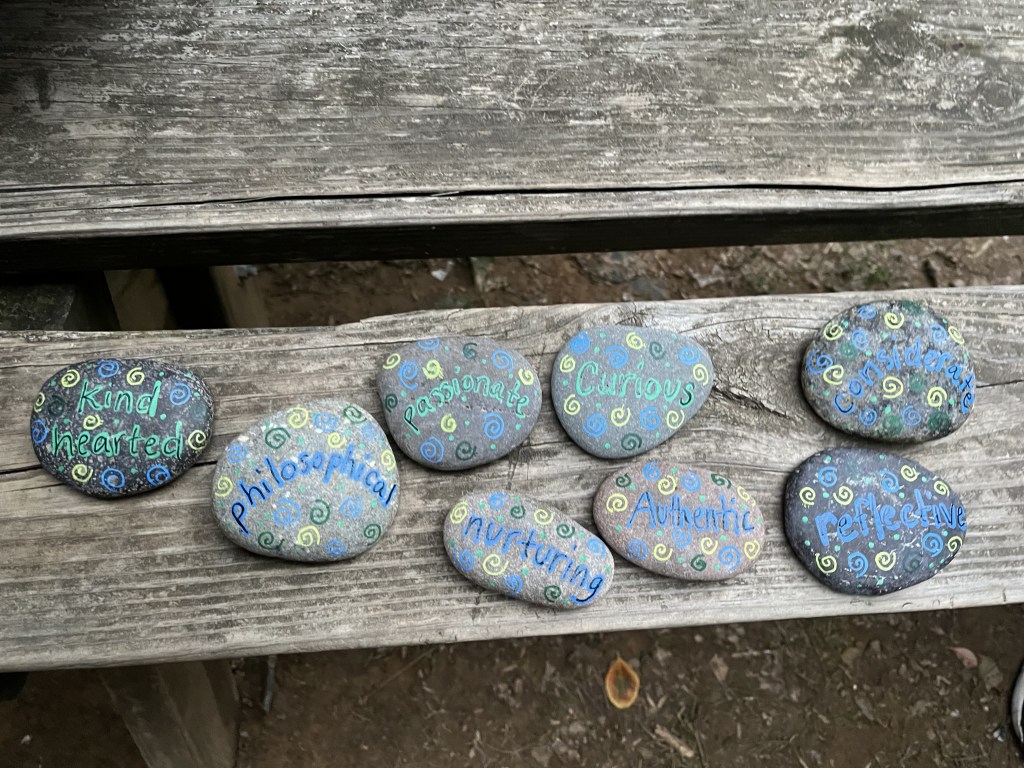
At our end-of-session celebrations this week, each learner was presented with a special character “rock”, displaying a single word that represents a character trait that the learner has exemplified this school year. Words like “Authentic, Curious, Perceptive, and Brave” are imprinted on individual rocks and presented to each learner by their guides in the company of their peers and family members.
In addition to the presentation of the character rocks, many learners give speeches, reflecting on their own personal growth in character and beyond. Not surprising, the unique anecdotes, stories, and advice in their speeches often illustrate the very character trait they find written on their own personal rocks.
A learner who is recognized for being innovative, states:
“I learned how to use other people’s advice and import it into my doing.”
A learner given the trait “courage”, gives advice to new learners and says:
“Be yourself and everything will work out!”
From a learner described as “perceptive”, we hear:
“There are still times when I will let my desire to do things perfectly slow me down. But since I know this about myself, I ask for help, move forward, and create something I’m proud of- not something that’s perfect.”
A learner who is celebrated for their confidence exclaims:
“One of my favorite quotes is If you can dream it, you can do it. This quote by Walt Disney reminds me that I can do anything I put my mind to and so can you!”
Yes, in a school such as ours, we have the great honor of seeing, knowing, and celebrating each and every learner on their journey of becoming. And yet, as we celebrate their unique character traits at this particular moment in time, we acknowledge that it is in fact a journey. This moment, while worthy of celebrating is also fleeting- tomorrow our learners will surprise us in new and unexpected ways by transforming into something yet unknown. Grow, learn, change, repeat, repeat, repeat. It’s what childhood and adolescence were designed for.
Perhaps our great task as guides and parents is to embrace a practice of “unknowing”, seeing them each day with curious, fresh eyes- knowing that they will carry only pieces of these traits with them into tomorrow.
As we end our fifth year as a school community, I am celebrating our own unique journey of becoming at TVS with gratitude, awe, and openness to all that awaits- knowing that we carry so many beautiful pieces of who we are today into the next great adventure of tomorrow.
The word is out on learner-centered education and we couldn’t be more excited about the number of educators who are passionate about our mission here at TVS. After reviewing over 150 guide applications, 40 phone interviews, and 15 in-person (and learner-led) interviews, we are thrilled to welcome five new Guides to complete our team and help us welcome new families to our community for the 2023-2024 school year!
At the same time, some of our current team members will be taking on new roles. It is our hope and belief that these positions will strengthen our learning design, our community, and our ability to deliver on our mission.
New Team Members
Aaryn Drapiza- Lead Adventure Studio Guide
Aaryn is a lifelong learner and deeply passionate about inspiring others to follow and nurture their natural curiosities. She discovered her love of guiding learners while working with children of all ages as a swim teacher, teacher’s aide, camp gymnastics instructor, and nanny. After graduating with a degree in Humanities, a discipline that challenged her to think critically and never stop asking questions, Aaryn pursued a path in education so she could continue inspiring, equipping, and connecting young people on their journeys. Aaryn has worked as an Elementary Guide and Lead Middle School Guide and is excited to further her education experience at The Village School. She also has her Upper Elementary Diploma from the North American Montessori Center. In her free time, Aaryn enjoys listening to audiobooks, singing along to musicals, running, and exploring DC.
Madelyn Brewer- Lead Discovery Studio Guide
Whether it is discovering what makes something float or memorizing the lyrics to the latest Disney hit, Madelyn aims to guide learners with the same boundless enthusiasm and curiosity that they embody every day. Madelyn received her Bachelors in Philosophy from Connecticut College in New London, CT. However, it was her volunteer time and work outside of school that inspired her to pursue education. Since beginning her career, Madelyn has taught at a country day school, a project-based micro-school, and a parochial school. Madelyn is eager to join a school community where she can prioritize what she considers essential for young people to thrive–a multifaceted approach that nurtures curiosity, confidence, and independence. It was only natural that she found her way to The Village School!
Cara Borja- Lead Discovery Studio Guide
Cara has a strong passion for the fields of science and education. She received two undergraduate degrees in biology and psychology from the University of Maryland, Baltimore County, and a master’s degree in neuroscience from Brown University. During her studies, she actively pursued teaching opportunities and obtained professional teaching certification in middle school science. Her professional work experience includes being a researcher at the National Institutes of Health, working for non-profit communities in Washington, D.C., and being an educator in multiple areas in the DMV.
She loves building connections with young people, enhancing their knowledge and curiosity about the world, and having the opportunity to make a positive influence on their lives. She is thrilled to be continuing her journey at The Village School!
Lauren Coyle- Lead Spark Studio Guide
The first “classroom” Lauren experienced was the grapefruit groves her family cultivated for generations, where she dug in the dirt and helped care for trees with her dad. There, she learned that education is more than desks and tests; education is experience, learning with your hands, and cooperating with others to grow something new. Lauren loves witnessing each child’s unique sense of wonder about the world and welcomes the chance to be curious with them as they learn.
Lauren has a B.A. in psychology from The College of William and Mary and a doctoral degree in clinical psychology from George Washington University. Alongside coursework in child development, Lauren interned at two different schools in D.C. She completed her residency at a community mental health center in Fairfax and then continued there as a full-time clinician, conducting individual and group therapy sessions for patients of all ages. After taking some time off to raise three toddlers, Lauren grew passionate about combining her background in psychology with early childhood education and five years ago returned to the workforce as a lead teacher at a Reggio-Emilia-inspired preschool. She is excited to join The Village School Guide team and aid in cultivating young learners’ natural ability to follow their interests and learn in community with others.
Lauryn Elliot- Visiting Guide
Born and raised in Northern Virginia, Lauryn is a native of the area and has always strived to give back to her community in any way that she can. Lauryn is a member of Delta Sigma Theta Sorority, Inc. and crossed at James Madison University where she earned her B.A. degree in Justice studies with a minor in Political Science and pre-Law. Lauryn is currently pursuing an M.S. in Political Science at Liberty University and has hopes to earn her doctorate degree. Lauryn has always had the enthusiasm, determination, and passion for being a guiding hand for the younger generations and has witnessed firsthand how different pedagogical approaches can improve a child’s education. Lauryn is excited to join a community of life-long learners at The Village School and support the mission of empowering young people to become architects of their own learning!
New Roles
Hannah Runyon- Program Designer and Camp Director
Hannah graduated from Colorado College with a degree in Geology and Environmental Issues. She is passionate about inspiring curiosity and critical thinking in connection with natural world and has worked with children of all ages as an environmental educator, mentor, camp counselor, nanny, and wilderness trip leader. Hannah grew up in the Adirondack Mountains of Upstate New York and attended non-traditional schools as a child. In her free time, she likes to run, make clothing on her sewing machine, bake, and make pottery.
Hannah has spent the last two years at The Village School as an Apprentice Guide and Discovery Lead Guide. She is excited to be stepping into the role of Program Designer and Camp Director for the 2023-2024 school year, which will allow her to utilize her passions and talents for learner-centered curriculum design and outdoor education. Although Hannah will miss guiding learners each day in the studios, she is excited for the opportunity to design and lead camps at TVS throughout the school year- and as always, to continue learning!
Rebecca Blake- Assistant Guide and Extended Day Coordinator
Rebecca grew up in Northern Virginia exploring nature trails and historic sites in the area. She received a BBA in Computer Information Systems from James Madison University and worked for a technology company before moving into education. Creativity and play foster a love of learning she is passionate about sharing. She spent a year teaching a nature class, helping students explore the woods, cultivating youth leadership, and teaching technical outdoor skills in a mixed-aged learning environment. Rebecca believes learner-centered education is crucial for keeping learners engaged and responsible for their own education, acknowledging individuals’ unique interests and strengths. She loves to see a learner excited to learn more about a new topic or feel pride in understanding a tricky concept. She endeavors to empower learners to think creatively, use empathy, and solve tough problems. In her free time, Rebecca enjoys reading and hiking.
Rebecca has spent the last year at The Village School as a Visiting Guide and Assistant Guide. She is excited to continue on as an Assistant Guide with the goal of supporting our Wellness and Spark programs as well as taking on the additional role of coordinating and overseeing TVS’s Extended Day program for the 2023-2024 school year.
Join us in celebrating our new guides and new roles to complete our team for the 2023-2024 school year!
“We don’t learn from experience. We learn from reflecting on experience.”
John Dewey
I recently had the pleasure of talking with one of our fifth-grade learners at The Village School who is getting ready to make the transition to the middle school studio. As we chatted, he shared some of his thoughts about his growth and progress over the past few years. He said, “I wasn’t as focused last year and I let a lot of distractions slow me down. Because of that, I’ve had to work extra hard this year. I know middle school is going to be really challenging and I definitely learned what NOT to do if I want to meet my goals and stay on track. I can still have fun, but I have to do the work each day too.”
In a learning model like ours, young people are given the opportunity to be trusted with their own learning. It’s easy to do when you sit next to a learner, like the one above, who can provide such clear insights and lessons learned from this opportunity they are given. It can be a lot more difficult when you’ve yet to see them connect these dots.
Like anything, being able to “connect the dots” comes from practice. It takes repeated practice to learn how to thoughtfully reflect on your experiences. It’s also developmental. Younger learners are most suited to reflect on something that just happened, or that happened yesterday. Eventually, the time spans get longer- we can look back at the last week or the last month. Eventually, we can look back over a longer period of time- thinking about who we were and what we were capable of earlier in the school year, or last year, and compare and contrast that to who we are today.
Growth over time is the goal. But even more than that is our young people’s ability to measure and assess that themselves. There is no greater tool than practiced reflection to solidify this connection.
Through practice, they will get there. Once they do, their ability to reflect and learn from their experiences will blow you away. Take a look at last month’s end-of-session reflections from the learners in our elementary studio (ages 8-11).
In experiential learning, making space for reflection is paramount. It’s the antidote to mindlessness, in which we just keep plodding forward in “go mode” with no conscious awareness of what it is we’re actually experiencing. Reflection is how we learn life-worthy lessons- lessons that we tuck in our back pocket, ready to be used at moment’s notice, lessons that we wear in our stance, perhaps with a new aura of confidence or self-assurance, and hopefully, lessons that can be applied to whatever experiences await.
The focus at The Village School is on building the skills and mindsets of a self-directed learner.
The first year or so at TVS involve a young person learning how to learn. For each studio, these starting points look different. In Spark Studio, it starts with learning how to do something as simple as staying focused for 10 minutes on a task or participating during circle time. In Discovery Studio, it looks like learning how to set smart goals consistently, or how to navigate the systems in a learner-centered studio. In Adventure Studio, it looks like learning how to manage your time, or learning how to give and receive meaningful feedback.
These are the things a young person is learning in their first two years in a self-directed learning community such as ours:
Developing a growth mindset/(vs fixed mindset)
Learning how to respond to failure/mistakes
Learning to take responsibility for their choices
Learning to give and receive feedback from peers
Learning how to hold their peers accountable
Learning how to participate in discussions productively
Learning to work well with peers on group learning activities
Learning to regulate emotions
Learning to advocate for themselves and others
Learning to set goals for a day, then a week, then a session
Learning to organize their belongings and their work
Learning to track their work accurately
Learning which systems to use when
Learning to operate a laptop
Learning to navigate their learning without it being micromanaged by a teacher
These are real-world skills that take a lot of real-world experience to master.
But in order to learn these skills, they have to take a lot of missteps. These “missteps” can look like avoiding work, distracting others, or searching out loopholes. This is the “pushback” phase. Which boundaries can I push? How much freedom do I actually have? What will happen when I use my freedoms irresponsibly? Exploring and experimenting with these questions is a natural part of learning how to learn. It’s an essential component of truly seeing and understanding the connection between your freedom and your responsibility, which is critical to taking the reigns as a self-directed learner.
As a community in our fifth year, I can quite clearly see the trajectory of a young person’s learning journey at The Village School- especially at this time of year. Learners are more comfortable with each other. The studio environment and its rhythm are familiar and predictable. Everyone knows what to expect and can easily navigate the studio systems.
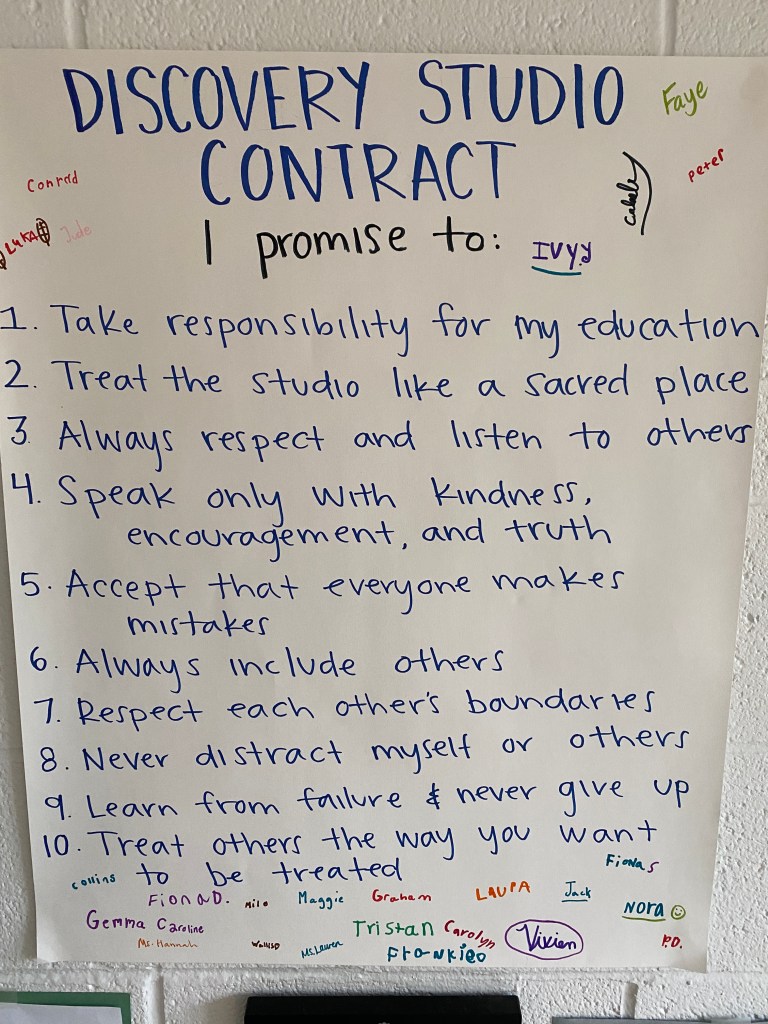
Look closely and you can see two distinct groups of learners at work in the studio. You can see the group of returning learners who have been through that pushback phase. They have failed, missed deadlines, and experienced the natural and logical consequences of their choices. They see the throughline between their freedom and their responsibilities. They are (for the most part) focused, intentional and disciplined, setting and achieving the goals they set for themselves, contributing to studio life, and kindly and firmly holding themselves and others accountable to their studio promises.
You can see another group of learners, many of whom are in their first or second year at The Village School, who have not yet been through this phase. They have diligently followed the studio promises. They have tried their best to please the guide, their parents, or other more seasoned learners in the studio. Up until now, they have spent their time getting comfortable in a learner-centered environment. And now that they are in fact comfortable, they are ready to explore the limits of their freedom. These learners are often distracted and bold, or silly and unfocused, pushing back on some of the promises they made in September and seeing what happens.
It’s important not to miss this part. This is the good part. Each learner will make choices and experience the natural or logical consequences. Some of them will feel good, (Yay, I earned a badge!) and some of them will feel not so good (Ugh, I kept talking and had to leave the discussion circle). Through experience and reflection, every choice is an opportunity for learning how to learn. It’s what our learning environment is designed for. This is the foundation that will allow them to thrive as self-directed learners in our community and beyond when they set out to navigate the new world we now live in.
These are the skills of a life-long learner. They don’t develop overnight- nothing important really does.
If you google “Self-directed learning” you will get many different definitions- enough to make your mind swirl. As a learning community, we’ve settled on this definition, as we feel it encompasses our why and mission at TVS the best:
When learners—in the context of an interdependent community of peers, trained educators, and caring adults—choose the process, content, skills, learning pathways, and/or outcomes of learning, with the guidance, accountability, and support of others, in service of finding a calling that will change their communities and the world.
There’s a lot packed in this definition. It’s a good one. But what does it really mean? Does it get us any closer to understanding all that self-directed education is? All that it promises? What it actually looks like in practice?
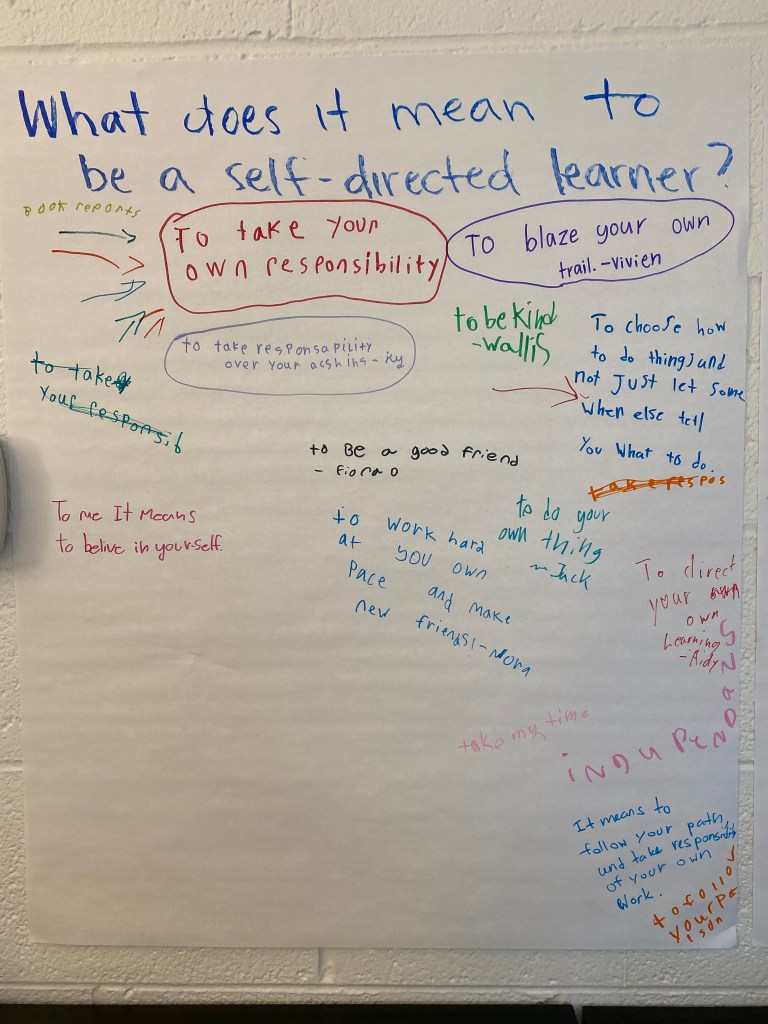
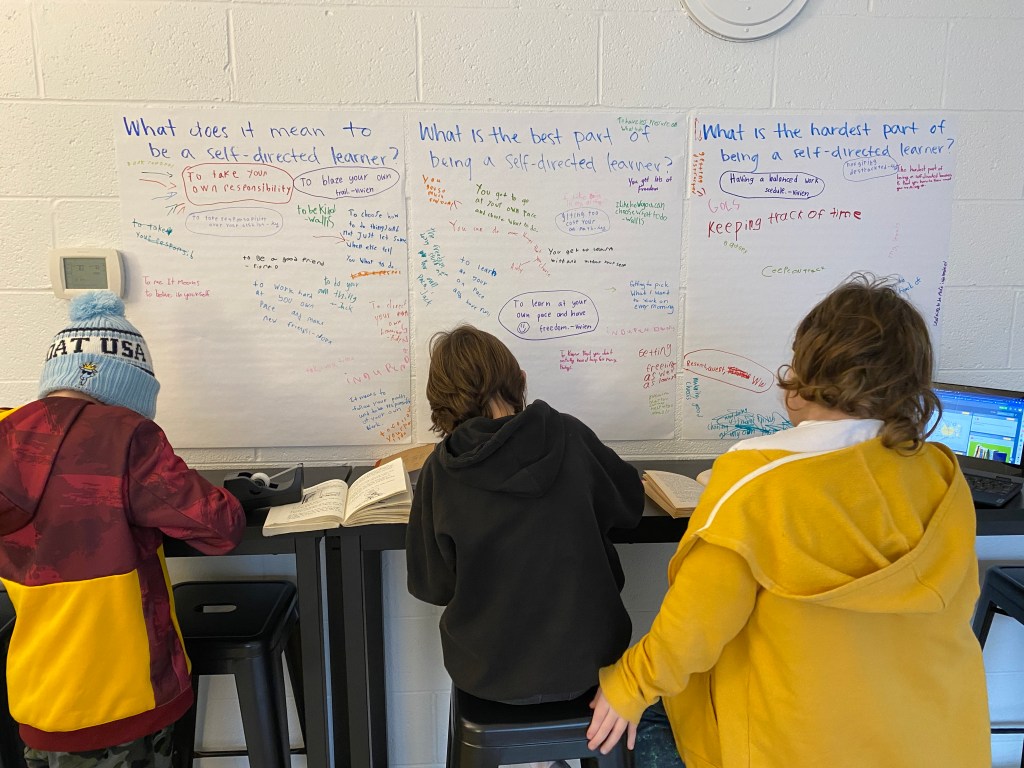
Maybe. But, I think to really understand self-directed learning we have to ask the learners. Earlier this week, as we kicked off a new session of learning and a new year in Discovery Studio, this is exactly what we did. First, we asked: What does it mean to be a self-directed learner?
Then, they were asked: What is the best part of being a self-directed learner?
Finally, learners were asked: What is the hardest part of being a self-directed learner?
I don’t know about you, but seeing self-directed learning through the eyes and minds of the young people who are experiencing it directly, does make me feel closer to understanding what it actually is, what it looks like, and what it feels like.
In regard to what self-directed learning promises, I think their answers speak volumes. In their responses (in addition to what I see every day in the studios), I see and hear young people who exude confidence, self-awareness, a strong sense of personal responsibility and agency, passion, and curiosity- among many other things.
I also see an awareness that the very best things about being a self-directed learner are also the hardest. Freedom and choice are wonderful things, but wonderful things are often found on the flip side of easy. As they say, with great freedom, comes great responsibility.
But of course, just dig a little deeper and our learners could have told you that.
“Animals, we are doing this for you!” -Spark Learner
At their end-of-session field trip to a nearby creek, Spark learners were excited to clean up plastic waste in the creek–even if it meant getting their feet wet! In session 4, they will expand on that passion for cleaning the environment and saving animals’ habitats. They will learn about how watersheds work, what kinds of animals live in the creek, and other ways to clean our creeks, bays, and oceans.
Spark learners will also study the continent of Asia in Session 4. They will explore materials from Asia in the classroom, view videos, and hear stories from the continent, and have the chance to join a Saturday family field trip to the National Museum of Asian Art on February 4. They will also start a weekly science series, where learners do hands-on experiments with evaporation, rainbow making, and color mixing.
Discovery Studio
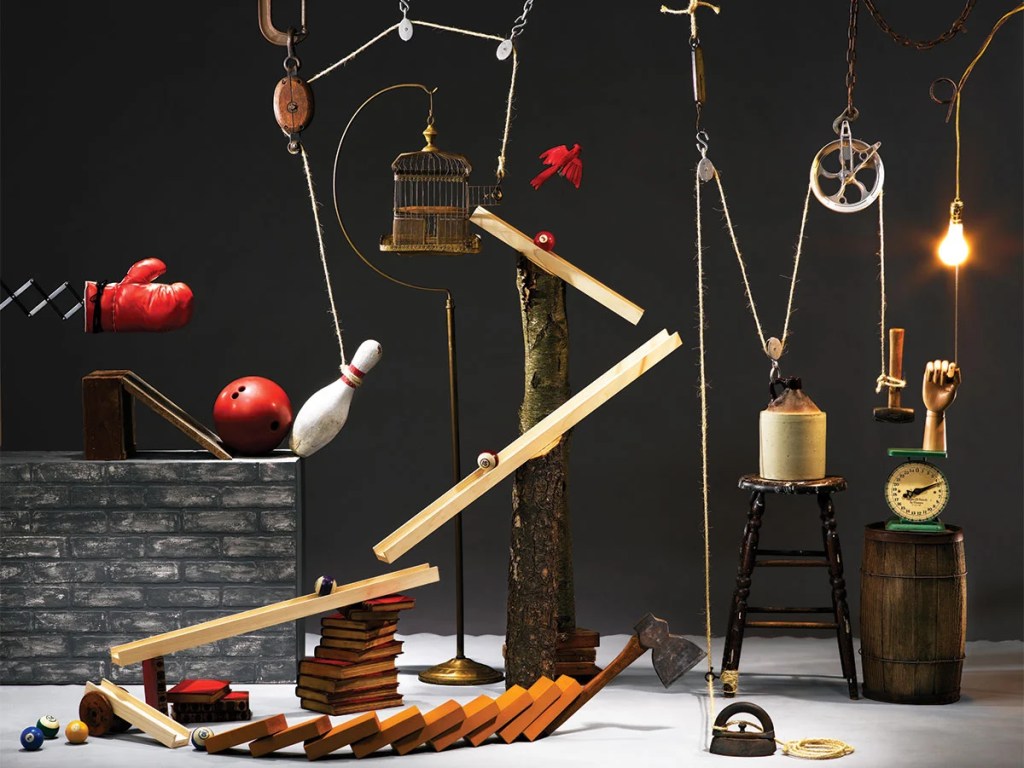
This session, Discovery learners will step into the shoes of physicists, working through experiments, testing hypotheses, and completing physics challenges to learn about work and force. Learners will explore the six different simple machines, discovering how each type of simple machine makes everyday tasks easier to perform. They will end the session by learning about Rube Goldberg and making their very own Rube Goldberg machine!
The wonderings Discovery learners have about the animal kingdom will inspire this session’s writing workshop. Kicking it off with a trip to the National Zoo, learners will choose an animal to explore, research and write about. As an extension to their studies, learners will have the option of creating a scientific drawing of their animal to accompany their research. At the end of the session, Discovery learners will share their informative writing projects with an in-house gallery walk exhibit for Spark and Adventure Studios to explore.
Adventure Studio
“What if, every time I started to invent something, I asked, ‘How would nature solve this?'” – Janine Benyus
Adventure learners will consider this question and more this session as they continue their quest to contribute to solutions to the United Nations Sustainable Development Goals with nature’s superpower: Biomimicry! Learners will use the expertise they built in Session 3 to continue their exploration of the solutions to some of our planet’s most dire problems that can be found right under our noses – in nature. Learners will take a field trip to the Botanical Gardens to explore examples of biomimicry, interview biologists working in the field of biomimicry from Villanova, UVA, and George Washington University, and create submissions to the Biomimicry Youth Challenge 2023.
Biology will also inspire the Session 4 Communications Challenge, Biologist Biography. Learners will identify a current biologist whose contributions to their field are worthy of being documented. Learners will consider the great responsibility they have as writers, especially as writers of someone else’s story. Whose stories should we have more of in this world? What stories would make the world a better place? What can we learn about ourselves through the stories of others?
The Session 4 Exhibition will feature final submissions to the Biomimicry Youth Challenge and inspiring Biologist Biographies.













 villageschoolnova.blog