This week marks the one week each school year that our elementary and middle school learners spend time with a standardized test. They show up to school, sit in front of their computers and try to determine the best answer: A, B, C, or D. For these few hours our studios full of learners look a lot like classrooms full of students.
Before we begin the testing experience, we spend time considering the purpose of the test and what it does and doesn’t measure. Like so many other mornings, we begin with a story and some questions:
You are about to go on a solo trip on a sailboat around the world. It will take you 3-4 years to circle the globe. You will be alone on the sailboat with all your provisions. And because vast portions of the ocean are so remote, much of the time you will only have your wits to rely on.
Question 1: How will you prepare yourself for this epic journey?
Study and take a test
Go out and sail every day in vastly different conditions, taking longer and longer trips until you feel prepared
Question 2: Imagine this… You have a dream to become the CEO of a multi-billion dollar company. You have an amazing idea but little business experience. What do you do?
Study and take a test
Talk to other CEOs and experiment your idea by starting very small and growing
Question 3: Imagine this… You want to write and produce your own Broadway play- it’s going to be the next Hamilton! You know how to write and understand music but you have never written a play before. What should you do next?
Study and take a test
Write a play, get feedback, and try again
In most of these scenarios of epic adventures, our learners identified that the best way to prepare for the journey is to practice and develop their skills, not take a test. Life is an epic adventure and often, the real test is the journey each of us go on. And yet, in most schools, a standardized test is the only way that learning is measured and success is defined.
The last question we pose to our learners is the most important and resulted in the most profound responses.
Question 4: And really importantly, what does this test not measure that will help you on your life adventure as you blaze your own trail?
Our learners’ responses included…
“It won’t measure how good of a friend I am.”
“Collaboration and how well I work with others and even how well I work with myself.”
“Basically every character trait that we think is important – like curiosity and compassion.”
“Respect.”
“How funny I am.”
“How I’ve grown in public speaking.”
“All of the things we talk about in Health & Wellness.”
We closed our conversation confirming our learner’s ideas – that each of them are so much more than a score on a standardized test, and we reminded ourselves of some of our TVS core beliefs.
We believe who you are is more important than what you know. We believe that a learner should only ever compare themselves to who they were yesterday – not to the person next to them or to some arbitrary standard. We believe that all young people have a calling that has the power to change the world. We believe that what really matters can’t possibly be measured on a test.
As a community, we frequently discuss our self-directed learning model. The learners have a strong understanding of what it means to be self-directed. They demonstrate this through goal setting, establishing a process for success, evaluating their plan, and then reflecting on their results. These steps are an important foundation for what it means to be a Village School learner.
Independence is another character trait that we instill in our learners. We trust them to make decisions and execute their ideas. We trust them to solve problems they encounter along the way. We trust them to have freedom of choice and take ownership over the responsibility that comes with that freedom. This session, we reflected on self-directed learning, the independence our environment values, and we asked ourselves, does our self-directed learning model also depend on how self-directed we are in our relationships?
Our discussions began with the analysis of the following quote:
“Relationships are critical to becoming self-directed as no one achieves self-direction in isolation. Others contribute to our understanding of and ability to self-direct our lives. Self-direction is enhanced in social contexts and we need social skills to be able to interact with those who can help us achieve self-direction through supportive relationships. Self-direction must also be seen in the context of group direction where it is important for students to be self-directed while working in harmony with group-directed activities.” – Karl L. Squier
At first, the learners discussed how at The Village School, we are asked to be completely independent, we are required to learn on our own. As our discussion went on, the learners all shared how certain goals would not be obtained without the guidance or support of their fellow peers. We also related this to our families and how our growth happens with the encouragement of our parents, siblings, and grandparents. The learners all began to agree that no one person can operate alone in the world, we all need each other to achieve our hopes and dreams. There is no “self” without our community. Furthermore, being completely independent and alone leaves life without meaning.
According to C. Robert Cloninger in his book, Feeling Good: The Science of Well-being, being a self-directed person requires a person to take responsibility for their actions, their behaviors, and choices, and to accept the responsibility that in our relationships, this means that we must be seen are reliable and trustworthy. Our studios have been building trust with each other by engaging in trust building activities, like airport and high risk, low risk. We have engaged in role play scenarios about other people and how they can rebuild trust once it is broken. We have also reflected on the relationships that we have and how they bring meaning to our lives.
As our session begins to come to a close, we will reflect on the skills that make us self-directed and how we can be more self-directed in our relationships with each other.
This session middle schoolers are hard at work trying to secure an apprenticeship for the final session of the school year. This real-world experience, typically reserved for juniors in college, is something we are proud to offer learners as young as 11 here at TVS. The apprenticeship, like much of our learning design, is intentionally named. The term apprentice is from the old French word, “apprentiz” meaning “someone learning” typically from a mentor in a specific field of interest. The word apprentice also relies heavily on a relationship between a mentor and a mentee. Growing our learners’ “village” is a large part of the apprenticeship experience goal.
The apprenticeship experience is a cornerstone of our school, as it draws on all three pillars of our learning design and puts into action our vision of empowering young people to discover their passions and share them with the world.
Learner-centered
We believe young people are capable of so much more than the world typically gives them credit for. Over a seven-week session learners will identify, research, and secure a meaningful apprenticeship working in a position where they can use and hone their greatest gifts, and explore an industry, company, and assignment that will advance them towards their calling in the world. Learners take personality quizzes that provide potential career fields to consider, determine what jobs they would never enjoy, as well as jobs they might consider the perfect match for their passions and skills. Learners are entirely responsible for this process, acting as the leaders in this work, while their parents and guides cheer them on as they go.
Experience-based
We believe that experience is the best teacher. Each step of the TVS apprenticeship is an experience that teaches learners about themselves and the world around them. The “process” here is just as important as the “product” (actually securing an apprenticeship). We consider it essential for learners to go through the process of reaching out to professionals, deal with getting “no’s” or no responses from potential apprenticeships, and to persevere and move forward. We know that our learners’ memories of time spent with a mentor in a field of their interest will last a lifetime.
Character-driven
We believe that who you are is much more important than what you know. The experience of learning from a mentor beyond our school walls is a chance for learners to further develop the TVS character traits they work towards and reflect upon all year including: leadership, responsibility, gratitude, accountability, compassion, and trust. We also believe in what we call real-world feedback: feedback from the real world, rather than feedback from our own community. This kind of exchange is character building and important in terms of character development and growth.
Our commitment to middle school apprenticeships is also an act of trust. We trust young people and we believe they can do and will do so much more than is generally expected of them. What will they learn from spending time with a professional podcaster, a Montessori educator, a costume designer, an entrepreneur, a chocolatier, a CFO, or a small business owner…. We can’t wait to see what each of them do and learn as they blaze their own trails this apprenticeship season. 3 – 2 – 1 Adventure Awaits!
“We don’t learn from experience. We learn from reflecting on experience.”
John Dewey
I recently had the pleasure of talking with one of our fifth-grade learners at The Village School who is getting ready to make the transition to the middle school studio. As we chatted, he shared some of his thoughts about his growth and progress over the past few years. He said, “I wasn’t as focused last year and I let a lot of distractions slow me down. Because of that, I’ve had to work extra hard this year. I know middle school is going to be really challenging and I definitely learned what NOT to do if I want to meet my goals and stay on track. I can still have fun, but I have to do the work each day too.”
In a learning model like ours, young people are given the opportunity to be trusted with their own learning. It’s easy to do when you sit next to a learner, like the one above, who can provide such clear insights and lessons learned from this opportunity they are given. It can be a lot more difficult when you’ve yet to see them connect these dots.
Like anything, being able to “connect the dots” comes from practice. It takes repeated practice to learn how to thoughtfully reflect on your experiences. It’s also developmental. Younger learners are most suited to reflect on something that just happened, or that happened yesterday. Eventually, the time spans get longer- we can look back at the last week or the last month. Eventually, we can look back over a longer period of time- thinking about who we were and what we were capable of earlier in the school year, or last year, and compare and contrast that to who we are today.
Growth over time is the goal. But even more than that is our young people’s ability to measure and assess that themselves. There is no greater tool than practiced reflection to solidify this connection.
Through practice, they will get there. Once they do, their ability to reflect and learn from their experiences will blow you away. Take a look at last month’s end-of-session reflections from the learners in our elementary studio (ages 8-11).
In experiential learning, making space for reflection is paramount. It’s the antidote to mindlessness, in which we just keep plodding forward in “go mode” with no conscious awareness of what it is we’re actually experiencing. Reflection is how we learn life-worthy lessons- lessons that we tuck in our back pocket, ready to be used at moment’s notice, lessons that we wear in our stance, perhaps with a new aura of confidence or self-assurance, and hopefully, lessons that can be applied to whatever experiences await.
Session 6 at The Village School will bring meaningful learning experiences to all of our studios. Learners will explore the world, discover plant science, express themselves through creative writing, design an original mural, and more! Read more about all of the experiences each studio has to look forward to over the next session.
Spark Studio
In Session 6, Spark learners will embark on an international quest. They will explore the cultures of countries on all seven continents. Learners will first design their own passport, complete with a stamp design representing a place they want to visit. They will then examine landforms on our planet and construct and paint their own imaginary island. With the help of older learners from other studios, they will then pick a continent or country of interest and research the different cultures, foods, clothing, artifacts, landmarks, music, and animals that make that place unique.
Spark learners will also hear the history of how the continents came to be and how they evolved by listening to the Five Great Lessons and participating in hands-on demonstrations. At the end of the session, learners will display their unique project creations within the studio.
Discovery Studio
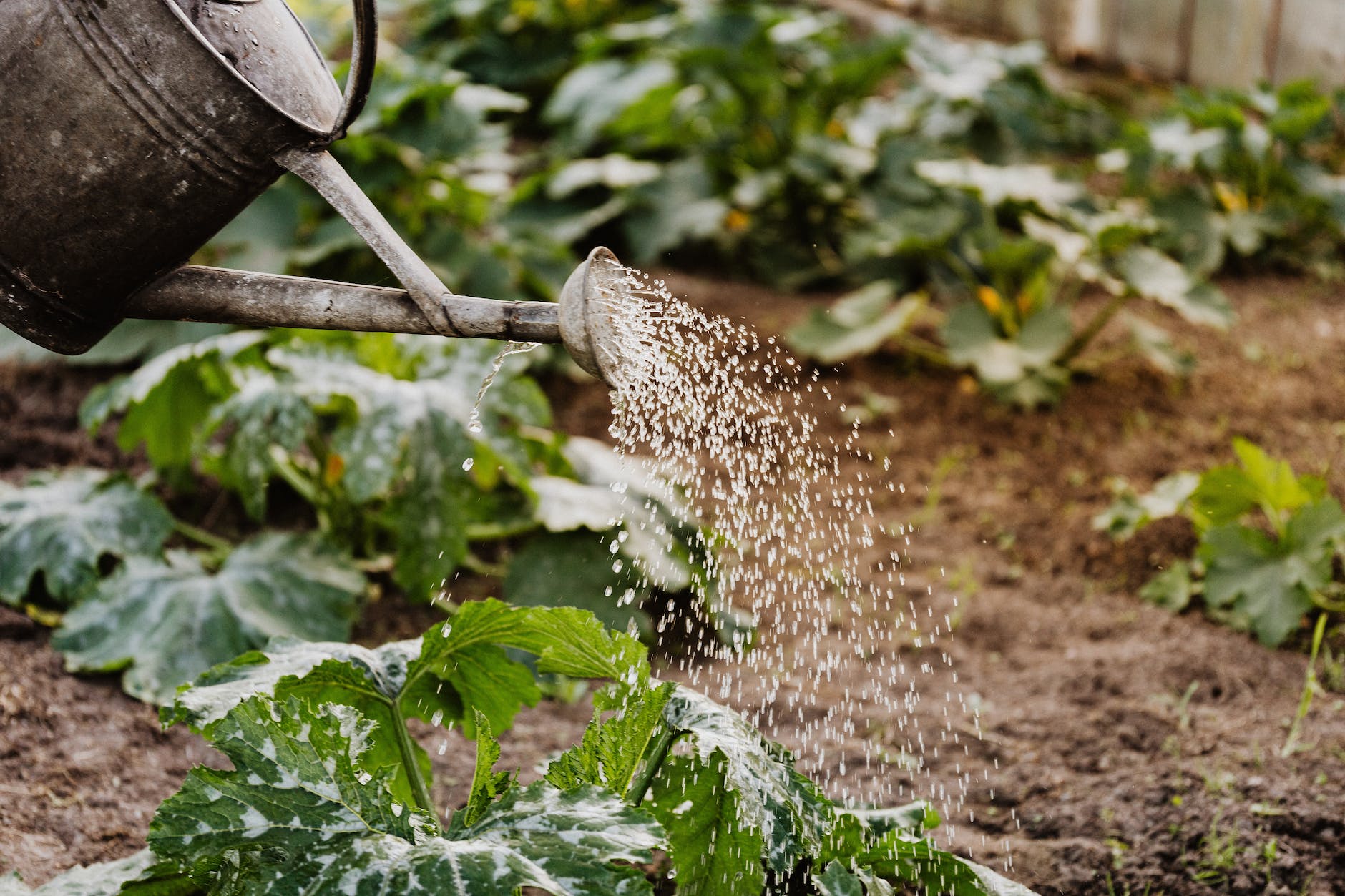
During the Session 6 Community Garden Quest, Discovery learners will step into the shoes of gardeners. We will begin the session exploring plant science, including cellular biology, photosynthesis, decomposition, capillary action, germination, and pollination. Discovery learners will then apply what they have learned to their own garden space at Ms. Jenny’s. As gardeners, they will take on the responsibilities of planning, building, and raising a garden.
In this session’s Writer’s Workshop, Discovery Learners will write a story with the goal of inspiring young people to read. They will create a great story by stepping into the shoes of a creative fiction author. Each week, they will write a draft of a new story or continue working on one they have started. At the end of the session, they will choose one story to revise, edit, and publish into a real book that will be added to the Spark Studio library!
Adventure Studio
It’s Apprenticeship Season in Adventure Studio! This session learners will research three possible apprenticeship opportunities, craft emails, elevator pitches, and talking points to help secure a placement. The Apprenticeship is one of the cornerstones of the TVS middle school experience – and one we are so proud to facilitate. Sending young people out into the world to learn about their strengths and passions is what we are all about.
This session’s Adventure Quest will require creative expression, collaboration, and lots of paint, as learners design, create, and install an original mural to display in the TVS playground. Learners will research the history of mural making, one of the earliest types of artistic expression, local murals, and muralists. The project will kick-off with a walking tour of the many murals in Washington, D.C.’s U Street corridor. We can’t wait to invite you to the unveiling of the final creation sometime this spring.
Health & Wellness
“Those who have a ‘why’ to live, can bear almost any ‘how.’” – Friedrich Nietzsche
Self-directed learning is a focal point of discussion at The Village School. Most of our learners have a good understanding of what this means, what this looks like, what is going well, and how they want to improve. But, what does it mean to be self-directed in our relationships with others? During session 6, we will explore what it looks like to be self-directed in our friendships and in our families.
We will also begin to explore our purpose. What social connections give our life meaning? What achievements have we accomplished? What do we hope to accomplish in the future? How do we express ourselves in a way that aligns with our purpose? What parts of our lives bring us excitement and joy? What gives our life meaning?
Meaningful learning experiences at The Village School have a research-based, intentional design. As guides, we work each session to create a storyline that fulfills the following criteria:
Authenticity: learners will find the storyline compelling, and make a personal connection
Lifeworthy: learners will have multiple opportunities throughout to build on their strengths, and develop interdisciplinary skills, such as those outlined in our Portrait of a Graduate
Experiential: learners are connected to the world beyond the school campus, through field trips and guest speakers
And, like all good stories, the experience must have a clear beginning, middle, and end.
This session, our middle school learners were challenged to identify a topic they were passionate about, research the topic and develop a strong opinion, write a persuasive speech on the topic, and deliver the speech to an audience of their peers and families.
The Beginning
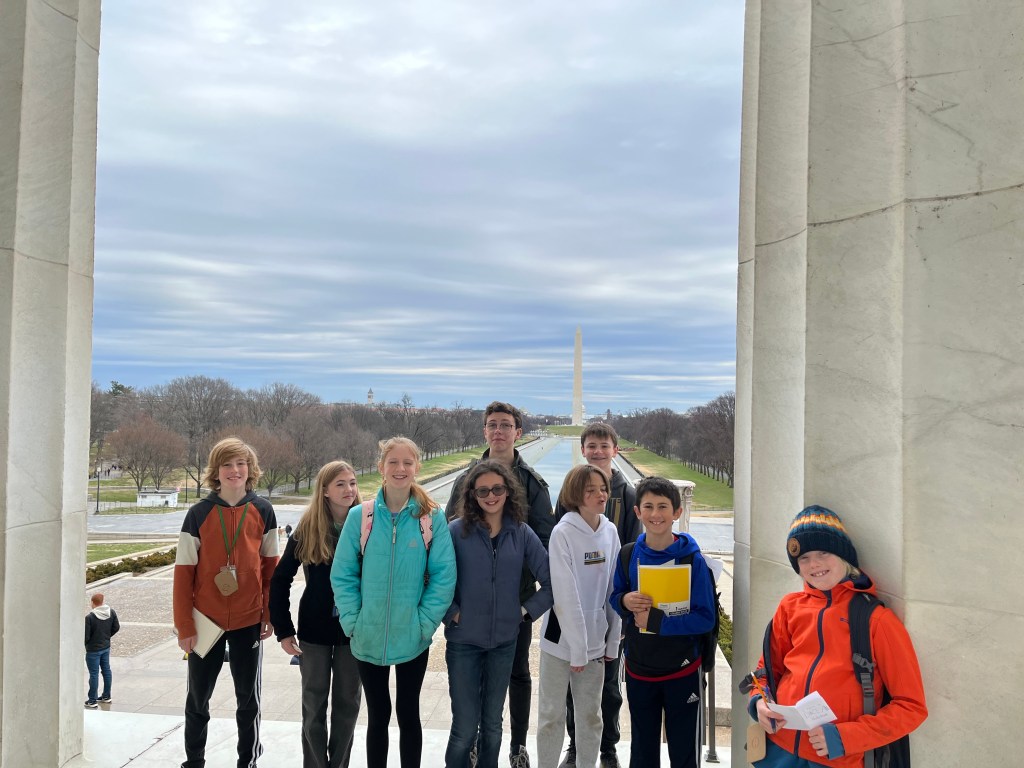
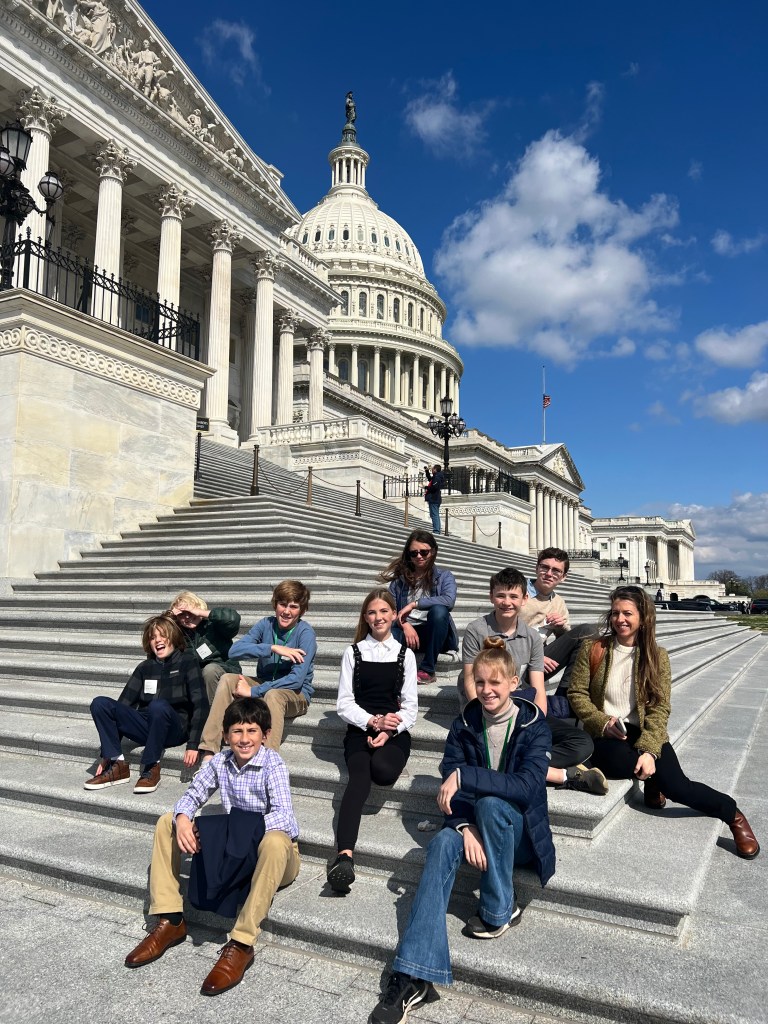
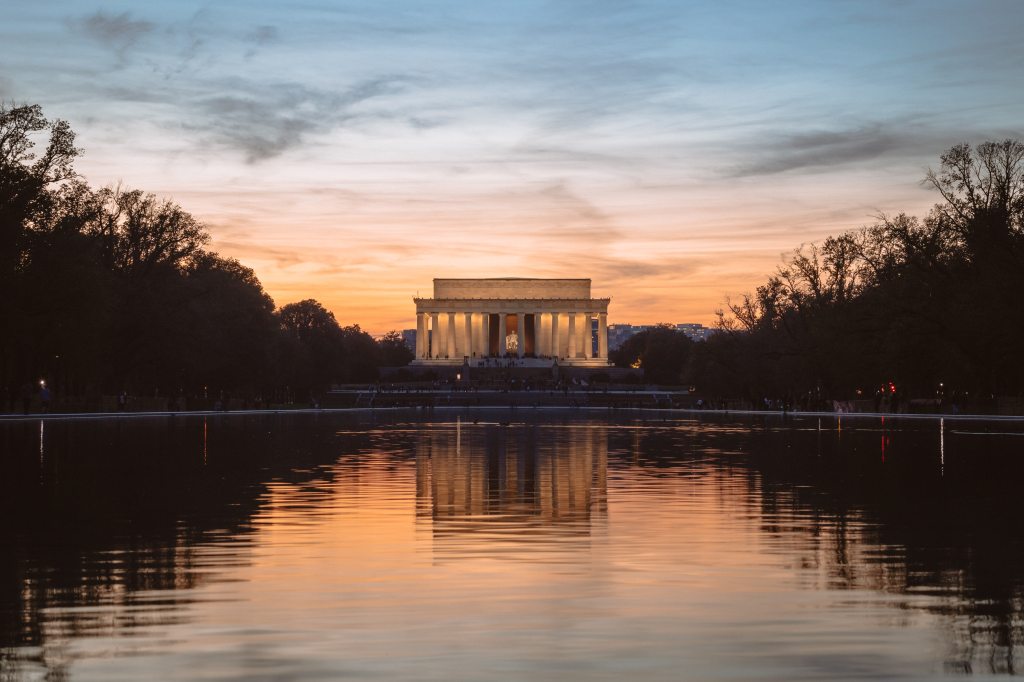
The project launched with a field trip to downtown Washington, D.C. to stand in the very spot that MLK stood when delivering his most famous speech. Learners stood on the steps of the Lincoln memorial, listened to MLK’s dreams for our country and looked out across the national mall to the U.S. Capitol, where they would share their speeches in just six weeks. After listening to MLK’s speech, learners walked along the National Mall to the MLK memorial where they considered how King’s words have continued to inspire new generations.
Experiences like this, where learners are an active participant in the world beyond our studios, is part of our storyline. Our goal is that young people see themselves as an important part of the world beyond our studios, and that young people experience the world instead of just reading about the world.
The Middle
After an inspirational day in the nation’s capital, learners returned to the studio where they watched examples of other inspiring speeches given by kids their own age – like an 11 year old’s speech at the March for Our Lives, and a 15 year old’s speech at the United Nations. Learners considered what elements made these powerful speeches and then began the task of selecting their own topic.
To choose a topic learners had to ask themselves questions that many middle schoolers are never asked to consider: What am I most passionate about? What changes do I wish I could see in my community, or the world? What is something that I deeply care about? What are my hopes for my future? What are my future hopes for my community and my world? How can my voice make a positive change in the world?
Speech topics ranged from taking care of our planet, raising awareness about learning disabilities, education that treats young people as human, new views on overpopulation, the value of freetime for young people, and kids’ right to vote.
Learners spent the next several weeks focusing on each aspect of their speech: the introduction, taglines, compelling evidence, elements of persuasion, and mic-dropping conclusions. This involved several rounds of feedback, and a practice run where each learner shared their entire speech.
The End
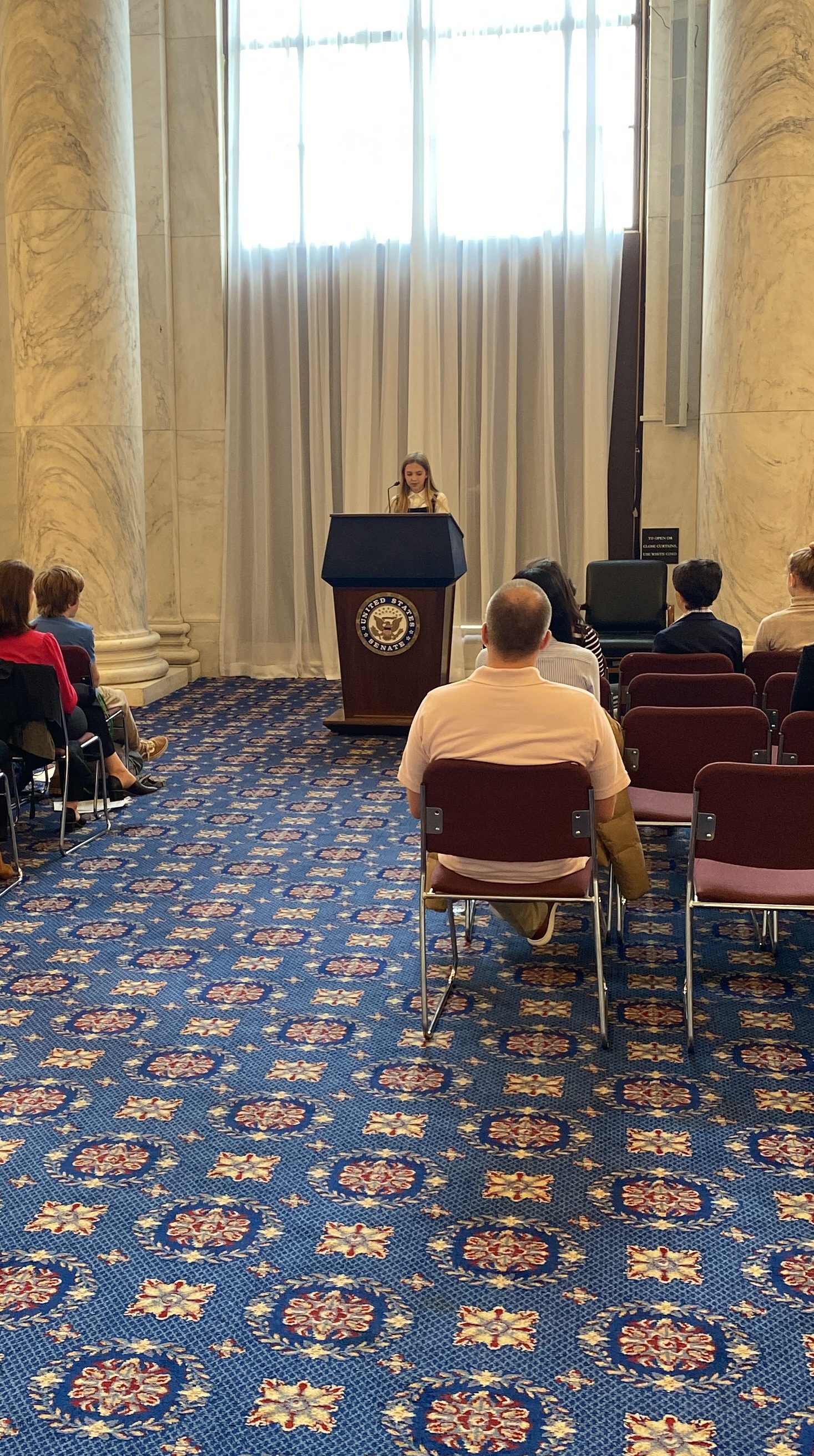
After 5 ½ weeks of preparation, learners traveled back downtown to Washington, D.C., this time to the U.S. Capitol. Learners spent the morning on a tour of the capital, taking in the rotunda, statues, and the hallways of history before making their way to the Kennedy Caucus Room in the U.S. Senate to share their dreams for their communities in front of each other, their families, and other members of our school community.
Here are a few excerpts from their final speeches:
“Now, what I take from this story is that teenagers need help. They are stressing about grades, college, maintaining a social identity and are feeling more persistent sadness and hopelessness than ever. As a teen, I find myself asking why? Why is this happening to my generation? What is causing this growth in teenage unhappiness? As a teenager, I am here to offer my views on one, what exactly the problem is, two why this is a problem and how it came to be, and three, how we can solve the problem.”
“It’s important to understand what learner-centered education is. It’s what it sounds like. Their learning is centered around them. It means that each individual learner is honored for who they are and what they need because each person is different and unique. I want more kids to experience this learning because this is education done right. It should be accessible to kids all over the country, and the world.”
“I am tired of kids being treated unfairly whether it’s not being trusted or not being listened to. Kids may not have fully developed minds, maybe we don’t have as much experience in the real world, Sometimes what we say doesn’t even make sense, but we know right from wrong and that is why our society needs to listen and hear what the next generation has to say. Today I am here to tell you why kids should be treated like humans and to go even farther to say that we should be able to vote and even run for office.”
Reflections
The morning after, learners spent time reflecting on the experience. When asked how they felt, they shared:
Proud because I wrote an excellent speech in just a few days.
Amazes me that I was able to do that, I don’t think that I could have done that a year ago
Proud that I was able to memorize a lot of it and I was able to look up at the audience.
Proud because I can tell how much my writing has improved since last time
Proud of my idea and how I included a personal story to connect.
Validated that audience seemed to agree and connect with my speech
I noticed that my writer’s voice has really developed this year.
Cultivating a sense of agency among young people is a part of our TVS mission statement. We define agency in young people as a feeling of confidence and a strong belief that they have a voice in their life, their communities, and their world. These reflections are evidence to us that the learner agency is alive and well after this learning experience – and it’s our goal that this is the case after each of our learning experiences throughout each year.
Witnessing the kind of change that occurs in young people after an inspirational, meaningful, and relevant learning experience gives us hope and it’s what keeps us coming back each day. At a time when the future seems like it could not be more uncertain, we simply have to look to our learners to see that there is indeed, so much hope for the future.
“I know what it is! I know what it is!” screams erupt at Madison Manor Park.
“It’s a mermaid!” “It’s a shark!” “It’s a spoon!” Discovery bursts into laughter.
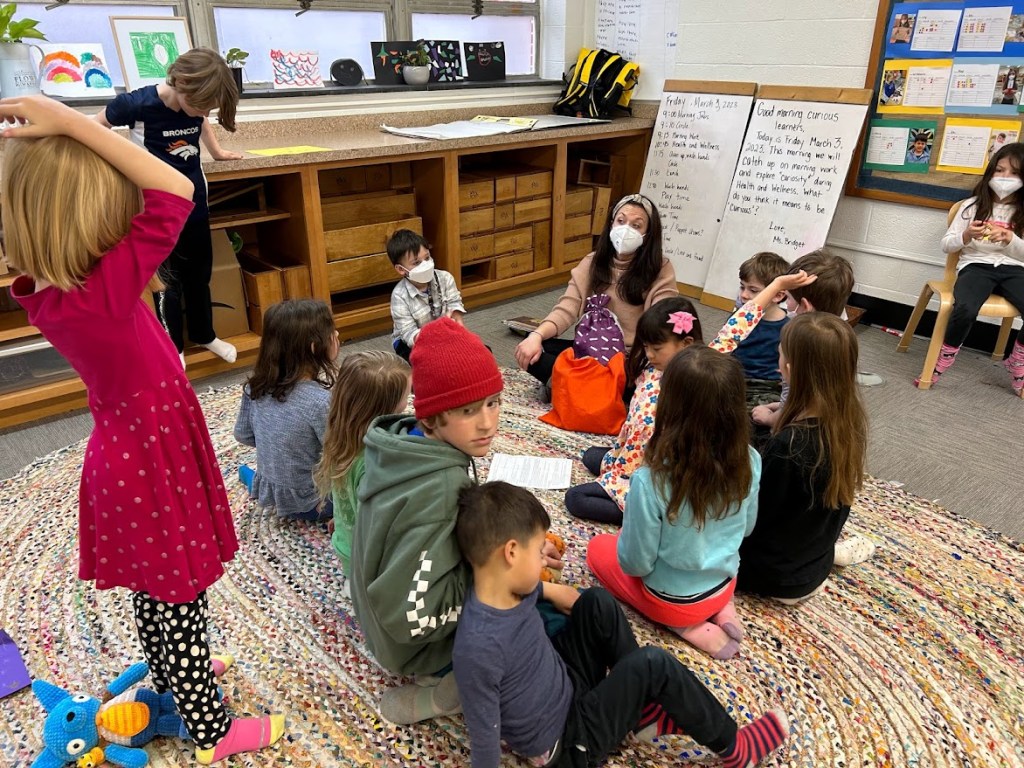
The learners are excitedly engaging in an activity, working together to figure out what is inside a mystery bag. This activity is a fun way for us to foster the skills of curiosity.
At The Village School, curiosity is an essential component of Learning to Be. But how do we define curiosity? How do we foster curiosity in our learners? Can we guide our learners to be curious? What does being curious look like? These are the questions I sought to answer before we began Session 5.
OECD’s Framework for Social and Emotional Skills defines curiosity as “the interest in ideas and love of learning, understanding and intellectual exploration; an inquisitive mindset.” There are many ways that a Guide can support creating a space for curiosity in their studios.
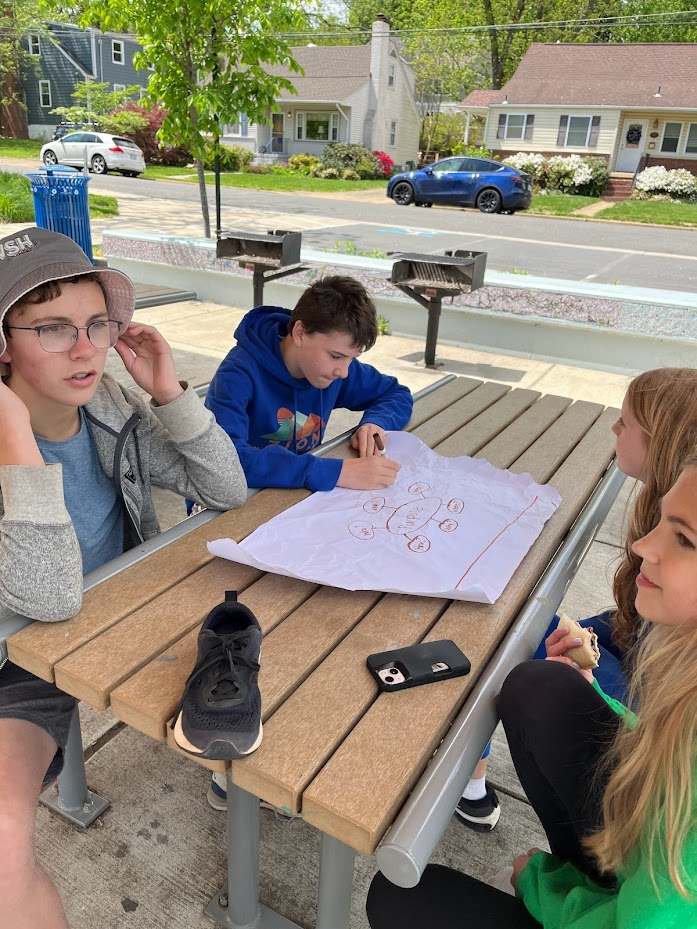
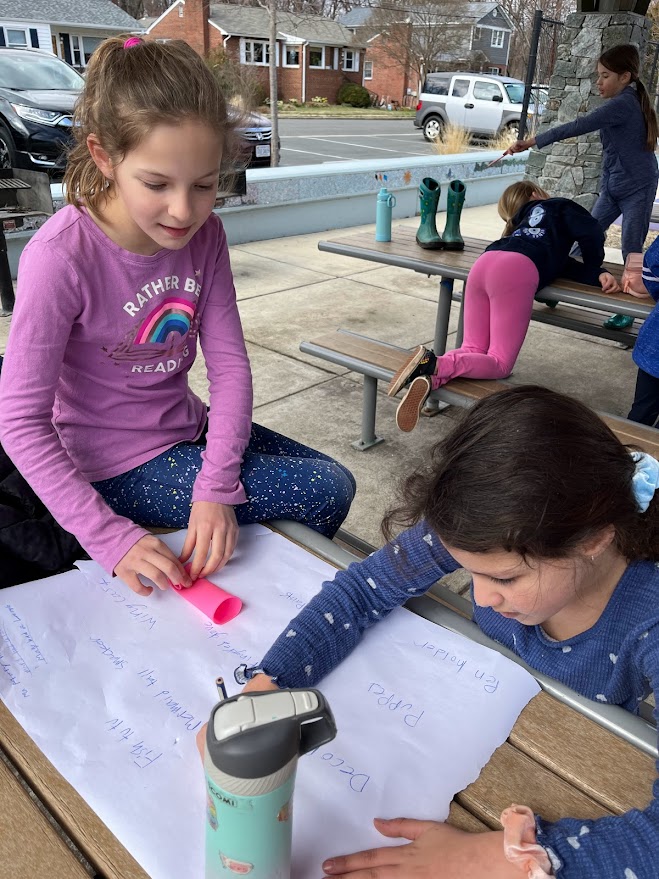
In each studio, we began our exploration by learning about what curiosity means. Linking our curiosity to health and wellness, we practiced asking questions about ourselves. The learners created maps or lists of questions about who they are, what they want to learn, and what their futures will look like.
After the learners practiced being curious about themselves, we moved to the practice of being curious about others. What happens when your values and beliefs do not align with your family, friends, and even spouses? Do you remain curious about their beliefs or do you pass judgment? This is a difficult question to ask one’s self and it was difficult for the learners to practice. Using Project Zero’s thinking routine of “True for Who?”, we engaged in a conversation about a claim that was made, who made it, the different points of view, acted it out, and then analyzed our thinking to see if we gained a different perspective. We decided if our statements were judgemental or fostered curiosity in a conversation.
We have also had fun with games and exercises that spark curiosity! The learners have taken every day objects and challenged themselves to think of 100 different possibilities for what the object could be. A favorite, especially in Spark studio, has been “what is inside the bag?” The learners are only allowed to ask open-ended questions. This was such a challenge for our Spark learners! And, an activity that they keep asking for. As our session progresses, we will challenge ourselves to have a growth mindset and explore why this is an important tool in remaining curious. The learners will also take away a special reminder that all traits and pieces of who they are, are valuable. Each learner is unique. Always remain curious about who you are, practice a growth mindset as you explore your curiosities, and embrace the pieces that make you, you.
The focus at The Village School is on building the skills and mindsets of a self-directed learner.
The first year or so at TVS involve a young person learning how to learn. For each studio, these starting points look different. In Spark Studio, it starts with learning how to do something as simple as staying focused for 10 minutes on a task or participating during circle time. In Discovery Studio, it looks like learning how to set smart goals consistently, or how to navigate the systems in a learner-centered studio. In Adventure Studio, it looks like learning how to manage your time, or learning how to give and receive meaningful feedback.
These are the things a young person is learning in their first two years in a self-directed learning community such as ours:
Developing a growth mindset/(vs fixed mindset)
Learning how to respond to failure/mistakes
Learning to take responsibility for their choices
Learning to give and receive feedback from peers
Learning how to hold their peers accountable
Learning how to participate in discussions productively
Learning to work well with peers on group learning activities
Learning to regulate emotions
Learning to advocate for themselves and others
Learning to set goals for a day, then a week, then a session
Learning to organize their belongings and their work
Learning to track their work accurately
Learning which systems to use when
Learning to operate a laptop
Learning to navigate their learning without it being micromanaged by a teacher
These are real-world skills that take a lot of real-world experience to master.
But in order to learn these skills, they have to take a lot of missteps. These “missteps” can look like avoiding work, distracting others, or searching out loopholes. This is the “pushback” phase. Which boundaries can I push? How much freedom do I actually have? What will happen when I use my freedoms irresponsibly? Exploring and experimenting with these questions is a natural part of learning how to learn. It’s an essential component of truly seeing and understanding the connection between your freedom and your responsibility, which is critical to taking the reigns as a self-directed learner.
As a community in our fifth year, I can quite clearly see the trajectory of a young person’s learning journey at The Village School- especially at this time of year. Learners are more comfortable with each other. The studio environment and its rhythm are familiar and predictable. Everyone knows what to expect and can easily navigate the studio systems.
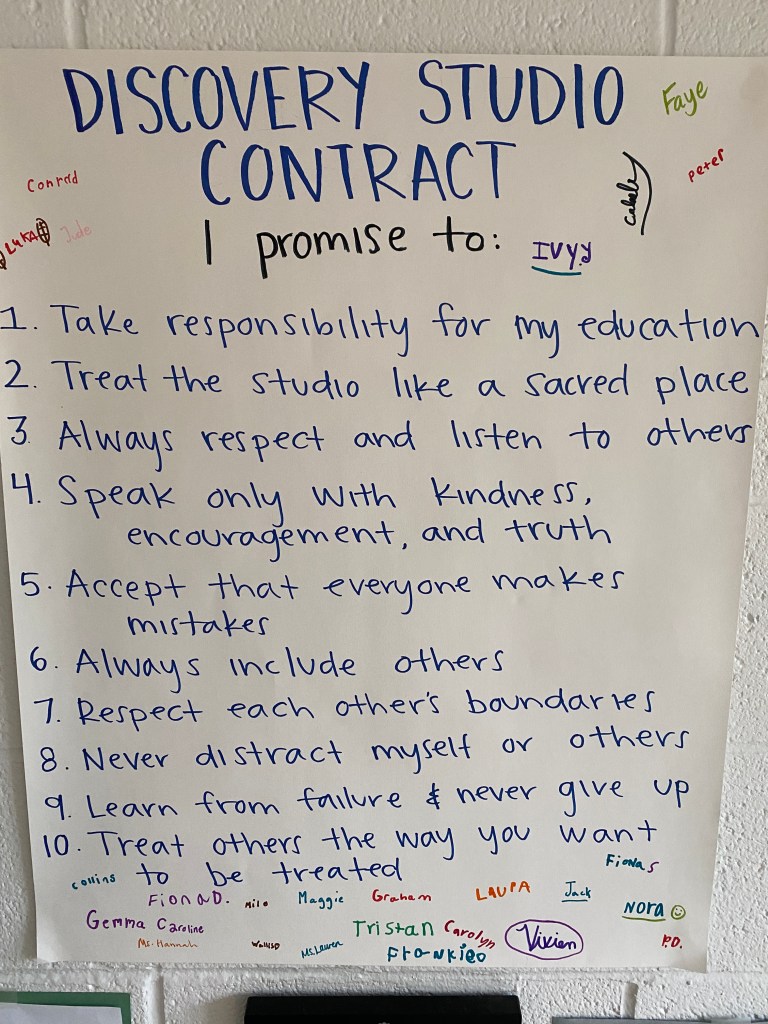
Look closely and you can see two distinct groups of learners at work in the studio. You can see the group of returning learners who have been through that pushback phase. They have failed, missed deadlines, and experienced the natural and logical consequences of their choices. They see the throughline between their freedom and their responsibilities. They are (for the most part) focused, intentional and disciplined, setting and achieving the goals they set for themselves, contributing to studio life, and kindly and firmly holding themselves and others accountable to their studio promises.
You can see another group of learners, many of whom are in their first or second year at The Village School, who have not yet been through this phase. They have diligently followed the studio promises. They have tried their best to please the guide, their parents, or other more seasoned learners in the studio. Up until now, they have spent their time getting comfortable in a learner-centered environment. And now that they are in fact comfortable, they are ready to explore the limits of their freedom. These learners are often distracted and bold, or silly and unfocused, pushing back on some of the promises they made in September and seeing what happens.
It’s important not to miss this part. This is the good part. Each learner will make choices and experience the natural or logical consequences. Some of them will feel good, (Yay, I earned a badge!) and some of them will feel not so good (Ugh, I kept talking and had to leave the discussion circle). Through experience and reflection, every choice is an opportunity for learning how to learn. It’s what our learning environment is designed for. This is the foundation that will allow them to thrive as self-directed learners in our community and beyond when they set out to navigate the new world we now live in.
These are the skills of a life-long learner. They don’t develop overnight- nothing important really does.
Play is the ultimate teacher, isn’t it? Children can learn just about anything on the playground; how to interact socially, what their bodies can and can’t do, even how to read and write. Play is an essential component of social and emotional development.
But what happens if play doesn’t yet come easily to a child? Perhaps they are unsure how to approach a new group and feel excluded by others. Or, once they make friends, they have trouble sharing their ideas or incorporating those of others. It can be unsettling–even downright distressing!
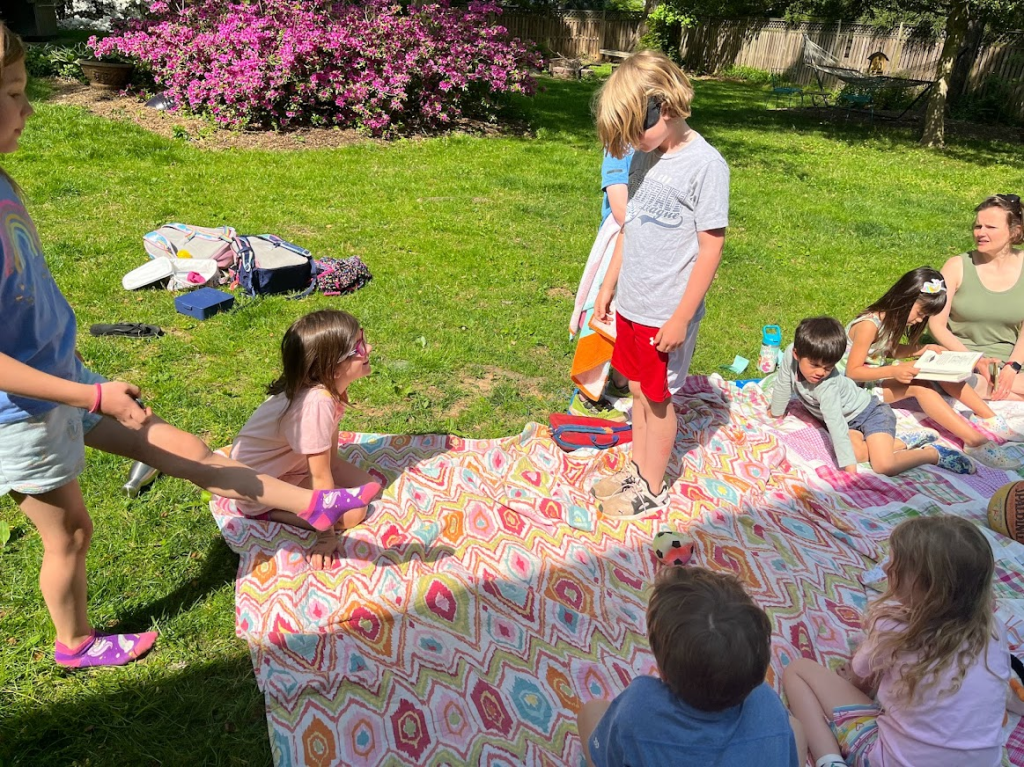
Play and social interaction are among the most complex things we explore at the Village School. Part of learning to live together is learning to play together. But play can’t be “taught” with books and circle time discussions (though those can be helpful tools for troubleshooting). Rather, play has to be tried, tested, tweaked, and tried again. So at TVS, we play, and play, and play some more!
The pandemic took away so many opportunities to play with others. Many children are still catching up. In recent years we have seen more tentativeness and anxiety around play, especially when a learner first arrives at TVS.
To counter this, we talk a lot about taking turns, voicing a desire to play, and including everyone in the studio. Whenever guides or other learners see a lonely-looking child, they gently ask how they are feeling and help them figure out what they would like to do next. They often invite them to play or give them space, depending on what they prefer.
Sometimes learners need more help. If two of them disagree all the time on the playground, guides might group them together to collaborate on a fun project so they share positive experiences. And as this Pedagogy of Play paper points out, what is playful to one learner may not be experienced as playful by another. We frequently revisit the ways to know someone else is having fun.
Occasionally, when nothing else works, we get a little metacognitive. One learner came to Spark last year and spent weeks trying to fit in on the playground. They yelled to be heard, fought over toys, and or declared that they were no longer friends with so-and-so because they were “so mean.” Despite our best efforts, other learners started to exclude them to avoid these angry outbursts.
We took one of the more senior learners aside and said quietly: “We need your help. Our new friend is still learning how to play. We can teach them! If you tell them how they can play so that you both can have fun, I wonder how their actions will change?”
She got the message. In ten minutes, the veteran learner had a quick huddle with the new learner, left her original group of friends, and the two spent the rest of the afternoon playing restaurant. It wasn’t necessarily smooth sailing from then on, but this was a significant turning point for that learner.
There are countless other ways we coach learners to learn the more difficult lessons of play:
“I hear you say you are feeling left out. I wonder what would happen if we went to ask them to play? I can go with you.”
“They said no? Hmm, I wonder why they said that. Let’s go talk to them together and try to figure this out.”
“What do you think we could do differently so that everyone has fun?”
“Do you want to join in on their ‘family’ game or would you rather find someone else to play football with you?”
All this to say, navigating play, friendship, and learning to live together is a TVS signature learning experience that sets us apart from most schools. Rather than outsource “social emotional learning” for a 15-minute lesson once a week, we intentionally include long periods of playful learning experiences and unstructured outdoor free time every day. We also walk to the park and library once a week and go on frequent field trips. These present countless opportunities to interact. There’s no better way to teach social skills than by diving in and trying them out. The opportunities are well worth of everyone’s time, energy–and yes, a little uneasiness–to get right!
How can we celebrate individuals of the past who’ve made a positive impact in the world while looking towards future leaders of tomorrow? We will start the session learning about people, places, and things that have positively contributed to our society. Learners will examine the choices these individuals made through stories and artistry. Learners will discuss how their choices have guided the outcomes of the world.
Learners will then research an artist, pioneers, or an entrepreneur who inspires them. We will document their journeys, create autobiographies of learners’ future selves, and dress like these innovators of tomorrow. Learners will also create a business plan which will highlight the problem they would like to solve, the one main idea they will create to solve it, and how to inform the targeted audience about the product or service.
Learners will explore different states in the USA and countries of the continent of Africa. In some cases, they will hear about a problem faced by that place, look at the available resources, and think about ways to improve the situation. In projects this session, learners will plant food and flowers, design a state of their own, and make a no-sew stuffed animal.
These projects will help learners see and celebrate themselves as part of history as they act as makers of their future.
Discovery Studio
In the Making Space for Change Quest, Discovery learners will work in teams to redesign a local public space to be more sustainable.We will start the session learning about what sustainability means. Learners will then explore different sources of renewable energy, water management practices, and building materials before determining the most important sustainable design principles for their public space. Learners will then create a model of a local public space that they have redesigned to use resources more responsibly.
In Writer’s Workshop this session, learners will learn more about young people who are tackling some of our environmental and sustainability issues and dive in to the (not yet lost) art of letter writing! Learners will write a long, formal letter to an environmental trailblazer of their choice. In their letters, learners will express gratitude, find common ground, and try to seek a response. The goals of this Writers’ Workshop are to encourage learners to discover more about individuals who are making a positive difference in the world and to explore the different backgrounds and origins of these trailblazers in order to further understand that heroes come from everywhere- and can be any age!
Adventure Studio
Learners will jump into Session 5 with a field trip to the Lincoln & MLK memorial to launch the Session 5 Communications Challenge: I Have a Dream for My Community – a TVS Adventure Studio tradition. Learners will spend time researching issues that are important to them, studying the persuasive techniques of other passionate young people, and developing a ten minute speech. Learners will end the session by sharing their final speeches in front of an audience of our community in the Kennedy Room at the United States Capitol.
What does red hair, blue eyes, freckles, dimples, toes and ear lobes all have in common? The Genetics & Bioethics Quest will ask learners to develop a basic understanding of the biological concepts of genetics, as well as consider some of the greatest bioengineering ethical dilemmas of our lifetime. Learners will spend the first half of the session delving into 6 mini-genetics challenges focused on Mendel, Punnett Squares, Di-hybrid crosses and more. Each completed mini-challenge will earn learners additional argument time in the bioethics debate that will take place the last week of the session.
These two projects will require learners to delve into research skills, hone their persuasive techniques, and step out of their comfort zone in several ways: developing arguments that challenge their own perspectives, or deliver a ten-minute speech in front of a crowded room. Each experience will prove to themselves that they are ready for the ultimate challenge that will come next – a real world apprenticeship. We’ll be cheering them on each step of the way – Adventure Studio, we can’t wait to see what you’ll do next!
Health & Wellness
“Once we believe in ourselves, we can risk curiosity, wonder, spontaneous delight, or any experience that reveals the human spirit.”~E.E. Cummings
Session 5 will be a time to embrace curiosity and what it means to have a growth mindset. Our study of “learning to be” will continue with learning to be curious about ourselves, our inner dialogue, our imperfections, who we are as learners, friends, and individuals in our community.
Curiosity will be explored through questions about ourselves and the world around us. We will analyze the questions we have and embrace the unknown. We will also discuss curiosity vs. judgment and why this is an important tool to use today. Remaining curious when others express value differences is a life skill. We will discuss how we can remain curious in these difficult moments.
Do you know whether you have a growth or fixed mindset? Did you know that there are several different types of mindsets? We will be reflecting on who we are when we face challenges and tough moments. What type of person do we want to be? How do we view our imperfections? What can we do to embrace who we are and see ourselves as a whole person? Imperfections and all! The learners will be challenged to embrace who they are and continue on their journey to discovering their value and how they make a difference in our world.











 villageschoolnova.blog