The beginning of a new school year brings so much to the table; seeing old friends and meeting new ones, learning rhythms and routines, setting goals, and in Spark, butter!
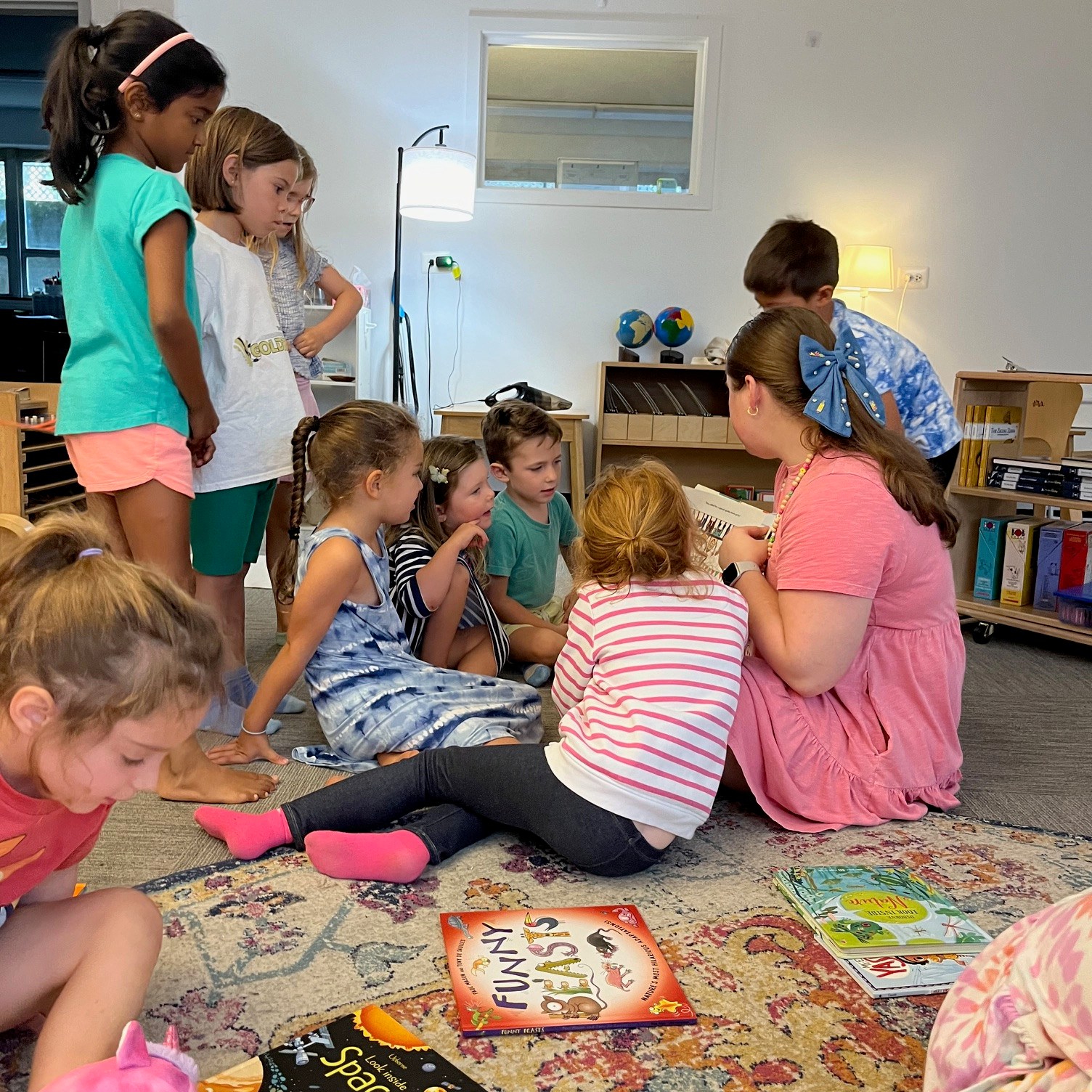
Book Cafe has become a part of the routine that learners, and guides, look forward to each day. A chance to plop down after a long day of working and playing and be immersed in the magic of story. Learners sample books across genres, topics and authors. Books that make them giggle, books that make them empathize, books that they beg to read again and again.
Why do we devote daily time for learners to listen to stories rather than only practice reading on their own? With so much to accomplish and get done in a day, is this the best use of our time? Simply put, yes. If you have a data driven mind, then there are statistics galore to support the power of time spent reading aloud to children, even those who are independently reading. The Commission on Reading has stated that, “the single most important activity for building the knowledge required for eventual success in reading is reading aloud to children”.
While the Book Cafe has a general outline planned, so much of it is driven by learner interests and students’ favorites. Often an extra book or two is read and then excitedly added to the studio library for eager eyes to devour the next day. At The Village School it is the guides’ role to create a learning environment that fosters creativity and creates opportunity for further imagining. That is not a role that we take lightly!
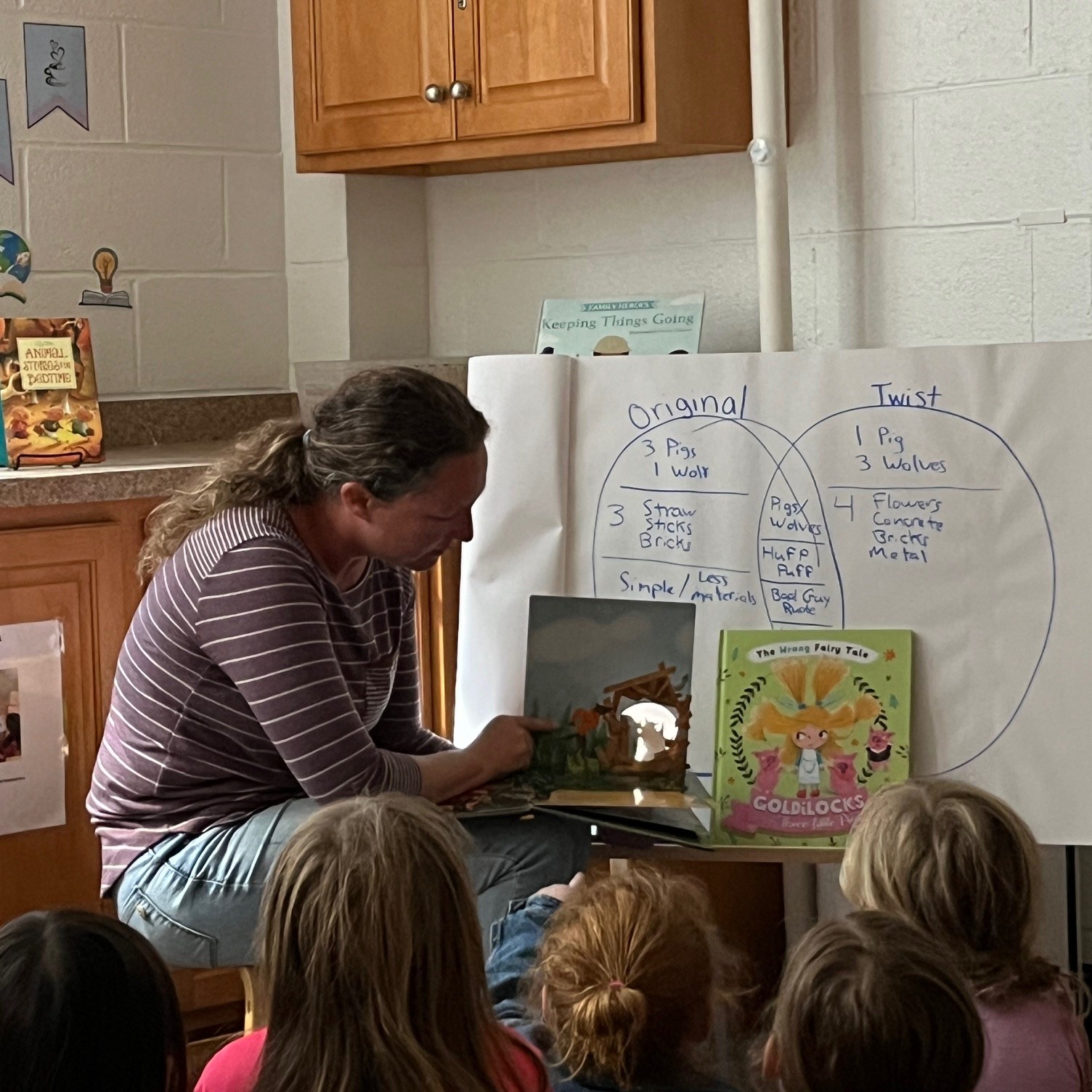
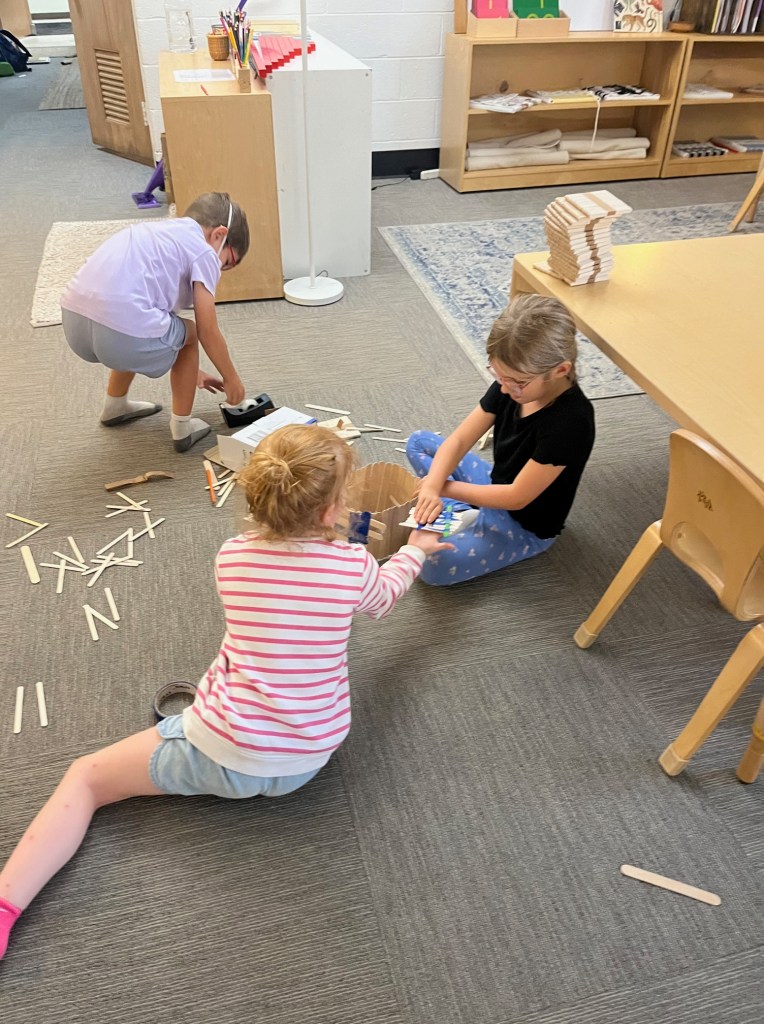
Last week Spark had the chance to explore the simple and magical world of The Three Little Pigs, not once, not twice, but through six different versions. Discussions were sparked about perspective, fairness, the author’s choice of words, hidden clues the illustrators left for the reader and so much more. We dove into new vocabulary and made our learning visible through charts, reenactments and STEM challenges.
The amount of focus, energy and thrill that went into churning their own butter was a sight to behold! And as learners went on their first excursion to Parkhurst Park, you better believe that nothing tasted sweeter than freshly churned butter on a delicious piece of bread!
Have you ever wondered how insects move their bodies without bones?
In our final session of the school year, learners will focus on insects. Learners will begin the session by learning what insects are and look into its many different types. Learners will be introduced to the foods insects need to eat to survive and explore how insects are different from other groups of animal families. Learners will explore how insects adapt to changes in their environment and why insects are attracted to different surfaces.
The project room will become an insect lab with loose parts, art materials, and science tools to explore and create. Spark learners will work together to create an “insect hotel” that provides both basic necessities for life and also added fun features that stem from using our imaginations to consider possibilities beyond what we know and see.
Discovery Studio
In this final session, Discovery learners will embark on a virtual journey around the world. We will learn about explorers, interpret maps, and dive into stories from each continent. Each learner will complete their own handson project to synthesize what they have learned. These projects include World Factbook, Cartography, and DIY Historian. Learners creating a World Fact book will explore different countries around the world and document their findings in their own hardcover book. Those diving into Cartography will explore maps before trying their hand at making their own of a continent. Lastly, participants of DIY Historian will choose an event in history to research and design a way to share their findings with the studio.
Keeping with tradition, the final Writer’s Workshop invites learners to reflect on their year in Discovery Studio. Learners will consider their most important lessons learned and use these insights to craft an inspirational speech aimed at uplifting and empowering the TVS community. As a right of passage, the learners endeavoring to transition to Adventure Studio next fall will share their speech during the Discovery End of Year Celebration along with speeches voted on by the studio!
Adventure
It’s Apprenticeship Season in Adventure this session – we wish them luck. Go Trailblazers!
As a guide who recently graduated college and moved states away from my family, I’ve been grappling with some personal challenges, which made last week particularly tough.
However, amidst those difficult times, I also experienced an overwhelming amount of love and support when I came into work each day, not just from my fellow guides, but from every learner in the Adventure studio.
On Monday, some of my coworkers noticed I was upset and surprised me with lunch and snacks, bringing me to tears. The learners noticed that I wasn’t myself, and offered support: “Are you okay?”, “What happened?”, and “What can I do to help you?” Feeling the overwhelming love and support, I went home that day thinking, “Wow, I can feel the support of the community” and “I am so extremely grateful to be a part of the culture we are building.”
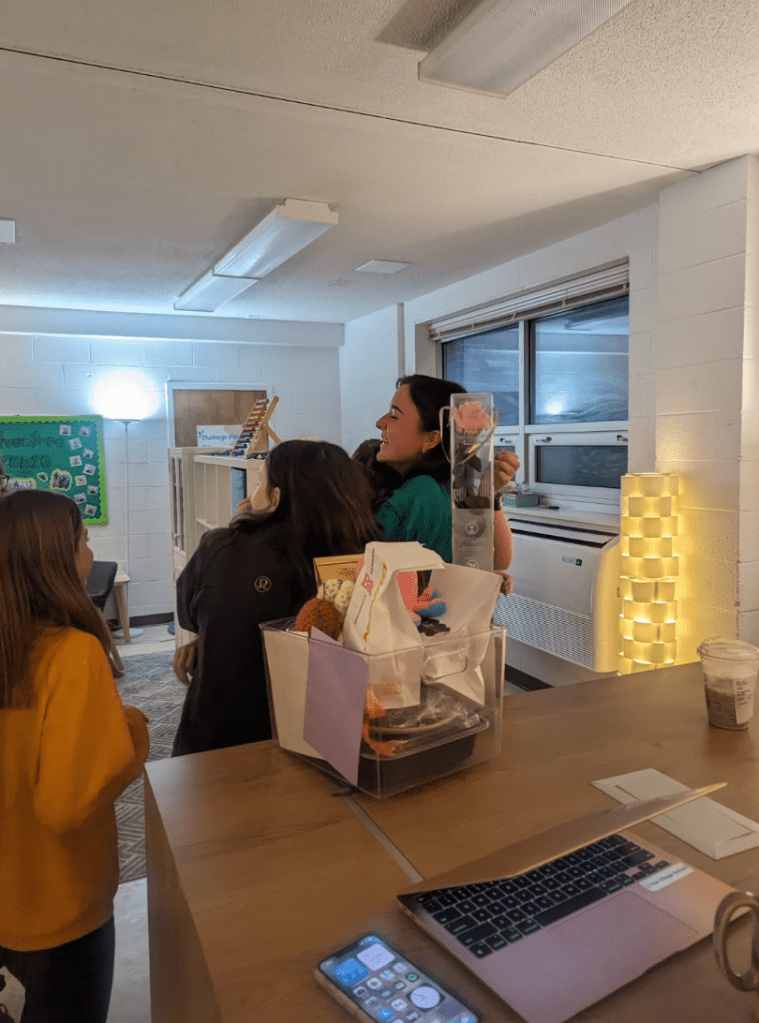
The next morning a group of Adventure learners approached me with another form of support – a bin full of goodies, from homemade cookies and brownies to a stuffed animal they made. Included was a card that read “I just want you to know we are here for you. Whether you need to talk to someone, you need someone to make you laugh, we are here!”
At that moment, I thought to myself, “I can see the model working. I can really see how this school differs from every school I have been to and any place that I had worked before this.” I was blown away by the compassion and empathy the learners had.
When I shared this story with my friends and family, they responded “your middle schoolers did what??” followed by, “Oh Gosh, that would’ve never happened at the schools I went to.”
These are not the only stories of empathy at The Village School, but just one of many.
I’ve also witnessed this sense of belonging and support many times since the beginning of the year. Recently the middle schoolers went on a three day camping trip. After a long day of hiking in the rain, the girls settled into their tent and realized that one of the learners’ sleeping bag was completely soaked through, and she was freezing. Without a thought, another learner rearranged their own set-up to make more room and dry space. What strikes me as so special about this moment and the other moments like it, is that the learners do the next right thing without asking for help, assistance, or guidance. They do the next right thing because it’s the right thing to do and they really do care about each other.
These stories of empathy also include moments during work periods when learners notice a friend struggling to meet their goals. Just this week, a learner completed their pre-algebra badge and the entire studio erupted in cheers, acknowledging all the hard work that had led him to that point. This is evidence of a culture of care and collaboration, which is in contrast to the culture of competition that is the status quo in many schools.
At The Village School we care about who the learners are, rather than what they know and these stories are just some examples of how a culture of belonging and support are enacted in our studios every day. We lift eachother up when we are down. We help each other through the lows, and cheer for each other through the high.
Our learners have the opportunity to cultivate close relationships with their guides and peers. Unlike traditional schools, where students frequently switch classes, here they work closely with guides across subjects. As guides, we strive to understand each learner individually, including their progress, passions, goals, needs, strengths, and learning style. This understanding extends beyond academics, allowing us to nurture a community that is empathetic, loving, and kind. We genuinely care about each learner, demonstrating to them that they belong and are valued in our community.
I’ve never considered myself a “math” person until I became a high school English teacher and realized that there was no such thing as a “math person” just like there was no such thing as an “English person”. Throughout the ten years of my career that I spent as an English teacher, I made a point to share my appreciation for math with all of my students, many who were shocked that a person who loved books could also love numbers. Friends who were math educators and well-known educational researchers also helped me shake this misconception – and so did the statistics classes that I took during my doctoral studies.
So where did I get this idea? I know for certain that it originated early on as a result of the messages I received in school. To be a math person at school you had to be good at math, and to be good at math you must learn fast and solve problems even faster. In fifth grade, my math teacher would pass out our tests in order – best to worst score. Each week I would cringe with scarlet cheeks as she placed the last test in her stack on my desk, face-down, of course. If I had only had the chance to take my time, learn at my own pace, and most importantly, build confidence in my ability to learn to learn math – maybe I would have been a math, not an English teacher.
The irony of the traditional math teaching approach is that math in the real world is meant to be slow – not fast. In a typical math class, the lessons are planned and scheduled before the school year begins leaving no time to plan responsively to the emerging needs of learners. Memorization is prioritized over conceptual understanding, and efficiency is prioritized over divergence. This type of learning is shortsighted, and as a result, turns many young people – myself included – away from understanding and appreciation for math.
One of the most frequent questions we get about our learning design is often in the form of a complaint about math and they go something like this… “But, don’t you need a teacher to learn math?” “My kid really doesn’t like learning math this way.” “Learning math that way doesn’t work for my kid.”
As a parent myself, I can relate to these sentiments – learning math is difficult and stretches a different part of the brain. I can also empathize with how difficult it can be to watch your child struggle to learn something, and how fear can creep in when I begin comparing my own children to their friends who attend different schools with a more traditional approach. When I slow down and think about the purposeful and research-based design of the math curriculum at TVS, my fears subside and I feel grateful for the opportunity my own kids have to learn how to learn math and develop confidence in their mathematical ability.
The goal of the math curriculum at TVS is much different than the typical or traditional math classroom. In fact, we would posit that the two are designed for completely different end results. The goal of our math curriculum at TVS is to build each individual learner’s capacity for learning how to learn math- or even, more broadly, how to solve problems, so when they encounter math challenges or difficult problems in their future schools, jobs, and life, they will have the ability to approach such challenges with confidence.
Most parents, educators, and learners can get on board with our ultimate goal of building the confidence and capacity to solve difficult problems. It’s the process that makes us uncomfortable.
For a learner, this process involves making mistakes, getting stuck, languishing a bit, feeling frustrated, avoiding asking for help, making more mistakes, complaining, figuring out what they need to learn, figuring out what tools they need, asking for help, finding momentum, making progress, feeling successful, making mistakes, getting stuck, (repeat, repeat, repeat!) Over time, the process of learning something new and challenging becomes far less intimidating, and learners draw on their previous experience to know what to do next.
Take an example of one of our oldest learners- a learner who has used Khan Academy to master arithmetic and pre-algebra, and is now halfway through Algebra I. Recently, this learner was making mistakes as he worked through the practice problems on Khan Academy. He was stuck. Feeling frustrated, he started avoiding math. Enter the languishing period. Noticing this, his guides and parents checked in with him. He responded by complaining about how difficult the problems were and how Algebra was a “different kind of hard” than he’d ever faced in math. He said he wasn’t sure what he needed to learn it but “Khan wasn’t helping”. Enter the complaining phase. Curious about his approach, a guide sat next to him as he worked through a problem. When he got stuck, she suggested going back to the video and modeled taking notes. Once back at the practice exercise, the learner referenced her notes as he solved the problem. Instead of the reassuring “ding” that indicated he got it right, his selected answer showed red and a “not quite” message. Before clicking “start over”, he clicked on the hints to see how they solved it. He looked back at the notes and discovered what he had done wrong. He solved the next four problems successfully and moved on to the next lesson. This time, he took out his notebook to take notes. At home, he confirmed with his parents that it is his goal to complete Algebra I this year. He made a weekly goal to stay on track and uses time outside of school to meet his goal if needed. Enter the finding momentum phase.
At TVS, we are deeply familiar with this process of learning how to learn math. The experience we share here is commonplace; the learner described is not alone in his process of learning to learn math. Mastery-based learning is hard and frequently uncomfortable and gratifying and confidence-building. All of this is by design. While our learners aren’t exempt from getting stuck, avoiding work, or complaining as they learn how to solve difficult problems, through our learning design they adopt a core belief that they are capable of learning hard things. They might need more practice, more support, or more tools, as they explore and master new concepts, but thankfully all of these are within reach.
As a result, I am certain that although some of our learners definitely enjoy math more than others, all of them would scoff at the idea that there is such thing as a “math” person. For this, I am so grateful.
I have vivid memories of Saturday mornings in the mid-80s. I remember sitting in my pajamas on the navy blue checkered couch in the family room of my childhood home watching cartoons. I remember the dread I felt at the start of that interminable what-felt-like-forever two-minute commercial break (a feeling my own kids will never understand) as I waited for Reading Rainbow or Rainbow Brite to return. As I suffered through the commercials, I can see a pig-tailed girl on TV smiling back at me exclaiming: “Hooked on phonics worked for me!” I remember this commercial like it was yesterday, which really just means either I watched a lot of Saturday morning cartoons or that commercial got lots of air time.
Reading instruction has strayed far from phonics since the 1980s and those commercials. Since then the approach known as “balanced literacy”, that was not research-based was the status quo approach in most early childhood and elementary school classrooms. The history and details of this misguided shift in reading instruction in the United States are shared in a recently released podcast, and countless articles published in The Atlantic magazine, American Public Media, The Washington Post, and The New York Times. The topic of reading instruction even made headlines at the annual SXSW conference, a meeting place for educational innovators.
Like so many aspects of education that have been under scrutiny since the pandemic, reading and how to best teach it has been under close inspection by politicians, parents, and educators. This close examination began in 2018, and only increased since parents had a front row seat to their children’s classroom lessons during virtual school in 2020. Since then, 18 states and counting have passed legislation requiring public schools to implement a curriculum that follows what is known as the “science of reading.” The science of reading is based on long-standing and emerging research from the fields of education and neuroscience about how one learns to read. The approach focuses on phonics instruction – the subject of those memorable childhood commercials.
The focus on reading instruction has found its way into our TVS admissions process last year. Families considering TVS have had more questions than ever about our approach to reading, especially in Spark Studio. We are proud to share with them that our curriculum and pedagogical approach is in line with phonics and the science of reading. It is designed not only to teach learners how to read, but is also designed to foster a love of reading.
Our Spark learners use phonics-based Montessori reading materials that include sandpaper letters, moveable alphabets, and the Waseca Reading Curriculum. These are enhanced with pre-reading activities and books from the All About Reading (AAR) curriculum, and later, an adaptive online platform called Lexia. These resources are highly engaging, research-based, and from what we can see, joy-inducing.
A new learner will first work on making the connection between sounds they hear and the letters that represent those sounds. They then learn to distinguish between beginning, middle, ending and ending sounds of words that they hear. They also explore concepts such as rhyming, segmenting words into individual parts, and blending sounds together.
Once all these skills are mastered, learners are ready to begin the Waseca Reading program, a multi-sensory set of materials that is based on the Orton Gillingham Method of reading instruction. Orton Gillingham is a highly structured, research-based phonics approach that is based on how children naturally develop language. It is a well known staple in many Montessori & Reggio classrooms, as it is self-directed and allows learners to correct their own mistakes. It involves careful encoding of words (sounding out and spelling words from picture cards), then decoding those same words by reading them without pictures. Through the drawers, children learn individual phonemes in a careful order. They then practice those same phonemes using the AAR readers, which follow a similar sequence.
Once learners have mastered the Waseca reading drawers, we introduce Lexia, a phonics-based program that has recently been adopted by local public school districts in an effort to shift reading instruction to align with the science of reading.
Beyond learning how to read, the goal of our reading program across all of our studios is for learners to identify as readers. First, we focus on creating the space for our learners to read for fun, build fluency, and gain confidence. Second, we focus on developing a love of reading, with dedicated time for reading called ‘DEAR’ (Drop Everything and Read), and whole studio read-alouds. In our elementary and middle school studios learners select their own books to read and write about. The books they choose must meet a specific set of standards, including meeting their reading challenge zone, and be peer-approved.
The autonomy we allow and the amount of time dedicated to reading as a group contrasts with traditional schools, in which the reading curriculum is pre-determined and dedicated to the kind of reading comprehension that results in passing standardized tests. New research even suggests that this type of success measurement is flawed; testing reading comprehension measures knowledge – not comprehension.
While we don’t use standardized tests in the same way that most traditional schools do, our learners do take a national test once a year as just one data point to measure their learning. Over the past 5 years, our learners typically score an average of 1.5 grade levels above their peers in all subjects, including reading.
Through the science of reading, and dedicated time throughout the day to read both independently and as a community, learners at TVS have many opportunities to see themselves as readers and find joy in reading. For some, it might not be apparent right away, but it is our hope that learners experience the kind of reading in school that might turn into a passion for reading at some point, whether that’s now, or when they leave us to continue on to the next phase of their educational journey.
My identity as a reader has certainly changed since I learned how to read in the 1980s, and my Saturday mornings have changed quite a bit since then, too. Instead of perched on my couch with cartoons, you can find me curled up in my bed with a book. My hope, and our hope at The Village School is that someday, our learners will find joy in something similar.
For many Spark learners, Friday is easily the best day of the week. Instead of heading to The Village School in Arlington, their cars and minivans steer two miles away to Ms. Jenny’s house. Jenny Thomas is a Community Partner, longtime educator, parent of a former TVS learner, and strong advocate of our program. Her historic two-acre property is an unusually large space in Falls Church City. In her words, “it begs to be shared.” With their unending grassy areas and spaces to explore, the grounds perfectly complement the environment at TVS. So much of our focus is on character building, relationships, following your curiosity and passion, etc. Some might argue that our deepest learning happens on Fridays.
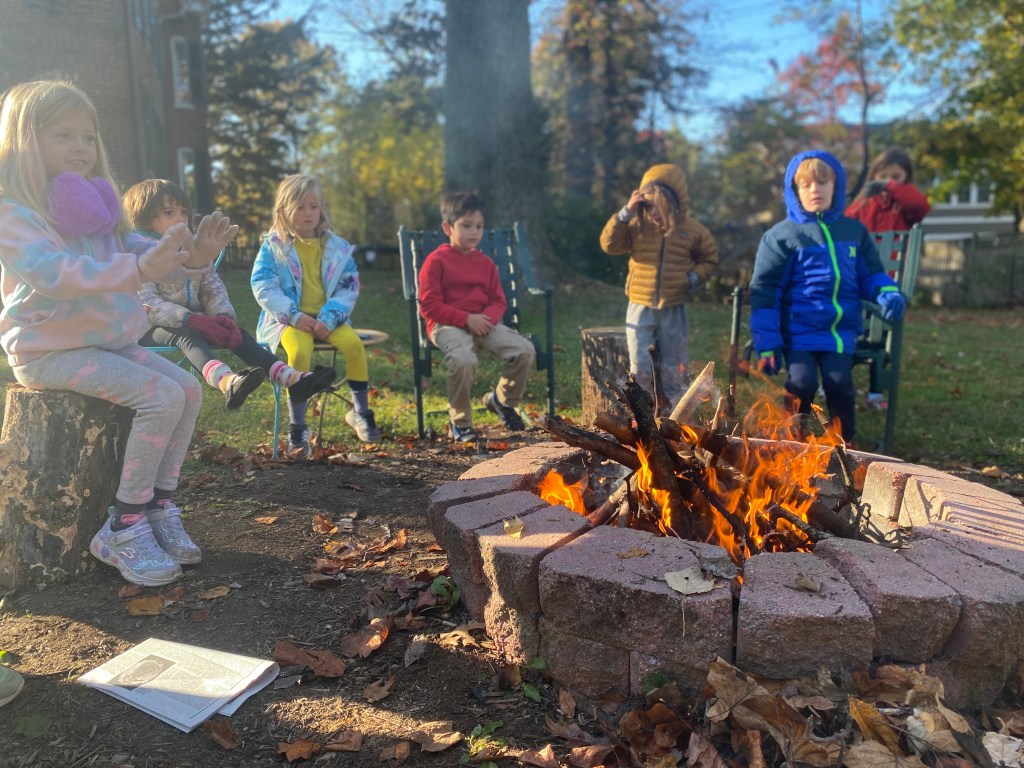
The crunch of tires on gravel as the first minivan makes its way up the long, stately driveway signals that the morning has begun. After saying a quick hello to the guide, children thud to the ground one by one and sprint for the backyard. After hanging their backpacks, lunch boxes and coats on the picket fence, they greet the animals awaiting them. There’s often a foster puppy (or five) waiting to play catch, or one of the three cats scurrying for a hiding spot.
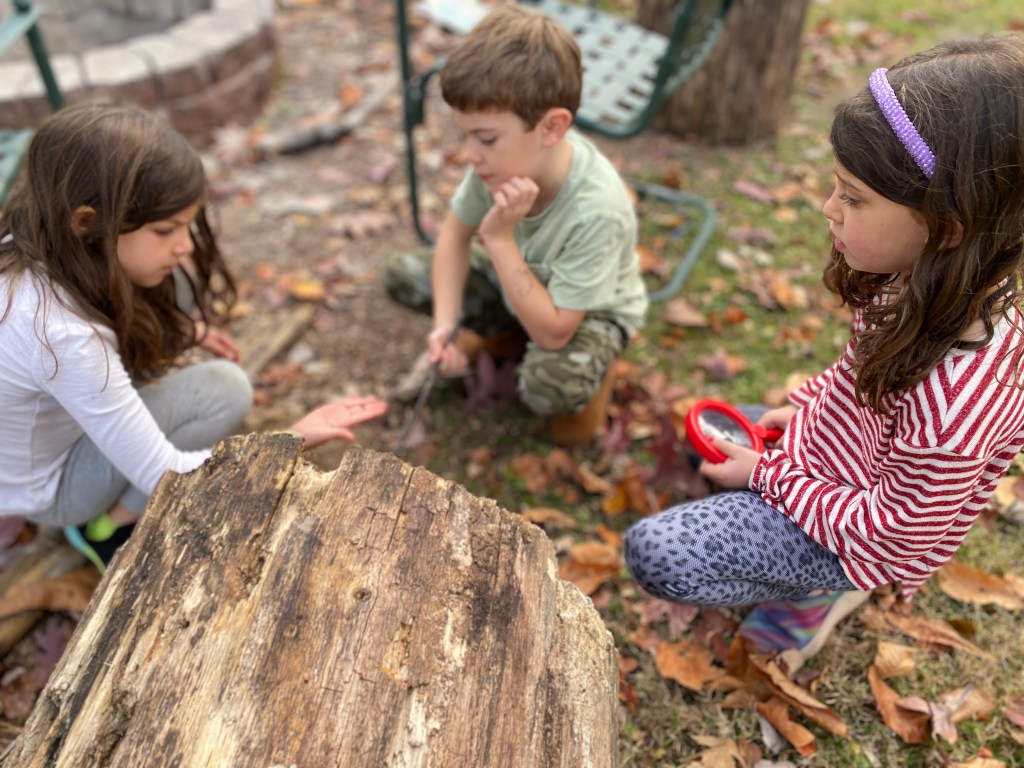
Some learners waste no time in turning over the giant logs surrounding the fire pit or rocks outlining the gardens. After having laid undisturbed for a week, these spots teem with new critters. Finding a stag beetle or two is all but guaranteed year-round, but the children marvel when they unearth the occasional centipede or spot a woodpecker. Last week, they found a salamander guarding its tiny, translucent eggs.
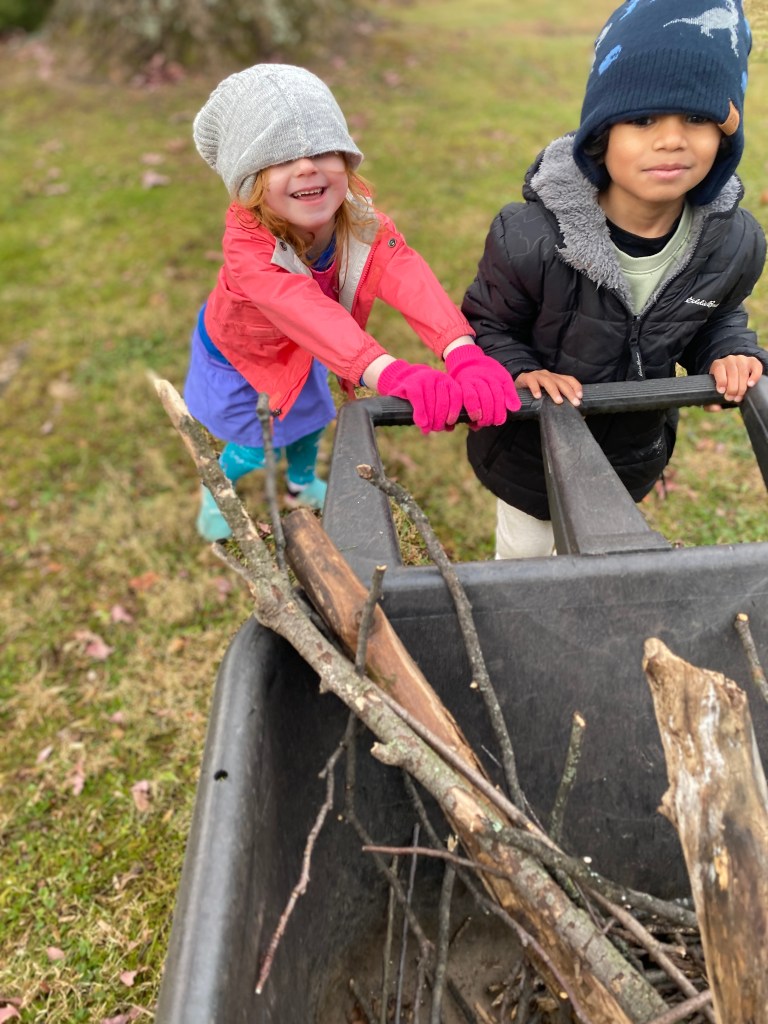
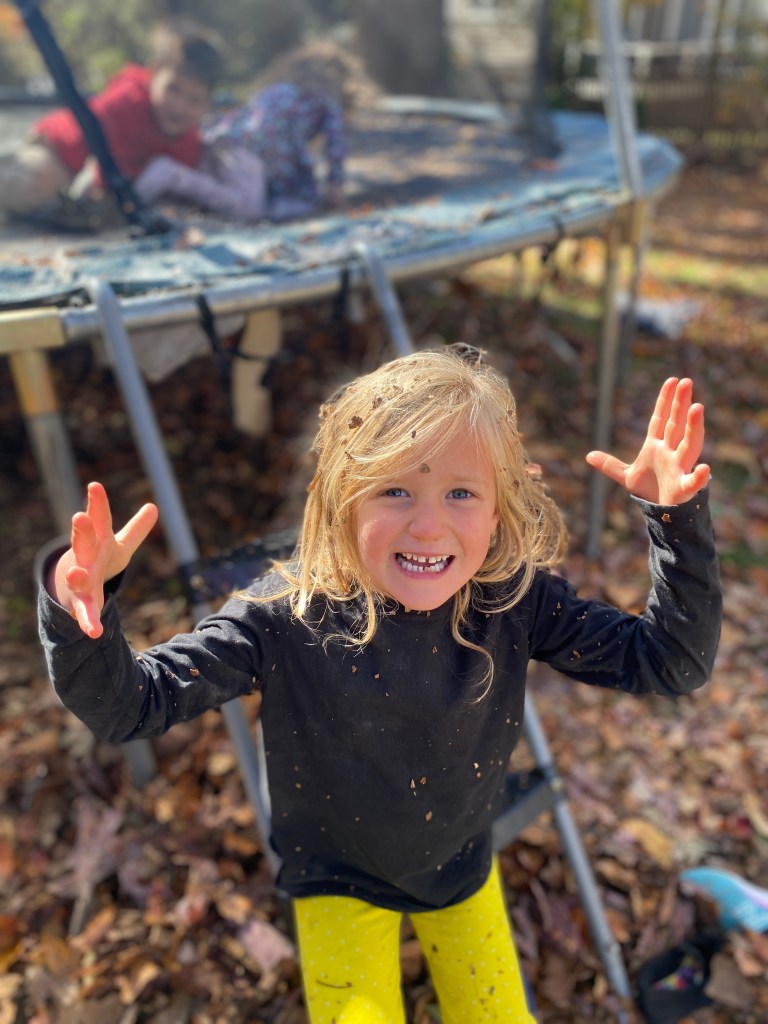
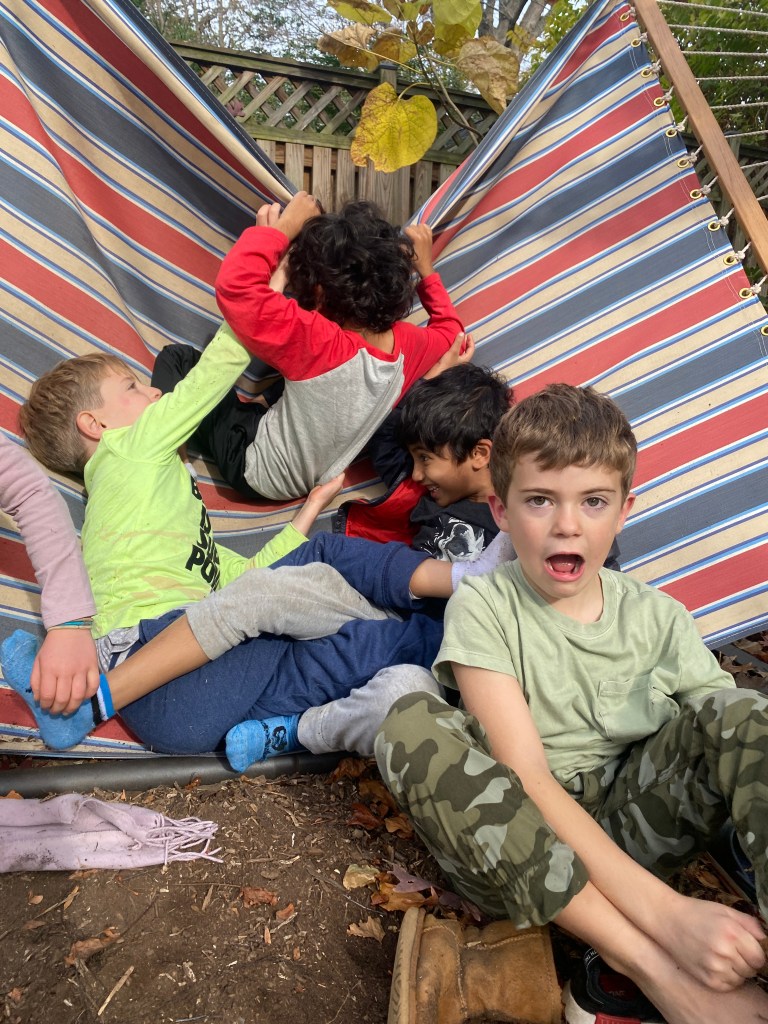
Other groups collect sticks for the afternoon fire, assemble “soup” ingredients, or swing on the hammock strung between two hundred year-old trees. In the autumn, oak leaves blanket the lawn, just waiting to be raked into piles. It’s amazing how much organization this takes, inspiring even the little ones to step up and lead. They all take turns leaping in and burying each other.
Then they let loose and run. Oh the running! They smile big and often as they gather speed and tear across the lawn, lungs gulping the fresh air. They shout to their heart’s content. It’s not unusual to see a learner stroll off by themselves, enjoying time to think quietly, let their mind wander, and rest in the moment.
According to Balanced and Barefoot, a therapist-recommended book by Angela Hanscom, young children should play outside 4 to 5 hours a day for optimal exercise and mental health. We do our best at TVS, giving them more than two hours a day. But at least one day a week, Spark learners get seven straight hours to let loose, jump on the trampoline, lift heavy sticks and logs, play tag football, and more. (Notice how they sleep really well on Friday nights?)
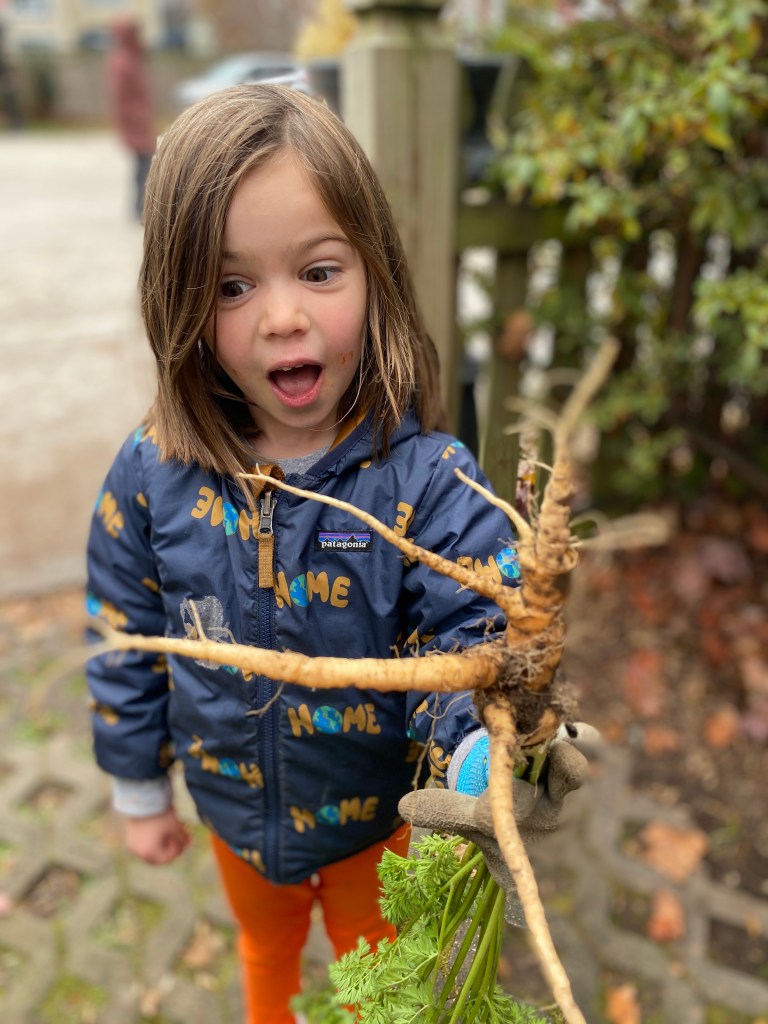
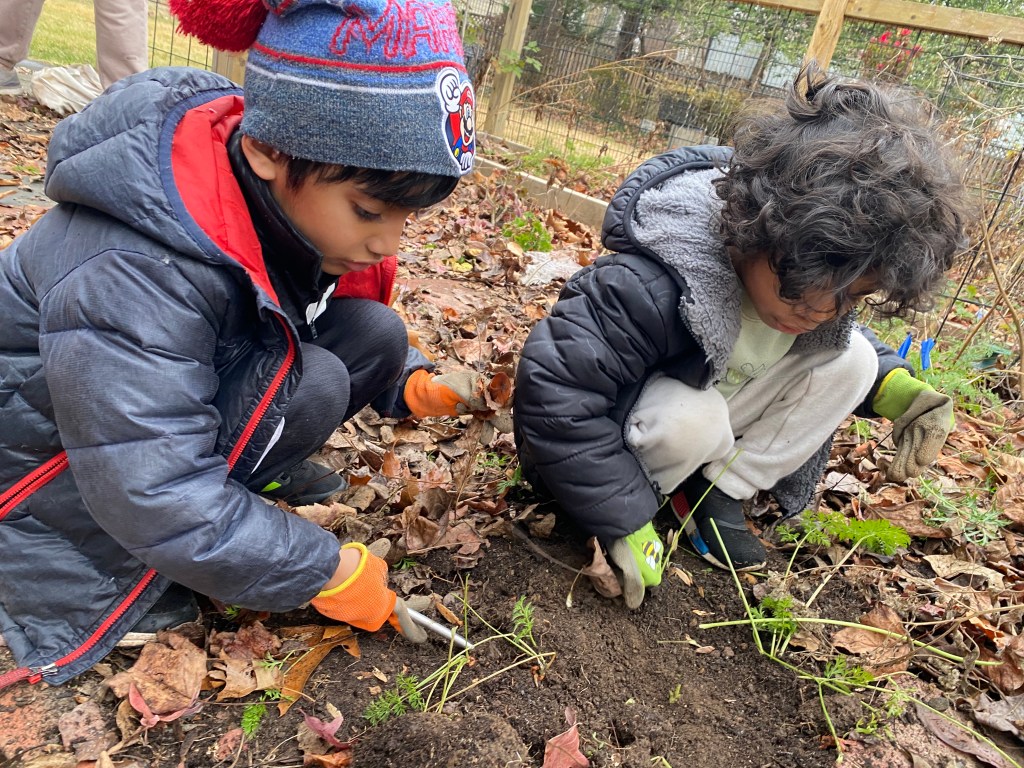
In Spark, this is experiential learning at its best. Children learn to do as they build fires in the pit built for 20. They learn about the limits of their balance as they climb on the hammocks and trees. They learn to live together as they mediate arguments over turns on the swing and retrieve ice packs for their hurt friends. They learn to be, to treat each other with kindness when they find out what is fun and what hurts others. Perhaps most importantly, they exercise autonomy over their entire school day. If they want to spend hours around the fire or take six turns on the trampoline, so be it. If they want to harvest carrots in the garden or help Ms. Jenny mow the lawn, that’s fine, too.
Seven uninterrupted hours allow play to evolve and new friend groups to form. Adapting to cold, rainy weather also helps build resilience. (Don’t worry–when it storms, indoor areas like the wraparound porch, craft room, and lofty barn provide shelter.) Children enjoy cozy traditions, such as sharing blueberry tea, roasting marshmallows over the coals of a dying fire, or wrapping up in blankets to enjoy a story or two at the end of the day. We have yet to enjoy a snow day here, but we have our fingers firmly crossed for the upcoming winter!
Guides look forward to Fridays, too. It’s time to observe each learner and see what they are capable of outside our school setting. We see their bravery, leadership, and skills in conflict resolution evolve. We can’t wait to return next week and see what they’ll do next. Personally, I relish the opportunity to talk as little as possible. This is time to just watch the learners play, play a little myself, build relationships with them, and get ideas to take back to school.
All this is crucial to our learning model at TVS. Children set and work toward their own goals, come up with their own rules, and get good and dirty. Children who play messy can think creatively. Spark’s unofficial motto? The dirtier the better!
I could go on about the learning opportunities at Ms. Jenny’s house. Suffice it to say, what may look like a throwaway day from the outside holds some of the richest learning experiences on offer at TVS. It is something that makes learning here truly unique!










 villageschoolnova.blog