This session, TVS heroes have been writing science-based stories. While you may feel like we are living a science-fiction novel right now, you might enjoy losing yourself in this alternate reality written by a hero.

April 28, 2058, this was the day “The Incident” happened. Oh, you haven’t heard about that yet? Well, are you sure you want to know? Ok, ok, fine I’ll tell you, although it is not a tale I tell often. Why is my name The Narrator? I have no clue why they named me that, but you wanted to hear a story so I suppose I’ll tell it to you.

April 28, 2058, 3:42 PM 

[Yes I know you already know]

This was the day they finally got a monkey into a computer file. In the state of the art DNA R&D faculty (they had a sign in the lobby saying things like “If you put all the DNA molecules in your body end to end, the DNA would reach from the Earth to the Sun and back over 600 times” or “Every human being shares 99.9% of their DNA with every other human”) It was a monkey because humans share 98.7% of your DNA in common with them. It still took a while because the human genome contains 3 billion base pairs of DNA (the other option was mice, humans share 85% of their DNA with a mouse). They were celebrating and they also wanted to get a creature into it, they edited the genetic code to be able to transfer it over. It was done using the B-84 prototype, which can change the properties of nucleic acid, which makes up DNA. Using this device, they transferred a monkey to their computer file. Everything was fine until they waited to see how long it could stay as a file. At 9:36 PM they got a ransomware virus (If you don’t know what that is, its a virus the encrypts your files and has you pay a fee to get them back), the scientists were scared for the experiment so they paid the fee (use virus protection to prevent this in real life) but a couple of files didn’t decrypt, including the monkey, they tried to see if the monkey was ok not knowing at the time that the monkey’s DNA was messed up and that the code running the decrypting process was also bugged.

The de-computerization process messed up and the computer got the location wrong

The Monkey landed on his side in a park next to the DNA R&D facility after Instantaneously appearing in it. Only this monkey was much smarter than before, he hid and snuck behind a skyscraper, unbeknown to him, he had been injected with a small tracker, back at the DNA R&D facility they were in a state of sheer panic,

“NO, NOT JACK!” one of the scientists yelled

 “We can find him trough the genetic tracking device by matching his DNA sequence”

“That doesn’t work remember, genes make up only about 3 percent of human and monkey DNA”

 they called the FBI to come and capture the monkey, which had turned an odd shade of green and at this point was knocking over trash cans. The FBI thought the team at DNA R&D facility was mentally insane.

The monkey was in an alleyway when he saw a way to get to the main street, after walking there he saw the window of a bakery, his brain having been altered, he really wanted a doughnut so he smashed the window with a rock and grabbed it. It was made of plastic of course so the monkey didn’t like it. The people inside the bakery screamed and ran from the monkey on first sight. The noise made the monkey even crazier, he started running around and eventually climbing on balconies.

Meanwhile, the scientists were panicking trying to convince the FBI they are not insane and they just need help. Eventually, they decided to go do it themselves and they got in a car and drove around the city desperately trying to find the monkey. They put up lots of posters and they put up posters all around the city. 

Monkey that is green for some reason

If found, please call 1-555-DNA-LAB

Reward $1000

The people living there also thought they were mentally insane and some of them tried to kick the scientists out. This went on for half an hour until they came across the monkey. All the citizens screamed and ran away. The monkey cased them, then the FBI inspectors came. They were shocked. They called a military team immediately and within 5 min they came and tried to find the monkey.

There was a sewer cover that was left open that happened to be the secret entrance to the Anarchists’ secret hideout. Anarchists were a group of people who didn’t like the laws and the government. No laws or anything. The monkey fell in, and there was a room.

“Aw shucks. You didn’t close the sewer cover all the way, Joe.”

“Don’t worry, John, it’s just a monkey, it’s not a person. Don’t worry about it. It seems the zoo’s not treating him too well. We will just give him some bananas to keep him quiet. He clearly doesn’t like the people either.”

The room had concrete walls and a couple of mismatched posters of random tv shows. One poster was of the monkey.

“Wait a minute joe, that monkey is wanted”

“Great then we can be friends, monkey”

The people down there had heard about the monkey and agreed to help him. So the group of outlaws and the monkey went into the main city and charged the investigators, the FBI had not arrived yet so they tried to stop the investigators. The investigators were in a coffee shop and were enjoying themselves. Then the Anarchists and the monkey barged in and started attacking people and they demanded that the investigators put their hands up and call off the FBI. The investigators said no and that they had taken FBI hand-to-hand combat training for emergencies.

Both sides fought with their hands and feet. Punch. Kick. Jab. Bang. The investigators won due to the fancy training they had. The Anarchists ran away with the monkey as fast as they could. The investigators were trailing not too far behind. The monkey tripped on a rock. Everyone else ran off. At the last moment, a black SUV with tinted windows, full of FBI agents, pulled up. The doors opened, the FBI agents dragged the monkey to the car, locked him in a cage, and drove away.

******

That’s all we know so far. So now, Chris, you’re going to get the monkey. You’re going to do this because you’re the best. And because I feel like making you doing it.

“Wha- w- wh- Why me?” says Chris.

Because I feel like making you do it. I mean, Umm, You’re going to be a hero. You’re going to accomplish great things. I think.

“Bu- b- but I don’t want to,” says Chris.

Just go do it!

*** The story of Chris ***

So I’m supposed to get a monkey and people will praise me? I don’t think it’ll be too hard. All this walking is really tiring. I’m getting close to the address The Narrator gave me. Here it is, the FBI building. What if I just ask the guards politely if I can go in?

“Ex- E- Excuse me. C- c- can you let me in?”

“Get out of here, kid!” said the guy at the barbed wire gate.

“Okay.”

I go behind a tree and fall into a random hole. At the bottom of it is an air shaft. I crawl around in it like in the movies. But of course, this isn’t the movie so they have security cameras. Alarms start blaring, and some guards crawl toward me.

“Ah, it’s just a little boy. What can he do?”

“He looks about 13. What do you mean little?”

“Oh shush, Jerry.”

Just then an Anarchist stabs him. Then the Anarchist says, “Go kid!” So I crawl as fast as I can, looking through every hole in the vent to see if the monkey is in the room. Eventually, I come to the scientist’s room and there he is. In the room, there are a few scientists in lab coats. One is a computer. The monkey is in a glass cage with scanners and monitors around him. There are also a couple of science things lying around on tables as well as some more monitors and random wires. The scientists are overheard saying, “We ran a DNA test on him. He is apparently more Irish now. Don’t bananas share 50% of our DNA?”  “No, that’s 50% of our genes, only 1% of our DNA.”

A fly comes over the guard’s head and he looks up and sees me. He shouts “There’s a guy watching us!” And he shoots at the vent cover. And vent cover comes off. “Oh shoot! That’s my last bullet.”

“Ok, I have permission to fire now. Thanks, Greg! I get to do something fun now!”

“*Sighs* Ok, fine you can shoot, but don-”

I jump down from the vent on top of the guard with bullets and knock him over. The scientists are so scared they don’t do anything. I grab the gun with bullets and shoot the other guard with it. One of the scientists tries to hit me with a test tube and he misses. The liquid inside the test tube splashes on the alarm. I duck out of the way, and the test tube hits the cage, breaking it. The monkey comes out of the cage and jumps on the scientists and knocks them out. I see a tranquilizer on the wall, with the label “Tranquilizer”. I take it and jab it into the monkey, and the monkey falls to the ground. The Anarchist comes into the room. I give the address of the narrator to the Anarchist to take the monkey. I’m about to run away when I hear some guards talking outside the door. I scramble up the air shaft as fast as I can. But the guards heard me. I crawl as fast as I can. I hear them coming down the shaft. Then, everything went black.

I wake up being dragged down a hall by some guards. 

“Aw shoot Jim he woke up,” says a guard.

“Darn it! Knock him out bill”

I free myself and start running, they shoot at me, but they miss. I frantically try to get away. I look for an exit for what seems like forever. Then I realize I can jump out a window. I smash the window with a potted plant I picked up from the hall and jump out. I land in a bush and run. I don’t think anyone saw me, but then I hear the guards. To throw them off I go back into the building, I don’t think it’s a good idea when I hear guards behind me. I dash into a room but I think the guards saw me, I look around frantically and realize its the room the monkey was in. I realize I can upload myself to the internet and live forever but I’ll be lonely. Or, I can fight the guards and risk going to jail. I have to make up my mind quickly. I hear the gauds saying they see me. I panic and start trying to figure out how to put myself on the internet. The guards rush in and I jump at the sound of the guards. I fall on the computer and get sucked in.

***

You live in a nice peaceful neighborhood a couple of houses away from the narrator, but you never forget what happened that day.

The 10 Science Facts in this Story:

  1. DNA is made of nucleic acid
  2. You share 98.7% of your DNA in common with chimpanzees and bonobos
  3. Every human being shares 99.9% of their DNA with every other human
  4. You share 85% of your DNA with a mouse
  5. The human genome contains 3 billion base pairs of DNA
  6. Genes make up only about 3 percent of your DNA
  7. Your DNA could link you to places you’d never imagine
  8. A DNA test can reveal you’re more Irish than your siblings
  9. If you put all the DNA molecules in your body end to end, the DNA would reach from the Earth to the Sun and back over 600 times
  10. You share 50 percent of your DNA with each of your parents. But with bananas, we share about 50 percent of our genes, which turns out to be only about 1 percent of our DNA

A Poem for a Hero

This time of year can be extra challenging for our young learners. Add a major world event that’s disrupted their daily lives and it’s no wonder that they may be feeling stressed or overwhelmed. As the school year winding down, and some of our heroes look at goals they have yet to finish, I find it helps to focus on “small wins” in the form of a few solid daily habits and a time at the end of the day to reflect and reaffirm their efforts. In this way, it becomes more about the process of who they’re becoming and less about the end result.

Below is a poem, from me, to your precious children- because even heroes doubt themselves sometimes…(I hope Dr. Suess would be proud):

Do Not Forget

Do not wilt in the face of what

you can not yet do

An opportunity is there, waiting for you

Do not forget all that you’ve

already done

Your daily persistence

Your hard work has won

Keep going, keep SHINING

when self-doubt sets in

There is nothing as beautiful

as you in your skin

Full of magic and LIGHT

with an unstoppable mind

You are STRONG, you are SOFT

both able and kind

Don’t run from the voice

that says, “No you can’t do it”

BREATHE it in and then OUT

with a “hello” and “I knew it!”

That voice is not you

just an unwelcome neighbor

leaning in to distract you

from your role as CREATOR

So good riddance, goodbye

You’ve got work to do

Playing and making

DISCOVERING something new

Because we need what you make

We need what you do

What we need more than anything

is for YOU TO BE YOU

Who is this “you” that we need you to be?

Only the “you” that is your TRUE and your FREE

So keep going, keep shining

when self-doubt sets in

There is nothing as BEAUTIFUL

as you in your skin.

Ms. Lauren

Positive Feedback: The Words We Use Matter

“Good job, kids! Well done, that’s beautiful! Way to go, that was great!”

These affirmations are music to our ears, aren’t they? We all love to hear that someone else likes our work, that something we did makes them proud, that they approve.

But perhaps a bit paradoxically, we try not to say things like this to heroes at The Village School. When we tell kids that we like their work or we think they did a good job, we are essentially giving them gold stars. It doesn’t take long to shift their drive from “I want to learn new things,” to “I need applause from another person.”

For this same reason, we don’t give grades. Grades have the unintended consequence of encouraging students to do whatever they need to do to get that ‘A+.’ Instead, without that pressure, our learners have room to tinker, try new things, work at their own pace, and make mistakes—all without worrying that they need to perform to perfection. That frees their young minds to learn and grow and helps foster the learner-driven environment that we are trying to create.

So we try not to praise results at TVS. But we still want to cheer our learners forward, steer them in the right direction, and maybe give them a boost of confidence. How do we shape that feedback?

In the studio, one thing we try to do is praise effort rather than results. We say things such as “Wow, I saw you keep trying and not give up.” Or “I can tell you worked really hard on that.” In praising their effort, we strive to help kids focus on the process they used to make something. That encourages them to continue trying in the future—to practice and get better—which builds persistence.

Another way is to ask a few pointed questions. “Interesting, what gave you the idea to use those colors?” “Wow, how did you decide to use wood instead of cardboard like last time?” These questions show our interest and engagement, but avoid any judgment—positive or negative. And if they seem hungry to do more or make more, we might say something like ,“Great, what do you want to do differently next time?”

Perhaps the hardest method—but one of the most effective—is to say nothing at all. So many times, kids aren’t looking for any kind of feedback while they’re hard at work. If they don’t ask, they won’t miss it!

Our fervent hope is that the payoff for learners will be huge and long-lasting. Their whole lives, they will be able to pat themselves on the back for a job well done rather than chase the elusive accolades of others. Above all, they will be excited to learn for learning’s sake, which will help maintain that precious intrinsic love of learning. That life lesson will take them far!

A Bump in a Hero’s Journey

ES Session 6: Week 5

Last week, a hero submitted his Newsela Badge. The Newsela Badge is designed to improve non-fiction reading and a hero must master 30 articles to move to the next level.

When this hero submitted the badge, he was proud that he had worked hard to complete the challenge. What he didn’t realize was that 14 of his 30 articles had disappeared. Nearly half of his work was gone.

As a guide, I made a comment on his badge. I thought that he had simply forgotten to post a third picture of the missing articles. I posted the comment, figured that he would fix it soon, and moved on.

I didn’t know that his work had disappeared. I didn’t hear a complaint about this weird system glitch. The next thing I heard was nearly a week later…

“Oh yeah, my Newsela got messed up,” he explained. “I have a plan to do 1 article a day until I catch up.”

This was mind-blowing.

Think to yourself about the last time that you were hit with unforseen circumstances. Maybe a restaurant messed up your dinner reservation and you had to wait an extra 30 minutes. Or an important email got shifted into spam and caused company delays.

Or back in the days of Microsoft Word, you were writing a term paper, forgot to hit save, and you lost the last 5 pages you had written right before the deadline (definitely not recalling a real memory).

You would be irate. Even the best among us would complain (often and loudly). 

But this hero didn’t do that. He did not try to blame others. He did not try to reason that he should be exempt from the full requirement. This hero accepted that this task was his responsibility and made a plan to finish the work. (And he sent the company an email to see if they could fix the problem for himself and others.)

In this pandemic, every day we are challenged to accept what we cannot change, so that we can move forward and do the best with what we have. I’m grateful for this elegant example from a hero.

Obstacles: Roadblocks or Opportunities?

Problems in life may seem to come one after the other, especially when you’re young. In one afternoon, a child might spill red paint on the table, get muddy water in their boots, and lose a favorite toy. What to do? Get mad and complain? Or tackle these situations head-on?

This week we talked about problems like hurdles on a track. Some kids might grumble, kick or yell that they’re not fair. Others may decide to leap over them. What would you do? During launch, I asked the heroes what advice they would give to a child who was stuck behind a hurdle. One piped right up. “I would tell him to jump!” And jump, I believe, they would.

An outdoor mission this week followed on that same theme. The heroes were invited to make themselves or their siblings an obstacle course using objects they had around the yard or garage. I saw footage of heroes jumping through hoops, balancing on pool noodles, and jumping off of playhouse roofs. Even if they didn’t quite grasp the obstacle course as a metaphor for life, I couldn’t help but imagine them bobbing and weaving, pirouetting, and running when life’s challenges came their way.

But while it might seem fun to leap over obstacles in a game, it’s not so easy to scramble over the stumbling blocks of real life. A sticky mess, painful scrape, or shouting match with a sibling—none of these is fun. So how can we nudge kids to see these problems as hurdle-like opportunities they can surmount?

One thing guides try to do in the studio is model the approach. We might say we are perplexed, explain how we feel, and then talk through step-by-step how we could put things right. We might even ask heroes’ advice about the best course of action.

We also try to help heroes recognize that they can solve their own problems. After we acknowledge that it’s a hard situation and label their feelings as valid, we may offer a way to reframe or give a choice of actions. “It sounds like this is a tough problem. What would you tell a friend in a similar situation? How could you turn this into an opportunity? Would you prefer to do X, Y, or Z?”

Lastly, we might ask their advice when a fellow hero (or at home, a sibling) has run into a difficulty. “It seems like Maeve is having a tough time waiting for her turn to use the toy John has. What advice could you give her?”

It is certainly a long process, but little by little we can help show our heroes that their problems don’t have to get them down. They can be part of life’s rich experiences, and they can mold us into more resilient human beings!

Problem? Problem-solved

ES Session 6: Week 4

“You cant do it”

This week, the heroes have been creating songs as part of the Music Producer Quest. One hero worked hard on his drumbeat and then posted his first draft online. A fellow hero commented, “you cant do it.”

This hero was heartbroken. He had put a lot of effort into his song. He knew the comment broke the studio contract. But it was also personal- he considered this fellow traveler a close friend.

In Town Hall, the hero brought up the incident. Even though he was sad, he explained it clearly and succinctly. The other hero was dismayed. “Sorry!” he said, “I meant to say- you can do it. I must have typed a ‘t’ accidentally.”

He fixed the comment and that was it. Problem solved. 

Sometimes, we forget that children are more resilient than we think, especially when they are given the right tools. A unique part of TVS is Town Hall Meeting because it allows learners to solve problems together.

Other problems brought up in Town Hall Meeting this week: independent scheduling for Wednesday, asking for peer approvals, and making a system fair for everyone. 

How do you empower great problem-solvers? Give them lots of problems to solve!

Building the Tribe: Home Edition

At The Village School, we work diligently on “building the tribe.” We strive to create a community that works well together, can talk about problems, resolve differences, and encourage one another. These character-based, real-life lessons are a huge part of our learning design and a solid way to build lifelong social skills. 

While we are learning from home, it’s hard to build those same school relationships. However, we can turn our focus to a different tribe—the one at home. Heroes’ relationships with siblings, parents, even pets will be some of the longest-lived—and arguably most important—relationships of our lives.

One thing we can say about this pandemic is that it has led to LOTS of family together time. (That can be either a blessing or a curse sometimes…) Kidding aside, we may never again have so much uninterrupted time together. So how can we make the most of it now?  

As a studio we are exploring sibling relationships in morning launch. This week we read a book called “Violet and Victor Write the Best-Ever Bookworm Book” in which a sister-brother duo writes a creative story together. The two sometimes disagree and dislike each other’s ideas. But at the same time, they compromise, respect each other’s contributions, work as a team, and delight in their final product. “I like our story,” says Victor at the end, before Violet spends the afternoon rereading it aloud. That push-and-pull of the sibling dynamic is one we will continue to explore.

We are also trying to provide opportunities for siblings to participate in projects. In the past couple of weeks, siblings (often younger ones) joined heroes to explore the water cycle, create art, and collaborate on videos. So while more togetherness inevitably invites more squabbles, yelling, and competition, the lessons in teamwork are invaluable.

Have you noticed any shifts in the sibling dynamics at home? What challenges have your kids faced? In what ways have you observed the strengthening or deepening of that bond? Where do they seem stuck, and have you discovered helpful tips that might help another family? Do you have any beautiful or encouraging stories to share? Please share in the comments!

Hopefully, when this is all over, we will emerge stronger as family units. That will translate to better relationships at school, where we will continue building our Spark tribe as soon as we can safely be back together.

Brave New Writing

ES Session 6: Week

“It is not the strongest of the species that survives nor the most intelligent that survives. It is the one most adaptable to change.” – Charles Darwin

The scientist in me really loves this quote. Approximately 2 months ago, the world began to change rapidly. We had a call to action to adapt all our lives; for school, this meant moving our community online.

There have been many tough moments. While it is easy to get bogged down in them, it helps to focus on the silver lining. This is a time of innovation. A chance to explore new methods and re-discover the tried and true. For me, this means an opportunity to develop a new Writer’s Workshop.

In this Writer’s Workshop, heroes enter the world of science fiction. They have a mission: saving the town from radioactive sheep, surviving severe weather, or escaping the sphinx. The missions themselves are examples of science fiction and they provide a launch point for heroes to develop their own stories.

The gameboards are flexible and adaptive: heroes can complete missions at their own pace. They can choose to write many stories or focus intently on one story. Heroes chose topics ranging from astronauts to animals. The primary goal is to write! To use their imagination to create a new world.

Perhaps you need a little escapism at the moment. Here is an underwater adventure by one of the ES heroes:

Once upon a time…There was a sea turtle named Shelly and a seahorse named Zoom Zoom. Their friendship was highly unusual in the ocean world, because Zoom Zoom was the smallest of all 53 species of seahorses. In fact Zoom Zoom was less than 1inch tall! Shelly was a Leatherback sea turtle which is the largest type of sea turtle in the ocean. She was more than 7 feet long! So they really had a special relationship. Like most Leatherbacks, Shelly had great eyesight and an excellent sense of smell. That is how Shelly found Zoom Zoom one day after her 10,000 mile journey across the ocean that year. Their friendship began in a beautiful coral reef off the coast of California two years ago. The day they met, a current pushed Zoom Zoom onto Shelly’s back. At first, she did not know that a seahorse was on her back because he was so tiny! When Zoom Zoom tried to get off of Shelly’s back, Shelly then noticed the movement of Zoom Zoom, and they started to talk. They have had many adventures together ever since. 

One day, while they were swimming side by side, they spotted some litter.They both noticed that ocean pollution and litter was getting worse and worse lately. In fact, some parts of their stunning, colorful coral reef were actually turning white, and dying. Many species of fish had gone away looking for new homes.

Shelly went to try to move the litter away from the reef, but Zoom Zoom was worried. Zoom Zoom tried to stop Shelly, but she was already hard at work. Shelly was picking up a plastic ring and tried to throw it out of the reef, but a big strong current thrust it right back to Shelly. It landed around Shelly’s neck! She tried to take it off, but it was stuck! Zoom Zoom tried to help pull the ring off, but the ring would not budge.

Zoom Zoom went to get help, but while he was gone a fisherman’s boat came bobbing through the water. Some men were in the boat. They put a net around Shelly, and hoisted her into the boat. Shelly saw something gleaming in one of the fisherman’s hands, it was a knife! Shelly tried to squirm away but they held her tight, but then Shelly felt the plastic ring getting looser and looser around her neck, they were cutting the plastic ring off her neck!

Meanwhile Zoom Zoom had gotten help but he did not see Shelly anywhere! He looked for her all day, and was about to go back home to go to bed when he heard something. He swam towards the sound and found Shelly! He thought Shelly was in danger because the fishermen still had the knife in his hand. He tried to cause big waves to throw shelly out of the boat, but he could only make little splashes. 

Just then the fishermen put Shelly back in the water, and the friends swam away. Shelly told Zoom Zoom that the fishermen were helping her get out from the plastic ring, and showed Zoom Zoom that the ring was now gone! They swam back to their houses, said good night, and went to bed.   

 TVS Heroes are brilliant and adaptive. They jump into new challenges, just like this one!      

Mission Complete

ES Session 6: Week 2

What are the benefits of a learner-driven environment? I could point to scientific studies on intrinsic motivation or educational leaders who point to the future of learning. But sometimes, it is simply easier to show you.

For the past two weeks, the Wolfpack has been learning from home. It is the ultimate test of independence. Certainly, heroes have struggled and run into obstacles, but they have also persevered, been resilient, and found success. Here are a couple of their stories.

Mission: Build a Boat

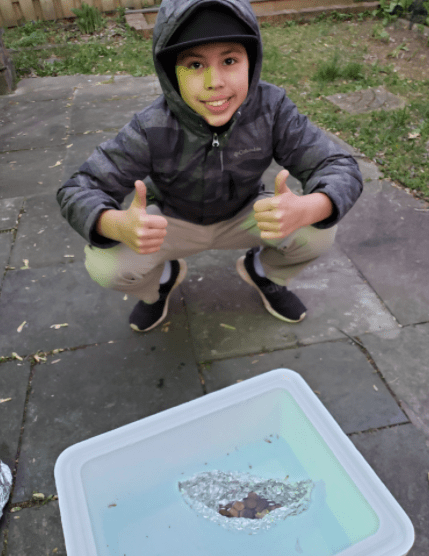
Heroes came up with creative designs to transport 25 passengers (pennies) at a speedy pace. 

Mission: Write a science-based story

Heroes are trying a new type of Writers’ Workshop this session. They each have a gameboard and level up by writing. This story comes from The Story Spine Challenge, based on Pixar’s world-class storytelling method. The first part was created by a guide as a prompt and the second half imagined and written by a hero.

Once upon a time there was a beautiful bee named Benji. Unlike normal honey bees, he was brassy green and aquamarine blue. His colors were so exquisite, it was like he carried a painting on his back. Everyday, Benji would fly around his forest in southern Mexico. He collected nectar from flowers and even fungi, but his favorite collection spot was the Orchid flower. Oh! Benji was overwhelmed with the scents: eucalyptus rolled into vanilla and spiced with wintergreen. Nothing else smelled like an orchid.

One day, Benji was drifting through the forest and saw a special flower- a Bucket Orchid. It was most fragrant and delicious flower he had ever smelled. He landed gently on a pedal. “This smells like heaven!” he thought to himself. He couldn’t wait to collect the scent and store it for his scent collection. Benji had special scraper hairs just for that purpose.

He was leaning forward to reach the first scent-patch when ploop! He fell down into the flower and was suddenly stuck in a patch of water.

Because of that…  Benji struggled in the water for a bit, afraid of not being able to get out, or getting stuck under water and drowning, for bees can not, just like humans, breath under water. Benji really wished he had gills then he could just stay in the patch of water and not worry about getting out. He used all his strength and tried to grow gills, It did not work. “Darn!” He thought (But in bee language) He needed to find another way to get out. It could be days until a fellow bee found him.

Because of that…  Benji franticly searched for a way of escape, He wished he could rip the flower, but unfortunately he was not strong enough to do that, and he had left his tiny bee sized tools at home this day. He tried to rip the petal with his stinger, so no success, the petal was just out of reach. He could feel the oxygen becoming low, that was bad. Because bees just like humans also need oxygen. He could not move from the water. He Came to the decision if he were going to get out, he needed to get rid of this water first.

Because of that… He searched for a way to get rid of the water, he could try to dump it out. But how? He could try to move to the other side to tilt the flower.. No that wouldn’t work He is not nearly heavy enough to to tilt it. He could try to scoop it out, but to his disappointment, he did not have hands. Benji felt there was no way to escape. He had lost all hope and came the conclusion that this was his fate. But then he had an idea! If he could not remove the water the water from the flower, then he would drink it! He began to drink the water “This has to work!” He thought. He quickly drinked the water. Although it was not all water, it had hints of nectar in it, being in a flower. This did not bother benji at all it gave the water flavor. He drank until he could not any more. “Oh no!” He could not drink it all! He decided he had to try anyways. There was nothing else he could do. Three.. Two.. One.. Fly!

Until finally…  It worked! He flew he got out. He debated going back to finish the flower, but that did not seem like a good idea. He was too full anyways. Next time he would be sure to be VERY carful.

Mission: Use the past to decide the future

Two times a week, the Wolfpack comes together for Civilization. This session, they are exploring the Middle Ages from the perspective of different countries. A recent question was inspired from explorers to the New World: should the new continent have been named America after Amerigo Vespucci, Columbia after Columbus, or something else since people were already living there? A hero answered, “I think it should be something else. Columbus enslaved people and didn’t treat them fairly.” A second hero agreed, “Plus, the Vikings were actually the first ones to land in Canada.” Pretty cool to be a history buff and evaluate through a different lens.

In sum, the heart of a learner-driven environment is that students care about the things that they create. 

Find the Flow

Pandemic parenting is tough. In addition to everything else, we are trying to homeschool our children and keep them motivated. I don’t know about you, but I find the latter one of the hardest tasks on my plate, and the one over which I have least control.

It has helped in the past couple of weeks to recall the primary goals of Spark Studio. Our chief aim lies not in academic progress, though that comes in time. Instead, it’s to help children expand their ability to find focus and joy in their work, and to concentrate on a task for longer and longer periods of time. Does it matter whether they are getting equal amounts of math, reading, and writing, or even whether they are doing any of these things at all on a given day? Nope.

Kids can find themselves in the concentration zone (or “in flow,” as it’s also called), when they are doing something that especially interests them in that moment. It’s especially common with hands-on work. They might be building with blocks, creating art, exploring an instrument, or playing a game. Those periods of flow, when heroes become lost in their task and are intensely focused—yet are completely relaxed and enjoying themselves—are the Holy Grail of learning. These are the times when the deepest learning occurs.

Why? Because that’s when learners are most curious and interested, which makes them hungry to go deeper. Key here is to give heroes the freedom to choose what they work on. (Within limits, of course. They can’t watch movies all day.) Kids have this wonderful innate love of learning that keeps them seeking novelty in their activities. We aim to preserve that intrinsic motivation by following those interests. Where will they take us today?

Aside from that, they can set the stage for periods of flow by choosing activities that are challenging but not too hard. They can set realistic goals that they know they have the skills to accomplish. And activities don’t have to come from school-related materials, but they certainly can. You as a parent can then keep an eye out for any periods of deep concentration and try not to interrupt them if you can avoid it.

Chasing those periods of flow and allowing them to linger has become my focus, which has shifted my thinking about what homeschooling should look like. I still have to remind myself several times a day, but I now have less pressure to check things off a list and more room to observe and enjoy the moment.

Does this mean heroes will ignore their at-home materials? Probably not. There may be days when they happily take out their grammar books, breeze through some math sheets, or tackle a few challenging Bob books. And on those other days (and there will be lots), as long as kids are getting outside and being read to, that’s plenty. There’s so much learning that takes place with just reading and unstructured play. The rest is completely optional and icing on the cake!